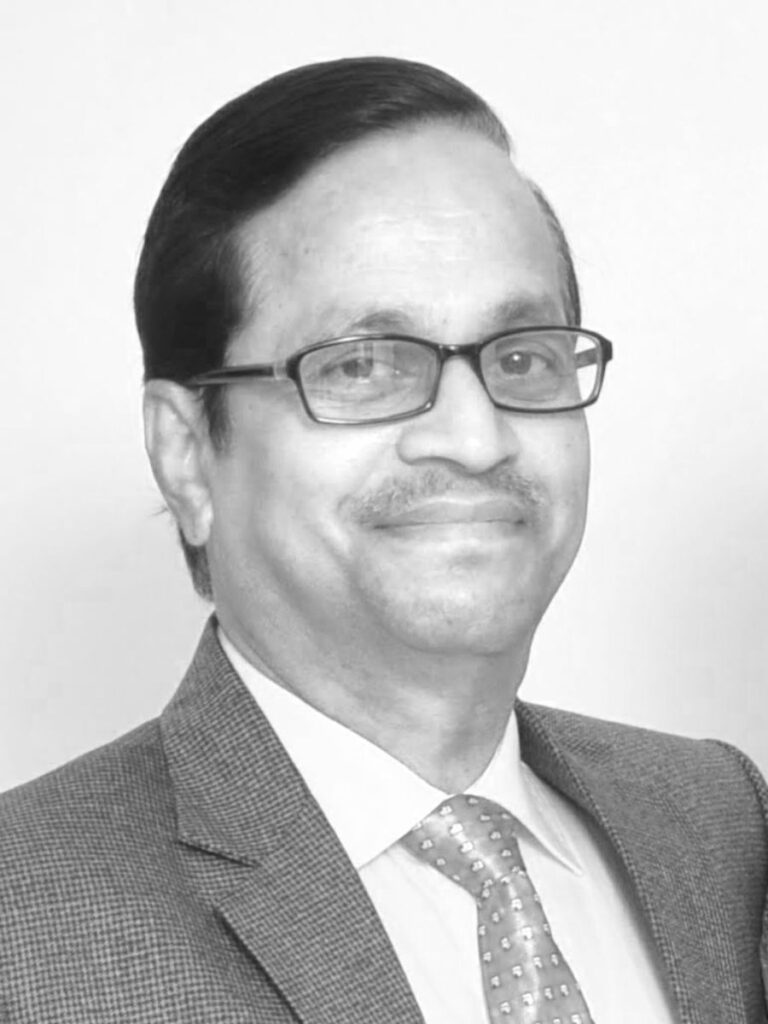
Dr. Naresh Kumar Dhaniwala
Associate Professor of Orthopaedics · MGIMS Tenure 1987 – 1991 Born 30 November 1957, Bhagalpur, Bihar Education MBBS, Institute of Medical Sciences BHU Varanasi (1983)MS Orthopaedics, Institute of Medical Sciences BHU Varanasi (1987)
Bhagalpur, Netarhat, and the Making of a Surgeon
Naresh Kumar Dhaniwala was born on November 30, 1957, in Bhagalpur, Bihar — a city of silk and shadows, known for its exquisite tussar silk and bearing the dark legacy of the 1980 Bhagalpur blindings. His father ran a cloth shop and later acquired an agency for Bombay Dyeing. Among seven siblings, Naresh was the third.
His educational journey began at Netarhat Residential School, one of the country’s most prestigious institutions, nestled in the forests of what was then Bihar. Admission was fiercely competitive — only sixty students selected annually from across the state. A lawyer customer of his father, whose son attended the school, recommended Naresh. The nearly free education provided at Netarhat broke down financial barriers. Living in an ashram-like setting, wearing simple khadi, embracing Gandhian values — he learned self-reliance, patience, and the quiet strength that would carry him through everything that followed.
Despite his best efforts, Naresh failed to secure medical admission on his first attempt — including to MGIMS. He spent a gap year at BHU, then secured one of twenty-two open-category seats at JIPMER Pondicherry. After a year, he transferred to IMS BHU, where he graduated MBBS with second rank in his final examinations. He chose Orthopaedics — medicine felt too theoretical, surgery too broad, but Orthopaedics combined the best of both. He pursued his MS under Prof. Dr. S.M. Tuli, an internationally recognised expert in bone tuberculosis, writing his thesis on congenital and post-infective dislocation of the hip in children.
The Village With No Roads
With his MS degree, Naresh joined UP Health Services and was posted to Chitbara Gaon, Ghazipur district — a village with no roads, no electricity, and during monsoons, submerged in floodwaters. His first journey there required a five-mile walk from the nearest bus stop through muddy fields and narrow lanes. Snakebites and scorpion stings were common emergencies. Villagers still relied on age-old remedies and prayers.
The isolation wore him down. On a whim, he wrote to the Dean of MGIMS inquiring about vacancies. Around the same time, his mentor Dr. Tuli wrote a recommendation to Dr. Vikram Marwah, a visiting professor at MGIMS. He was called for interview in 1987 — the same interview where Dr. S.P. Kalantri appeared for a Reader’s post in Medicine. Two candidates applied for the Orthopaedics post. Naresh was selected. On August 25, 1987, after a gruelling forty-hour journey, he arrived in Sevagram.
Orthopaedics at MGIMS in the Late 1980s
What struck him most on arrival was the absence of senior faculty. Dr. Kush Kumar had already left. The department had only one faculty member — Dr. Vijendra Chauhan, an MGIMS alumnus from the 1977 batch. Three postgraduate students were present: Anil Lokhande, Sanjay Marwah, and Sanjay Deshpande. Three months later, Dr. K.R. Patond joined as Professor and Head, bringing much-needed direction.
Orthopaedic care in the late 1980s was undergoing transition. Polio, tuberculosis, and leprosy were still prevalent — he personally corrected many deformed hands and feet caused by leprosy. Fractures were treated with plaster casts and skeletal traction. There were no CT scans, no MRIs, no C-arms, no arthroplasty, no arthroscopy. “We relied on clinical acumen and traditional methods, which, though effective, lacked the technological precision of today.”
Years passed, but frustration brewed. Promotions were scarce. He requested an independent unit; the plea was denied. He cleared the MPSC examination and in December 1991 joined Dr. Vaishampayan Memorial Government Medical College. By June 1993, he moved to Nanded, where he dedicated seventeen years to orthopaedic surgery.
A Life Across Borders
In North India, people identify themselves by their first name alone. In Maharashtra, bureaucratic norms require the full name — first, middle, and last. Thus Naresh Kumar, who had never used a surname in Uttar Pradesh and Bihar, became Dr. Dhaniwala in Maharashtra.
In 2015, after nearly three decades in government service, he opted for voluntary retirement and joined Jawaharlal Nehru Medical College, Sawangi, where he has served as orthopaedic surgeon and educator for a decade. His wife Sangeeta — from Shillong, a gifted dancer, singer, and actress — adapted seamlessly to Maharashtra’s arid landscapes, learning new languages and acquiring new skills. In March 2023, she published her first story collection, यादों की संदूकची. She now trains children in dance and music in Nanded.
Although Naresh lived in Sevagram for just over four years, he left an enduring imprint. The friendships forged there — with Drs. S.P. Kalantri, Ramji Singh, Mukesh Agrawal, S.K.T. Jain, Naresh Tyagi, and Deepak Mendiratta — remain cherished across the decades. Born in Bihar, educated in Jharkhand, trained in Tamil Nadu and Uttar Pradesh, employed across Maharashtra, married to a woman from Meghalaya — he adapted to each place with remarkable ease. Three times he considered private practice. Each time, fate gently steered him back to institutional service.
Key Milestones
| 1957 | Born, 30 November, Bhagalpur, Bihar — third of seven siblings; father in cloth trade |
| 1967 | Admitted to Netarhat Residential School, Bihar — one of sixty students selected statewide annually |
| 1974 | Completed Class 10, Netarhat |
| 1976 | Completed Intermediate, Netarhat — gap year at BHU before medical admission |
| 1977 | Entered JIPMER Pondicherry — transferred to IMS BHU after one year |
| 1983 | Completed MBBS, IMS BHU — second rank in final examinations |
| 1984 | Enrolled MS Orthopaedics, IMS BHU — under Prof. Dr. S.M. Tuli; thesis on congenital and post-infective hip dislocation in children |
| 1985 | Married Sangeeta from Meghalaya |
| 1986 | Son Mrigank Mauli born, November — two months before MS final examinations |
| 1987 | Completed MS · posted UP Health Services, Chitbara Gaon, Ghazipur — no roads, no electricity, monsoon flooding |
| 1987 | Joined MGIMS, 25 August — Lecturer in Orthopaedics; 40-hour journey from Ghazipur |
| 1990 | Son Mukund born |
| 1991 | Left MGIMS, 12 December — joined Dr. Vaishampayan Memorial Government Medical College via MPSC |
| 1993 | Moved to Nanded — served 17 years in orthopaedic surgery |
| 2015 | Voluntary retirement from government service after nearly three decades |
| 2015 | Joined Jawaharlal Nehru Medical College, Sawangi — orthopaedic surgeon and educator |
| 2018 | Son Mukund became orthopaedic surgeon — following his father’s path |
| 2023 | Wife Sangeeta published first story collection — यादों की संदूकची |