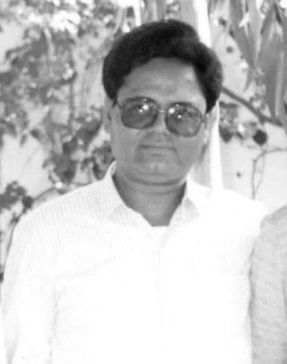
Dr. Raj Mridul Raizada
Professor of Otolaryngology · MGIMS Tenure 1980 – 2004 Lifespan 16 September 1952, Bhopal — 5 October 2004, Sevagram Education MBBS, Gandhi Medical College Bhopal (1975)MS Otolaryngology, Gandhi Medical College Bhopal (1979)
Bhopal, Gandhi Medical College, and the Bhopali Formation
Raj Mridul Raizada was born on September 16, 1952, into a family of distinction. His father Kailash Bihari Raizada was a Supreme Court advocate based in Bhopal — a man of precision and argument whose professional formation shaped the household’s values. Raj absorbed them and redirected them into medicine.
He completed his BSc from Bhopal University in 1970, his MBBS in 1975, and his MS in ENT in 1979, all from Gandhi Medical College, Bhopal. He was, as he remained throughout his career, thoroughly and proudly Bhopali — a city whose culture of grace, courtesy, and refinement he carried into every interaction. His speech carried the lilting Malwi dialect. His manner was gentle. Hospitality came naturally to him, a reflection of the warmth instilled in childhood and never set aside in the decades that followed.
He had married Rekha Raizada, an obstetrician who would build her own practice — RR Nursing Home — in Wardha. He joined MGIMS on September 10, 1980, as Lecturer, entering a department led by Dr. Chaturvedi that was finding its footing following ENT’s separation from Surgery at Nagpur University in 1978. The MS programme had just launched. He would be part of its consolidation for twenty-four years.
The Surgeon and the Teacher
In the operating theatre, Dr. Raizada was deliberate and unhurried — a safe surgeon, if a somewhat slow one, by the honest assessment of those who worked alongside him. The pace was not incompetence. It was the expression of a temperament that preferred precision over speed, that approached each procedure with methodical care, and that produced the near-bloodless field and unshakable calm that Dr. Ashish Varghese — a 1989 MGIMS alumnus, later Professor of Otolaryngology at CMC Ludhiana — would remember as defining qualities of the penetrating neck injury surgery twenty-five years after the night it happened.
He won the Best Paper Award at the Vidarbha AOI Conference in 1980 and again in 1981 — consecutive years, early in his career, establishing his research credibility before the slow institutional promotion ladder had moved past Lecturer. He organised ENT conferences and workshops throughout his career, understanding that the specialty’s development in rural Vidarbha required building a regional community of practitioners.
Between 1988 and 2004, he mentored nineteen postgraduate students — Dr. Prakash Nagpure of the 1980 batch as his first, Dr. Bhushan Patil of the 1993 batch as his last. He was available beyond working hours. He ensured theses were submitted on time. Before university examinations, he held revision sessions on operative surgery that drew the highest attendance of any teaching session in the department — which is, in its way, the most complete measure of a teacher’s standing among the taught.
Dr. Nagpure recalled a specific moment: a disagreement with a senior over ward duties had escalated into conflict. Professor Raizada stepped in, resolved it with quiet wisdom, and in the resolution taught something about communication and conflict management that the technical curriculum did not contain. Dr. Varghese recalled the eleven p.m. surgery. Both memories carried the same essential quality — a man who was present when presence was needed, who managed difficulty without adding to it.
The Late-Night Surgery
A patient arrived with a penetrating neck injury late at night. Professor Raizada was living in Wardha. He received the call, drove to Sevagram, changed, and was ready in the operating theatre before the patient arrived. The surgery began at eleven in the evening and lasted until four in the morning. He never raised his voice at the residents through any of it. A near-bloodless field, unshakable calm, and at the end, a patient who had survived an injury that could easily have gone the other way. That is the portrait his students gave him. It is the one he deserves.
The Home at the End of the Day
Mrs. Rekha Raizada’s nursing home was in Wardha; his operating theatre was in Sevagram. The home the Raizadas kept was, by their students’ memory, a warm one. Mrs. Raizada greeted visiting residents with high tea and snacks, dissolved their stress with humour, teased her husband in good spirit, made them laugh. The laughter occasionally inspired a gentle anxiety — the students confessed, with the affection of those who survived it, that they sometimes worried the good mood might translate into extra assignments the next morning. It rarely did.
His daughter Mridul earned her MD in Paediatrics from MGIMS. His son Mukul, of the 2010 batch, completed his MD from GMC Aurangabad before joining his mother’s nursing home in Wardha. The institutional connection extended into the next generation in the pattern that Sevagram repeatedly produced.
The Gap Between Rank and Recognition
The promotion to Additional Professor came in April 1997, and to Professor in March 2004 — six months before his death. The timeline carries a quiet institutional comment: a man who won consecutive best paper awards in his first year, who mentored nineteen postgraduate students, who organised regional conferences and drove to Sevagram at eleven p.m. for emergency surgery, reached the rank of Professor six months before a massive heart attack took him on October 5, 2004. He was fifty-two years old.
The rank was the system’s measure. The students’ memories were the actual measure. Many of his students went on to become professors and department heads. They carry what he gave them. He died on October 5, 2004. Barely six months a Professor. Twenty-four years a teacher.
Mentored Students (MD/MS)
Planimetric study of mastoid pneumatization and clinical profile CSOM in children
Clinico pathological profile of atrophic rhinitis and the role of intranasal placentrex therapy
Neonatal nasal septal deformities
A Clinical Profile of CSOM with special reference to TM perforation and measurement of eustachian tube opening pressure
Clinical pathological study of chronic maxillary sinusitis with special reference to annual washout by canine fossa inferior meatus routes
Clinical profile of epistaxis.
Role of Ginkgo biloba extract in acquired sensorineural hearing loss
Otological problems and prevalence of hearing loss in school going children in around Sevagram with emphasis of primary secondary ear care
Prevalence of nasal, oral pharyngeal condition with special reference to cervical lymphadenopathy in school going children in around Sevagram
Clinical profile of hoarseness of voice
Clinical profile of oral submucous fibrosis with special reference to the role of beta carotene (antoxid) in its treatment
Clinicopathological evaluation of neck mass
A study of human nasal cycle
Effects of radiation therapy and chemotherapy on ontological structure in head neck and esophageal malignancies
Clinical profile of vertigo and role of Apley’s canalith repositioning maneuver in benign paroxysmal positional vertigo
Study of symptomatic deviated nasal septum
Congenital anomalies in ENT and neonatal screening for hearing loss in a rural based hospital
Morbidity pattern ,treatment outcome quality of life expenditure analysis of head neck esophageal malignancy in a rural based hospital
Key Milestones
| 1952 | Born, 16 September, Bhopal — father Kailash Bihari Raizada, Supreme Court advocate |
| 1970 | Completed BSc, Bhopal University |
| 1975 | Completed MBBS, Gandhi Medical College Bhopal |
| 1979 | Completed MS ENT, Gandhi Medical College Bhopal |
| 1980 | Joined MGIMS, 10 September — Lecturer in ENT |
| 1980 | Best Paper Award, Vidarbha AOI Conference — repeated 1981 |
| 1988 | First postgraduate student — Dr. Prakash Nagpure, 1980 batch |
| 1997 | Promoted Additional Professor, April |
| 2004 | Promoted Professor, 16 March — six months before his death |
| 2004 | Died, 5 October, Sevagram — massive heart attack; aged fifty-two; tenure and life ending on the same day |