Dr. Chellamma Hariharan Iyer
Reader in Obstetrics and Gynaecology · MGIMS Tenure 1973 – 1980 Lifespan 11 August 1948, Tirunelveli, Tamil Nadu — 18 August 2024, Mumbai Education MBBS, Grant Medical College Mumbai (1971) DGO, (1973)MD Obstetrics and Gynaecology (1974)
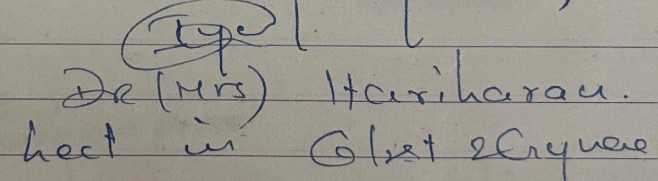
Reader in Obstetrics and Gynaecology · Seven Years at Sevagram · The Temple Bell in the Corridor
Tirunelveli, Mumbai, and the Single Mark
Chellamma Krishnan Iyer was born on August 11, 1948, in Tirunelveli, Tamil Nadu, the eldest of three daughters. Her father, Kechappa Iyer, was a stenographer at Mazagon Dock in Mumbai; her mother, Parvati, was a homemaker whose core conviction was that her daughters must be self-reliant. Mediocrity was simply not an option in their household.
She aimed for admission to a prestigious Mumbai medical college but missed the cutoff by exactly one mark. Undeterred, she enrolled in the Licentiate of the College of Physicians and Surgeons course in Nagpur. A year later, her sheer academic force allowed her to transfer to Grant Medical College, Mumbai, where she completed her MBBS in April 1971. Her early clinical training pushed her through Cama Hospital, Prince Aly Khan, Parsi General, Ismail General, and GT Hospital. She had initially dreamed of becoming a neurosurgeon, but the surgical specialty remained largely inaccessible to women at the time. She pivoted to gynaecology — a field where women practitioners were not just tolerated, but desperately needed — and found in it the perfect combination of elite surgical skill and raw human connection that her temperament demanded.
The Arranged Meeting
She arrived late from the hospital, walking with a pronounced limp from a minor injury. It was an arranged marriage viewing — he had come to see the girl — and she greeted him with characteristic unvarnished candour: “I want to study abroad.” He looked at her and replied gently: “Well, you can do that right here.” They married on November 7, 1973. He was Dr. K.K. Hariharan, the brilliant dentist who had been at Sevagram since 1971, the wiry man with the quick wit who sat across the card table cracking jokes that made the campus matriarchs laugh. She was Dr. Chellamma Krishnan Iyer, who would soon be known across the campus simply as Dr. Hariharan — beloved, radiant, and utterly impossible to overlook.
Together on the MGIMS campus, they were a beautiful study in contrasts: he tall and lean, she petite and radiant; he fluent in drama and storytelling, she fluent in warmth and wit. They were the Hariharans, and for the years they were both in Sevagram, the campus was a demonstrably livelier place because of them.
The Programme She Ran Alone
She joined MGIMS as Lecturer in January 1973, resigned briefly to complete her MD, and returned triumphant in January 1975. In December 1976, following Dr. Kasturi Lal’s resignation, she was asked to lead the entire department — while still officially only a Lecturer. A few months later, she took over the sprawling Postpartum Programme. By August 1978, the institution finally recognised the reality of her workload and her promotion was formally backdated.
The Postpartum Programme was staggering in scope: twenty-two wards in Wardha town, fifty-eight remote villages around Sevagram, antenatal and postnatal care, cervical cancer screening, sterilization surgeries, and mass immunisations. The plan envisioned a dedicated gynaecologist paired with a dedicated anaesthesiologist. When the appointed anaesthesiologist took extended leave, the position remained vacant. Dr. Hariharan simply carried the entire burden alone. At Kasturba Hospital alone in 1974, she helped oversee sixty-two major surgeries, three hundred and twenty tubectomies, and one hundred and thirty-nine medical terminations of pregnancy — operating at the scale of a senior professor supported by a massive department, while officially holding the rank of a Lecturer working without an anaesthesiologist.
The Teacher in the Pleated Sari
Her laughter rang through the stark hospital corridors like temple bells in a Tamil village. Her expressive eyes sparkled with constant mischief. She was always impeccably dressed in crisply pleated saris, a red bindi resting on her broad forehead. She moved with the easy, unforced grace of someone entirely comfortable in her own skin.
Her teaching contribution was entirely at the undergraduate level — the department’s MD programme was still in its infancy when she left. What those MBBS students carried into their careers was not just clinical knowledge, but the profound experience of learning from someone who made medicine feel like a shared human adventure rather than a rigid, terrifying obligation. She possessed the rare gift of dissolving clinical tension with humour precisely when a complicated labour most required that tension to be broken. Students adored her because they understood instinctively that her warmth and her elite clinical competence were not separate qualities — they were two expressions of the exact same character.
Nigeria, Riyadh, and the Final Return
On April 15, 1980, after five years of unbroken exhausting service, she resigned from MGIMS and followed her husband. They moved to Nigeria in 1983, where she worked at Westend Hospital. The Sevagram duet continued flawlessly in West Africa. This was followed by fifteen years in Riyadh, serving women in the Middle East with the same unflagging commitment she had shown in the villages of Vidarbha.
She returned to India permanently in 2004, joining her husband in Patiala. Tragically, he died within a month of her return — the highly specific grief of losing the person who had been by her side through the Bangladesh War, the MD near-failure, Nigeria, Riyadh, Sevagram, and that very first arranged meeting where she had arrived limping and demanding to study abroad. She resumed work in Obstetrics and Gynaecology at JNMC Sawangi, working until she was seventy, then took up consulting in Chandrapur. In 2018 she settled in Dahisar, Mumbai, and endured three years of dialysis for chronic kidney disease, fiercely supported by her family. She died on August 18, 2024 — exactly seven days after her seventy-sixth birthday.
What She Left
Her elder daughter Anuradha trained in dentistry but forged her own path. Her younger daughter Manisha moved from engineering into digital marketing and found her deepest calling in animal welfare — rescuing stray and injured dogs with a compassion that mirrors her mother’s lifelong service to the vulnerable. The woman who arrived at an arranged marriage demanding to study abroad had raised daughters who carried her fierce independence into the next generation.
She had told her future husband she wanted to study abroad. She studied in Sevagram instead. And then in Nigeria. And then in Riyadh. She carried the purpose that had driven her through the frantic wards of Mumbai into every single labour room she ever inhabited, refusing to let her brilliant, ringing laughter dim until her body finally required it to.
Key Milestones
| 1948 | Born, 11 August, Tirunelveli, Tamil Nadu — eldest of three daughters |
| 1971 | Completed MBBS, Grant Medical College Mumbai — missed first-choice college by one mark; transferred from Nagpur |
| 1971 | Emergency duty during Bangladesh War — baptism by clinical fire |
| 1973 | Completed DGO, October · Diploma in Family Planning 1974 |
| 1973 | Joined MGIMS, 1 January — Lecturer in OBG · married Dr. K.K. Hariharan, 7 November |
| 1975 | Returned to MGIMS, January — after completing MD |
| 1976 | Led entire OBG department after Dr. Kasturi Lal’s resignation — still officially a Lecturer |
| 1977 | Took over Postpartum Programme — 22 wards in Wardha, 58 villages; ran it alone when anaesthesiologist post fell vacant |
| 1978 | Promoted Reader, August — backdated to reflect actual responsibilities |
| 1980 | Left MGIMS, 15 April — followed husband |
| 1983 | Westend Hospital, Nigeria — with Dr. Hariharan |
| 1989 | National Hospital, Riyadh — fifteen years serving women in the Middle East |
| 2004 | Returned to India — husband died within a month of her return |
| 2004 | JNMC Sawangi — practised until age seventy; then consulting, Chandrapur |
| 2018 | Settled Dahisar, Mumbai — dialysis for chronic kidney disease |
| 2024 | Died, 18 August — seven days after her seventy-sixth birthday |