After the intensity of McMaster, I crossed the Atlantic. My old friend Dr. Mike Galvin—a long-standing ally of MGIMS—had choreographed the visit with meticulous care. The itinerary was split into two distinct halves: the professional, involving lectures in Leeds and London, and the personal, a quiet pilgrimage through the MGIMS family scattered across Britain.
I landed in a country that felt oddly familiar. It wasn’t the weather or the food; it was the people. Everywhere I turned, I ran into someone who spoke my language—not English, but Sevagram.
My base was Wakefield in West Yorkshire. I stayed with Agam Jang and her husband Suresh Kumar, both Class of 1985. They were living in on-campus accommodation, navigating the grueling process of retraining for the UK system. Agam was a Senior House Officer then, moving with that breathless, early-career velocity I knew so well.
One morning, as she rushed to the hospital, I found myself standing in their living room, ironing the school dress of their five-year-old daughter, Alakh. It was a domestic scene that would have looked perfectly ordinary in Wardha, yet here it was unfolding in Yorkshire. Two decades later, Agam and I still laugh about it over the phone. Alakh is a doctor now, having stepped into the very shoes I saw her parents lace up that morning. In that small act of ironing a child’s dress, the formal label of “Visiting Faculty” evaporated. I was simply a family friend trying to be useful.
***
A Stone House in Ackworth
Mike lived in Ackworth, a village of old, solid stone houses that seemed to have grown directly out of the landscape. Mike was a man of firm routines and fierce loyalties. His children often nudged him to move closer to them, but he refused. He liked his village. He liked his house. End of discussion.
His wife, Hazel, was warmth personified. She ensured that this vegetarian doctor from rural India was never once made to feel like a culinary burden. Mike hosted a dinner for me—easy hospitality, gentle laughter, and the kind of conversation that makes you forget the thousand miles of ocean between you and home. Between the soup and the dessert, we compared the NHS with our Indian system. The logistics differed, but the heartbeat was identical: too many patients, too little time, and doctors trying to bridge the gap with nothing but their wits.
Hazel passed away a few years ago, after a brave battle with lymphoma. Mike’s connection to Sevagram, however, remained unbroken. As recently as 2023, he returned to participate in the Medico Friends Circle (MFC) meeting. Watching him engage in our heated, four-decade-long debate on public health ethics, I realized that some friendships aren’t just personal; they are philosophical.
***
The Pinder of Wakefield
The professional peak of the trip was a talk at Pinderfields Hospital. I was charmed to learn the name came from the “Pinder”—an old town official tasked with impounding stray animals. It sounded like a detail from an English storybook.
I spoke about MGIMS—the village camps, our pro-poor philosophy, and the daily, gritty compromises of practicing medicine far from the luxuries of a metropolis. I explained how we kept care affordable without cutting corners on quality.
Midway through, I felt a jolt of genuine nervousness. Sitting in the audience was Dr. Maurice King.
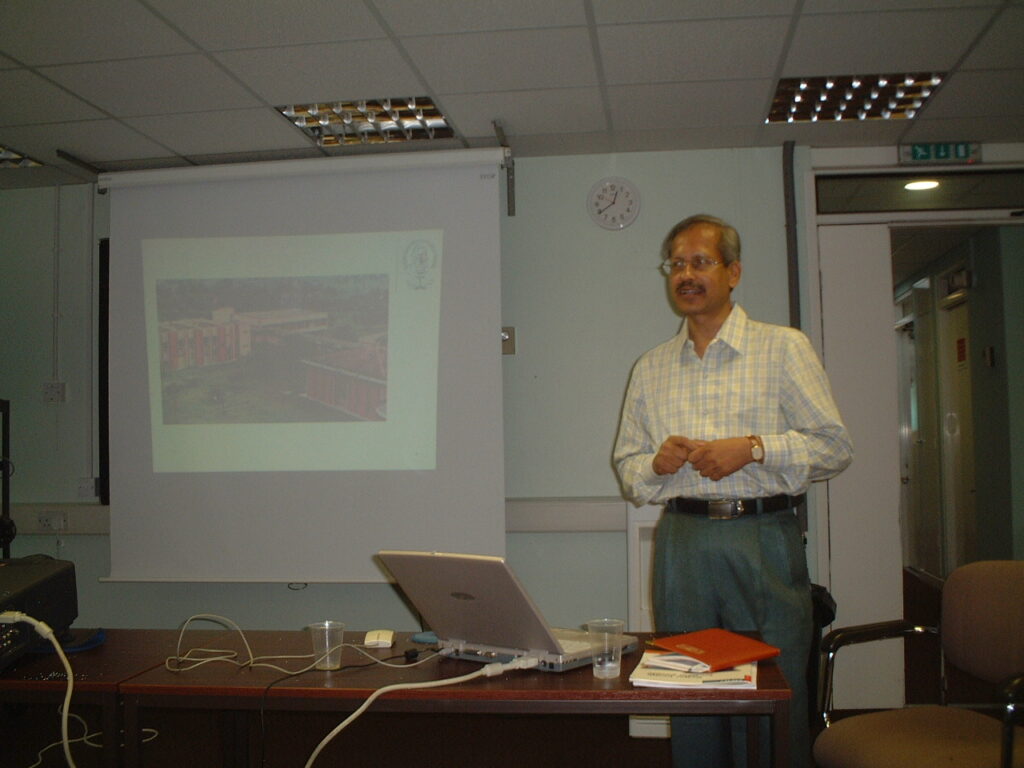
To anyone in public health, Maurice King is a giant. His seminal work, Medical Care in Developing Countries, shaped our entire worldview. For a fleeting second, I wondered what a doctor from Wardha could possibly teach the man who wrote the bible of resource-limited medicine. But he was the definition of grace. His questions were not tests; they were genuine inquiries into how we managed critical care in Sevagram. It was the highest form of compliment: serious attention from a master who did not give it lightly.
***
The Tour of Familiar Faces
The rest of the journey was a moving reel of old students. MGIMS had travelled much further than we ever imagined back in the 1980s.
In Leeds, I found Vandan and Veena Zamvar in a modest hospital apartment. In Edinburgh, I visited Vipin Zamvar (Bhavana’s cousin), now a Consultant Cardiothoracic Surgeon. He showed me the Royal Infirmary—gleaming, modern, and efficient. Yet, when he spoke of his patients, the tone was familiar: serious, involved, and quietly proud. What struck me most wasn’t his surgical theatre, but the community centre where he volunteered his time for cardiac patients. No spotlight, no fanfare. Just a surgeon giving back.
In Aberdeen, I stayed with Muthu Kumar and Sonali (Class of 1985). Scotland was a landscape of grey stone and biting cold. It was there that I performed the ultimate ritual of the Indian father abroad: I bought the Harry Potter audio series for my daughter, Ashwini. In 2003, those tapes felt like carrying back a suitcase of gold.
In London, I stayed with Monica Ahuja (Class of 1982), an outstanding student who had done her MD under my wing. She was then a Registrar in Oncology, newly a mother to her son, Rahul. Seeing her so calm and capable in a high-pressure North London ward gave me a deep, quiet happiness. (Monica has since moved to Perth, Australia, continuing the diaspora’s reach.)
***
Two Hours on Snakebites in Oxford
My final stop was Oxford, staying with Sadhana Bose (Class of 1985), who had built a formidable career in public health. Through her husband, I secured a meeting with Dr. David Warrell, the editor of the Oxford Textbook of Medicine and the world’s leading authority on snakebites.
We spent two hours discussing a problem that was a daily terror in Vidarbha but a clinical curiosity in Oxford: antivenoms, transport delays, and the subtle clinical signs that distinguish a lethal bite from a terrified patient.
It was surreal—sitting in the shadow of Oxford’s spires, talking about Indian cobras with the man who wrote the definitive text. Yet, it felt right. Medicine has a way of shrinking the globe until the most unlikely rooms are connected.
***
The Weight of Pride
I returned to Mumbai on British Airways with a suitcase of gifts and a head full of memories. But the real weight I carried was pride.
The students we had taught in the dusty wards of Sevagram were now healing hearts in Edinburgh, fighting cancer in London, and shaping health policy in Oxford. Our little institute had quietly gone global. For those ten days, it felt as though Sevagram hadn’t stayed behind in Wardha; it had come along with me.