In the winter of 2019, Bhavana and I planned a three-week visit to Amrita and Sahaj, who were both pursuing fellowships in Vancouver. Amrita was specialising in abdominal ultrasonography at Vancouver General Hospital. Sahaj was training in liver transplant. It was the sort of trip parents look forward to—time with children, a new city, and the quiet satisfaction of seeing them build lives far from home.
To get there, we took an overnight train to Delhi and then flew with China Southern Airlines. The route had a layover in Guangzhou before the final hop to Vancouver. It sounded straightforward, the kind of itinerary you book and forget.
We had a comfortable six-hour flight to Guangzhou. Dinner arrived on time. We watched a couple of movies. We tried to sleep. Somewhere in the middle of that half-sleep, I called Amrita, Sahaj, and Ashwini to tell them we had reached Guangzhou. I even added, with unnecessary confidence, that at 5:30 a.m. the sun was blazing and the city looked brightly lit.
A few hours later, we were going to understand what that “bright sunny morning at 5:30” really meant.
***
Parathas, Terminal 2, and Too Much Time
At the airport, we ate parathas we had brought from home—our small act of vegetarian self-respect in an unfamiliar country—and then caught some shut-eye. Our bags were checked in. Boarding passes were in hand. We had several hours to kill.
International airports, in theory, offer many ways to waste time: first-class lounges, designer shops, and restaurants that charge in dollars and taste in disappointment. Guangzhou airport had plenty of everything, except one thing we cared about—vegetarian food that didn’t look suspicious.
So I did what restless travellers do. I decided to explore the entire Terminal 2. Eventually we settled near Gate 142, where the seats were slightly more comfortable and the corner felt quieter. Our plan was simple: stroll to the gate two hours before boarding and behave like experienced flyers.
It was a plan built on one fragile assumption—that we knew the time.
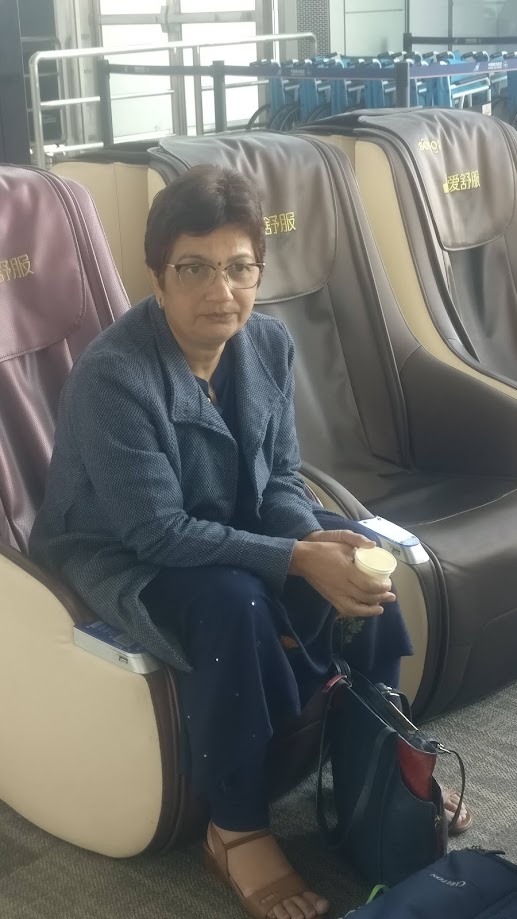
Bhavana at Guangzhou airport — twenty-four hours, no ticket, no Mandarin, and nowhere to go. Vancouver was still a continent away.
***
An Airport Without Clocks
Guangzhou airport, to my astonishment, had no visible clocks. I went to the enquiry counter to ask for the local time. The girl at the counter didn’t have a watch. It was such a perfect moment that I almost laughed, except the joke was on me.
The airport had free Wi-Fi, but Google was blocked. My Garmin watch, normally a reliable companion, didn’t show local time. We were stranded in the most modern of places with the most basic information missing.
So we waited—calmly, foolishly—about 400 metres away from our gate, unaware that time was quietly running away from us.
After a while, we checked our watches. It was 11 a.m. Our flight was scheduled for 1:20 p.m. Boarding would begin around 12:50. Plenty of time, we told ourselves. We walked leisurely towards Gate 150, still feeling like responsible adults.
***
Ashwini’s Phone Call
Then my phone rang. It was Ashwini.
He asked where we were.
I reassured him that we were fine and ready to board. Then, almost casually, I asked if he could check the local time in Guangzhou for us, because the airport had no clocks.
There was a pause.
“It’s 1:43 p.m. in Guangzhou,” he said.
It hit me like a slap. We had missed the flight. Not by hours. By minutes. By a cat’s whisker.
As we reached the gate, the emptiness confirmed it. The display board showed our flight was “closed.” Bhavana looked at my face and read it instantly—the disbelief, the fear, the sudden shame of having done something so avoidable.
Only then did the obvious truth land: I had forgotten to factor in the time difference between Delhi and Guangzhou. The departure time on the boarding pass was local time. The sun at 5:30 a.m. had not been poetic. It had been mathematical.
***
The Cost of a Simple Mistake
“How could I have made such a foolish mistake?” I kept asking myself. I had prepared thoroughly before leaving India. I had checked passports, tickets, medicines, everything. And yet we had missed the flight because we didn’t know what time it was.
Mistakes happen, of course. Even experienced drivers forget to fill petrol. Even regular commuters miss trains. Even frequent flyers can miss flights.
But some mistakes are expensive.
We rushed to the transfer counter. The clerk stamped our ticket with two brutal words: “Didn’t board.” Then she directed us to the China Southern Airlines counter.
The attendant there was a young, slim Chinese woman with spectacles and good English. She listened carefully and then said, politely:
“The next flight is 24 hours away. Seats are available. The tickets will cost 1300 dollars.”
“For both of us?” I asked, still trying to be optimistic.
“No. For each.”
“Canadian dollars?” I asked, bargaining with geography.
“No. US dollars,” she said, now slightly firmer. “On-the-day tickets booked at the airport can be expensive.”
She sounded sympathetic, but sympathy doesn’t pay bills.
We did the mental arithmetic. Our error would cost us nearly two lakh rupees. And we were only at the start of the itinerary. Buying a one-way ticket could also disrupt the entire booking and risk cancellation of the return journey. We were trapped in the fine print.
***
Three Problems, One Empty Airport
As we stood there, we realised we had hit a wall—three walls, actually.
First, the next flight was 24 hours away.
Second, the airline required a Chinese credit card to purchase tickets. International cards were not accepted.
Third, we did not have a Chinese visa, which meant we could not simply walk out and check into a hotel in the city. We were stranded inside the airport like passengers in a polite prison.
It is difficult to remain calm in such situations. But panic is useless. It only adds noise to an already complicated problem.
***
Children to the Rescue
This is where the modern family system kicked in—children, phones, emails, and mild desperation.
Sahaj was constantly on the phone with Expedia and the airline ground desk, trying to keep me calm while negotiating with two systems that both insisted the other was responsible. “A couple of hundred dollars will hurt,” he said, “but losing the whole ticket will hurt more.”
Amrita began writing emails to China Southern, stating that her parents were stranded at the airport and needed help. She called us repeatedly, soothing our frayed nerves with the calm authority that daughters develop once they begin parenting their parents.
Ashwini composed a few tweets to the ministry, doing what young people do instinctively—create public pressure with minimal words.
And I did what I could do best: plead, explain, and appeal to human kindness.
After an hour, I wrote a letter—old-fashioned, earnest—explaining who we were, where we came from, how we missed the flight, and why we could not afford new tickets. The counterwoman read it carefully and showed it to her colleague.
We waited in the empty airport, watching time move in slow motion. Nothing seemed to happen. Half an hour passed. Another. It felt endless.
***
The Angel with a Piece of Paper
Then Bhavana nudged me.
A China Southern Airlines employee was walking towards us with a piece of paper in her hand.
She asked for our old boarding passes. She took them politely. Then she handed us new boarding passes for the next day’s flight—without any additional charges.
“Please note the date and time,” she said, and then added, with a gentle chide, “And this time, don’t miss your flight.”
For a moment, I couldn’t speak. It felt like an angel had descended into Terminal 2, armed not with wings but with a printer.
I thanked her profusely, folded my hands, and said “Namaste.” She smiled and did Namaste back. In that brief exchange, two cultures met at the level that matters most: decency.
“What about our checked-in luggage?” I asked, now worried about the next disaster.
“It will travel with you,” the counterwoman reassured us. “You will collect it in Vancouver.”
Then she asked, thoughtfully, “Would you like me to arrange a transit visa for you?”
We declined. We preferred to stay in the waiting hall. After what had happened, we didn’t want adventure. We wanted stillness.
***
The Longest Flight, and the Sweetest Arrival
The next day, we reached the gate absurdly early—Gate 173, a good 800 metres away—determined not to repeat history. At 1:20 p.m., we finally boarded the Guangzhou–Vancouver flight, the longest we had ever taken: eleven and a half hours.
We ate the vegetarian meals—rice, vegetables, tofu, curd—and walked around the plane every two hours, mindful of the risk of clots in cramped seating. We watched movies to pass time: Life of Pi and Finding Nemo, both oddly appropriate for travellers who had recently been lost.
At 11 a.m., we landed in Vancouver. Immigration was routine. Our luggage had already arrived. And then, a few metres later, there was Amrita—waiting arms, familiar smile, the kind of welcome that makes airports feel like home.
We took a short taxi ride to their apartment at 1366 West 13th Avenue. Sahaj opened doors and elevators with digital keys—one of those modern conveniences that still feels like magic to people of my generation. From the tenth floor, the view was spectacular: mountains, sky, walking paths, manicured hedges, and maple trees in their winter beauty.
We showered, ate our first meal in Vancouver, and finally exhaled.
***
The Lesson Guangzhou Taught Me
A few days later, I searched the internet for “missed flight” and discovered a little-known policy called the two-hour rule, also known as the flat-tire rule. It isn’t advertised loudly, but it exists in some airlines: if you arrive within two hours of a missed flight, staff may put you on the next available flight on standby, sometimes at no extra cost. If the last flight has already departed, you may be put on the first flight the next day.
Perhaps that rule saved us. Or perhaps it was simply the kindness of a woman at a counter who decided that two confused parents did not deserve a two-lakh-rupee punishment for a time-zone mistake.
Either way, Guangzhou taught me something I should have known long ago: travel, like life, rewards calmness. It punishes arrogance. And when things go wrong, it helps to breathe, ask for help, and trust that you will eventually reach where you are meant to be—just a day later, and a little wiser.