In 1994, a dog entered our home not by accident, but by invitation. Until then, dogs belonged to other people’s houses and to the street, not to ours. This first entrant was a white Pomeranian, promptly christened Zombie—a name that made sense to no one outside the family and never needed explaining.
The idea, as with many domestic revolutions, began with Bhavana. She had always liked animals, and when she finally said out loud that she wanted a pet, Mr. Ashok Bang at Gopuri heard about it within days. We had known his family for almost four decades. He already lived with four or five animals of his own, and treated the addition of one more dog as a minor administrative task. He went to Gadchiroli to his younger brother, Dr. Abhay Bang, returned with a two-month-old Pomeranian, and handed Zombie to us as casually as one might offer a potted plant.
The first Zombie
Zombie lived with us in Vivekanand Colony from 1994 to 2004—long enough to stop being a pet and start becoming family. Ashwini was eight, Amrita five. They grew up with Zombie underfoot, over furniture, and occasionally on their nerves.
He was a classic Pomeranian: small in size, enormous in self-importance. He moved with a feathery bounce, barking at strangers with the ferocity of a wolf trapped in a cotton ball. He demanded attention, sat on laps uninvited, and ruled the house with high-pitched authority. There are photographs somewhere of the three of them together—Ashwini, Amrita, and Zombie—all looking equally convinced of their importance to the household.
Zombie died in 2004, suddenly and without warning, while I was in Berkeley. There were no signs of illness, no prolonged goodbyes—just a heart that decided it had done enough. Bhavana handled it calmly, as she handles most things. Bhaskar, the local electrician who helped us with most things mechanical and many things emotional, buried Zombie in the backyard. It was an unceremonious ending for a dog who had lived a thoroughly domestic life.
For the next eight years, we remained dogless. The house adjusted. Silence reclaimed certain corners.
The second Zombie
In March 2012, Ashwini—then newly married—brought home a black Labrador from Nagpur. Bhavana stepped into the role of his primary caretaker, naming him, feeding him, and managing the rituals of grooming and vaccination with her usual dedication. We named him Zombie again, perhaps to honour the memory, though the personality could not have been more different.

Exploring the green: Zombie on a backyard adventure.
Where the Pomeranian was frantic, the Labrador was philosophical. He had the classic Labrador build—a deep chest, a tail that never quite stopped—and a way of looking at you that made you feel, for a moment, entirely forgiven for whatever you’d done wrong that day. He didn’t demand attention; he leaned into it. He was a creature of comfort, happy to sleep at your feet for hours, a warm, heavy anchor in a busy house. He accepted Bhavana’s devotion as his birthright, settling into our household as if he had always belonged there.
The duel
It was this second Zombie who gave us an episode that refuses to fade.
It happened on Diwali evening in November 2017, around five o’clock. In an hour, we were to perform the Lakshmi puja. The house was in that peculiar Diwali state: flowers being arranged, lamps being tested, people half-dressed, half-devotional. In the middle of this controlled chaos, Zombie began barking. This was alarming. He was not a barker.
The barking led us to the kitchen gallery. When we opened the door, we saw Zombie and an eight-foot cobra across the steel criss-cross fence of our neighbour, Dr. M.V.R. Reddy—almost face to face. The cobra raised its hood, aimed, and struck. Zombie swerved and escaped. Again the hood rose. Again it struck. Again Zombie turned away, missing the bite by inches.
For ten to fifteen minutes—though it felt much longer—we stood helplessly as this unlikely duel continued. By rough count, the cobra struck at least fifty times. Each time, Zombie ducked, twisted, or turned away—not aggressively, but with focused calm.
We shouted. We tried to pull Zombie away. We tried to shoo the cobra out. Nothing worked. Eventually, the cobra tired of the exercise. It lowered its hood, turned with what looked suspiciously like irritation, and slipped into the garden bushes. Zombie remained where he was, victorious without knowing it.
The sarpamitra could not be reached—it was Diwali. By the time help arrived, the cobra had vanished. Zombie survived that Diwali. The puja happened, slightly delayed and noticeably subdued. The lamps were lit with gratitude rather than enthusiasm.
He was a kind, wonderful, and quiet dog who lived with dignity till his last breath. He stayed with us until March 2018, when he died suddenly—once again, presumably of a heart attack. He died young. He was buried in the open space in front of our home, a quiet neighbour even in death.
Hedo
The third arrival came not through adult deliberation but through the steady persistence of a grandchild. He arrived in 2024, bought from the same pet owner in Nagpur who gave us the second Zombie.
Hedo, a Golden Retriever, was named by Diti, who had just begun reading mythology and found the word irresistible. We resisted at first. Diti was given a lecture on shared responsibility—feeding, cleaning, walking, the endless small chores animals impose on humans. She listened patiently, agreed to everything, and wore us down.
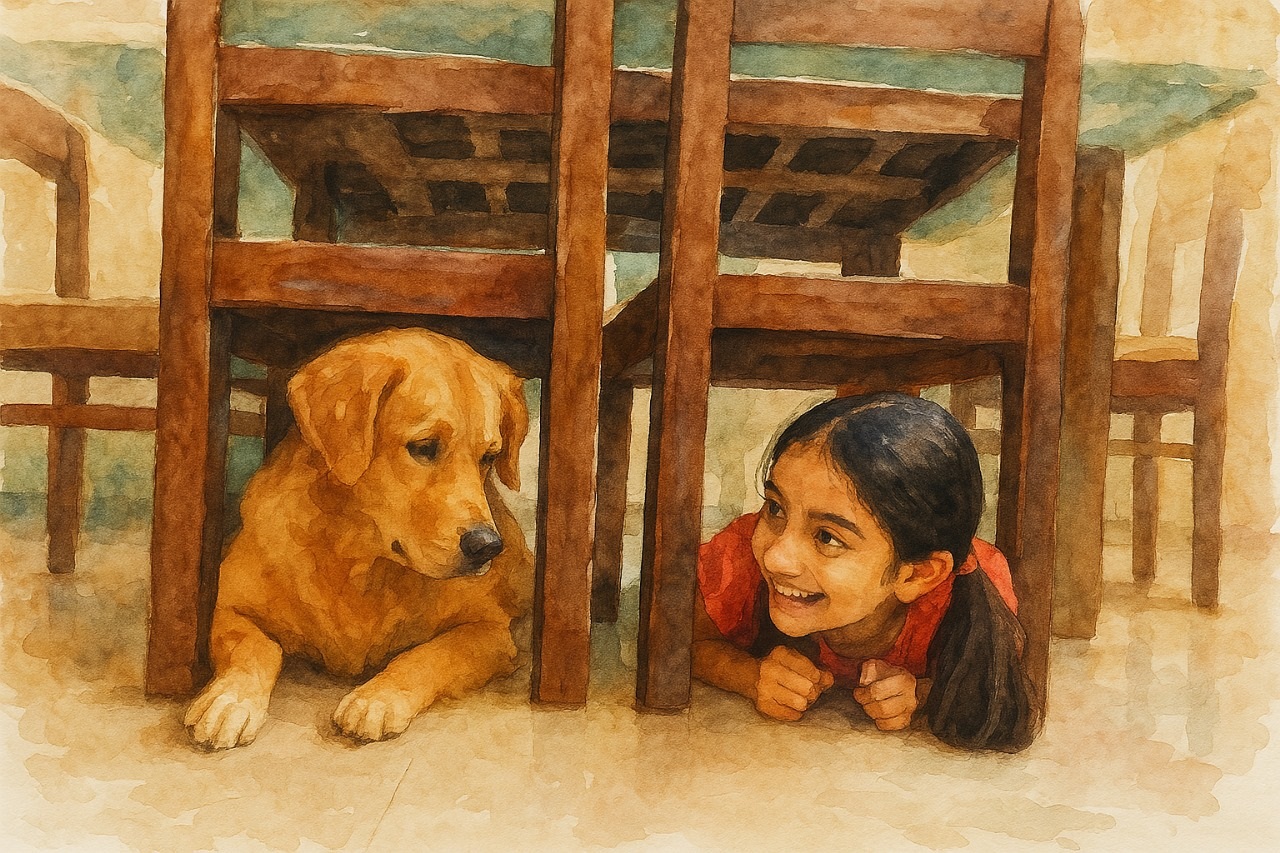
Quiet corners and loyal friends: Diti and Hedo sharing a moment.
Hedo is different. If the Pomeranian was a watchman and the Labrador a companion, the Golden Retriever is a pure extrovert. He has a coat like spun gold and a personality to match. He loves everyone—the postman, the milkman, the neighbours, the guests. To Hedo, a stranger is just a friend he hasn’t licked yet. He carries things in his mouth—socks, toys, sometimes just a leaf—as if offering gifts to the household gods.
Part of the house
Today, Hedo is two years old and no longer “the dog.” He is part of the house’s fabric. We take him for his morning and evening walks, feed him, and negotiate with him. Diti plays mother to him. Nivi, the moment she returns from school, seeks him out.
A year ago, when Ashwini and Shaily took the children on a ten-day trip to the Konkan, they took Hedo along. Finding hotels with “Pets Permitted” signs proved difficult, but that inconvenience mattered more to the humans than to Hedo. He enjoyed both the road trip and the holiday. More recently, he accompanied them on a trek near Chandrapur, a two-hour drive from Sevagram, enjoying the forest trails as much as the children did.
A daily transaction
Several times a day, when I am at my computer, he pads over and positions himself near the table. He then signals—politely but firmly, nudging my elbow with a wet nose—that his back requires stroking.
I oblige. He sits still, absorbs the attention, looks at me with what I choose to interpret as gratitude, and walks away, his business concluded.
It is a small, wordless transaction. But then, so are most lasting relationships.