The Hindi Mandir Pustakalaya
My early world was bounded by the smell of old paper and the quiet authority of the Hindi Mandir Pustakalaya. This library sat on the Bajaj Electricals campus, near Durga Talkies. Inside, the librarian Mr. Madanlal Purohit reigned over rows of Hindi classics. At an age when other children were perhaps chasing hoops, I was chasing the prose of Mahadevi Verma, Bachchan, Prasad, and Nirala.
English had not yet invaded my small private world. I became an addict of the Hindi printed word, copying the flourishes of Acharya Chatursen in my school notebooks. The Rashtra Bhasha Prachar Samiti, founded by Jamnalal Bajaj, turned my hobby into a series of hurdles. I climbed the ladder of their examinations: Prathmik, Prarambhik, Pravesh, and Parichay. I remember taking the Kovid exam alongside my bhabhi — a shared family effort under the lamp. I might have reached the heights of Visharad or Sahitya Ratna, but science began to compete for my attention. Science eventually won the battle for my career, but Hindi kept the keys to my heart.
The Monthly Magic — Parag and Chandamama
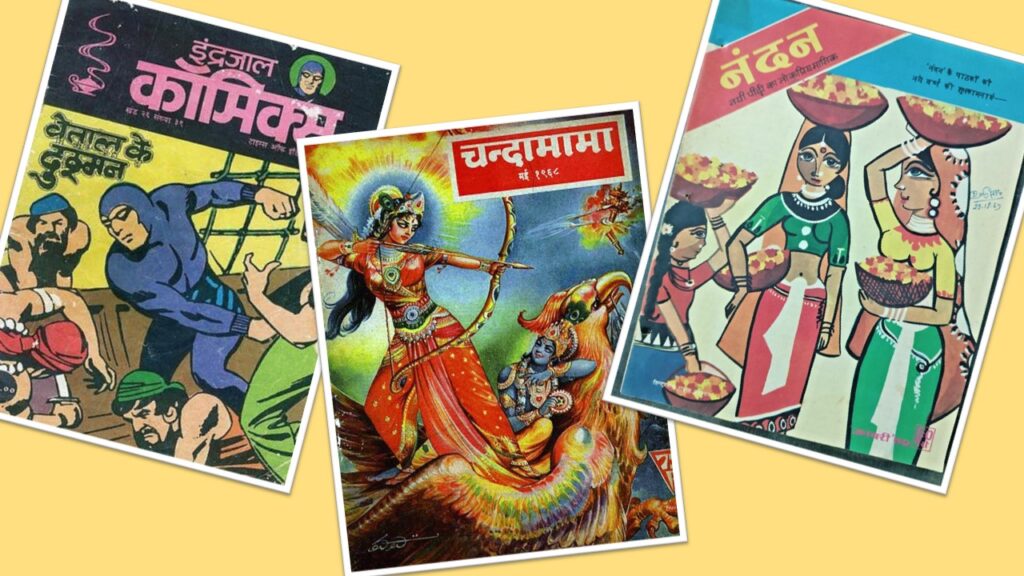
Every month, the arrival of Parag, Champak, and Nandan felt like a national holiday. These were not just magazines; they were windows out of our small town. Nandan brought the scent of Indian mythology, while Champak gave us animal fables that taught morals without the boredom of a sermon.
But the king of the shelf was Chandamama. Its pages were filled with sages, deities, and demons, all rendered in simple, translucent language. I spent hours lost in the Vikram and Vetal stories, fascinated by the king who never gave up and the ghost who never stopped asking riddles. It was a world where imagination was the only currency that mattered.
Swaraj Bhandar and the Open Tab
In middle school, Radhakrishnji Bajaj opened the doors of the Swaraj Bhandar library for me. It stood near the Sabzi Mandi — a place now so crowded you can barely park a scooter, but back then a quiet outpost of knowledge. When Radhakrishnji saw my hunger for books, he gave me an extraordinary open tab. I was told to take any book I liked, and he would foot the bill. I walked away with hundreds of volumes in Hindi and Marathi, reading them cover to cover.
The Smuggled Pages in Medical College
By the time I reached medical college, my literary palate had expanded, but the addiction remained. Like all teenagers and medical students of that era, we developed a desperate interest in Debonair. At the time, it was edited by Vinod Mehta, who would later produce such sophisticated work as The Lucknow Boy. Back then, however, we were not reading it for the political commentary.
Procuring a copy was a feat of high-stakes espionage. None of us had the courage to simply walk up to a magazine vendor and ask for it. Only the bravest among us would volunteer. He would approach the stall, wait until no one was around, and whisper “Debonair” into the vendor’s ear, then stand nonchalantly several feet away, keeping a sharp eye out for anyone who knew him.
Once the transaction was done, the magazine was quickly tucked inside a shirt, hidden against the skin until he reached the safety of the hostel. Back in the room, the door would be bolted. A single copy was often shared among three or four friends, hidden under a mattress when not in use. In our curiosity and our clumsiness, we were no different from teenagers anywhere else in the world.
Chacha Chaudhary and the Medical Resident
The love for the printed word followed me even into the gruelling years of residency. Buried under the weight of Harrison’s Principles of Internal Medicine, I found a secret sanctuary in comic strips.
Chacha Chaudhary was a favourite. He was a sprightly old man in a red turban whose brain was sharper than a needle and faster than a computer. When things got too heavy, his giant friend Sabu from Jupiter would provide the muscle. Even as a busy junior resident, I managed to find time for Pinki, the mischievous five-year-old created by Pran. I still have a vivid memory of being caught red-handed, tucked into a corner at my father-in-law’s house, reading a Pinki comic instead of a medical journal.
The Tongue-Tied Boy
Despite this vast internal world of stories and grand vocabulary, I remained a remarkably quiet child. By the time I entered medical college, I was too shy to string a single sentence together for my teachers or strangers. I was a tongue-tied boy — a creature of the library who had learned to think in the style of the classics but had not yet learned to speak to the world.
As my training progressed, the glossy pages of Sarika, Kadambini, Dharmyug, and Dinman gradually gave way to the Illustrated Weekly of India and the blunt, scotch-soaked wit of Khushwant Singh. I still remember the specific thrill of buying the inaugural copy of Sunday in May 1976. Edited by a young, sharp M.J. Akbar, it cost just one rupee and felt like the dawn of a new, faster-paced era of journalism. We would pore over his editorials, convinced we were reading the future.
Four decades later, the man behind those editorials would face a different kind of headlines. In 2018, Akbar was accused by Priya Ramani and several other women of predatory conduct. The reputation he had built over years of high-profile editing was dismantled by the testimonies of journalists who accused him of abuse. It was a sobering postscript to the magazine we once admired. Back in the seventies, however, we were oblivious — we just knew that for one rupee, Sunday offered a window into a world far beyond our hospital wards.
These books did more than pass the time. They built the foundation of how I see the world. They taught me that every patient has a story as complex as a Russian novel. I eventually found my voice, but the echoes of those Hindi classics and the silent corridors of the Swaraj Bhandar stay with me — a reminder of a simpler Wardha where the only technology we needed was a well-thumbed book and a bit of imagination.