Dr Anant Damodar Ranade
Medical Officer, Kasturba Hospital Tenure 1946–1982 Lifespan 22 February 1920 — 29 April 2019 Education Ayurveda Visharad (Ayurveda Mahavidyalaya, Pune) [1943]Trained Eye Surgeon (Kasturba Hospital, Sevagram)
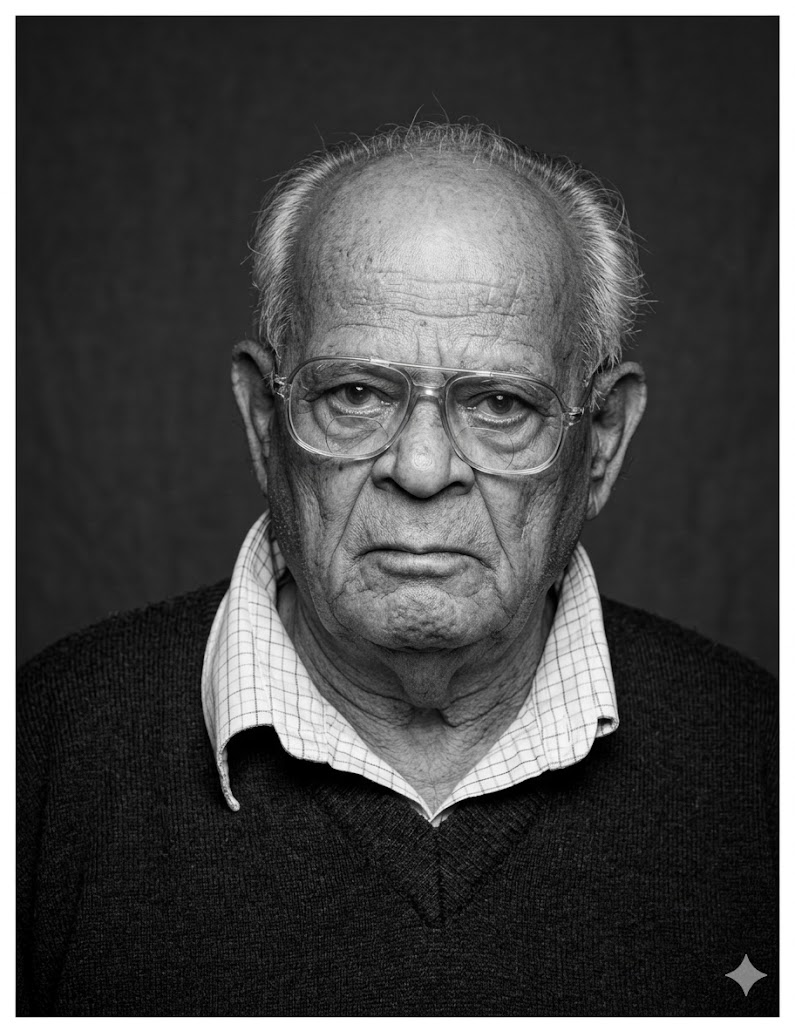
The bullock cart left before dawn. Two figures sat in it as it lurched down the red dirt roads of Vidarbha — a young doctor in white khadi and a determined nurse named Manimala Chaudhary. They were going to the villages to collect the harvest premium. Not cash. Jowar. A handful from one family, a sack from another, sometimes nothing but a smile and a promise. From this humble barter — grain for healthcare, goodwill for medicine — one of rural India’s most enduring health insurance schemes was born.
The doctor was Anant Damodar Ranade. He was in his thirties. He would spend the next three and a half decades doing variations of this same thing: riding into villages, listening to people, operating on their eyes, delivering their children, and quietly building an institution around them. He never sought recognition. He wore the same white khadi shirt and plain chappals every day of his working life. When he finally left Sevagram in 1982, the institution he had helped found was training hundreds of doctors a year. He moved to Nagpur to live with his son and spent his days spinning on a charkha.
He died on April 29, 2019, one year short of a hundred.
From Jamkhandi to Sevagram
Anant was born on February 22, 1920, in Jamkhandi, a princely state in what is now northern Karnataka’s Bagalkot district. His father, Damodar Ranade, served as a superintendent under the local raja. The family were Chitpavan Brahmins, but their deeper allegiance was to Lokmanya Tilak’s brand of nationalism. When Anant was old enough for school, his family sent him not to a government institution but to the National School in Chinchwad — a deliberate choice, rooted in the conviction that colonial education served colonial ends.
In the school library and in the magazines edited by Mahatma Gandhi, young Anant found his intellectual formation. At the urging of Annasaheb Sahastrabuddhe, he later visited Sabarmati Ashram, where he learned to farm, cook, clean latrines, maintain sanitation, and spin khadi. In 1930, when he was ten years old, the entire Ranade family adopted khadi. Anant would wear it every day for the rest of his life.
After matriculating in 1939, he enrolled at the Ayurveda Mahavidyalaya in Pune. While studying, he worked with the Rashtra Seva Dal and Congress Seva Dal. He earned the title Ayurveda Visharad and trained in eye surgery — a journey, as someone who knew him later put it, from pulse to scalpel. But history called louder than either.
In August 1942, Gandhi announced the Quit India Movement from Bombay. Anant, then in his final year of Ayurvedic training, threw down his books and joined the struggle. He was imprisoned for six months. When he was released and completed his training in 1943, he travelled to Bengal, where famine had already killed millions. While the British government diverted food to the military, ordinary people died in the streets. Anant worked among them. What he witnessed in Bengal — the geometry of poverty, hunger, and preventable disease — would never leave him.
Arrival in Sevagram
He returned from Bengal and began working at Wai Hospital. On the suggestion of Dr. Lagoo, he travelled to Pune to meet Gandhi. Dr. Lagoo told the Mahatma simply: this boy wants to work in Sevagram. Gandhi turned to Dr. Sushila Nayar and asked whether she would take him on. She agreed without hesitation.
On January 10, 1946, Anant Ranade arrived in Sevagram. He was twenty-five years old.
The Kasturba Hospital at that point was still finding its feet — a small dispensary that had moved from a room in the ashram to Birla House, a modest building a few furlongs away. Dr. Sushila Nayar, trained in Western medicine, was managing the clinical work. Gandhi, characteristically, continued to advocate for naturopathy and traditional healing alongside her. The patients who came were desperately poor. Malaria, typhoid, leprosy, complicated deliveries, cataracts — illness was as present in Sevagram as the dust and heat. Many died young and unnecessarily.
Anant began by doing what the hospital needed: everything. He rode bullock carts to surrounding villages to provide primary care. He assisted with deliveries. He watched, learned, and steadily acquired clinical skills that his Ayurvedic training had not given him. He trained in cataract surgery. Later, he went to Calcutta to study leprosy management. He was methodical and unhurried in everything, qualities that made patients trust him and colleagues rely on him.
One early lesson came directly from Gandhi. Anant had carefully prepared a hospital budget — a total of ₹25,000, with ₹5,000 allocated to preventive care and ₹20,000 to curative services. He presented it to Gandhi with some pride. Gandhi glanced at it, frowned, and said: this belongs in the wastepaper basket.
Anant was shaken. Where had he gone wrong?
Gandhi explained: reverse the figures. Put four-fifths of your resources into prevention, one-fifth into cure. Only then can a society be truly healthy.
It was a principle Anant would carry into every initiative for the rest of his working life.
The Man Who Kept the Hospital Alive
In 1948, Dr. Sushila Nayar left for a WHO scholarship at Johns Hopkins. She had entrusted Kasturba Hospital — wards, staff, supplies, accounts, and the surrounding community — to a man barely thirty years old. He managed it not with bureaucratic efficiency but with the quiet authority of someone whose commitment no one doubted.
The years that followed were difficult ones for the hospital. Gandhi Smarak Nidhi, which had taken over management after Gandhi’s death, found the expenses high and considered handing the hospital to the government. The staff were alarmed. This was not a government institution — it was built on an idea, on community participation, on the Gandhian conviction that health belonged to the people it served.
Dr. Ranade and Manimala Chaudhary climbed back into the bullock cart. They went from village to village during harvest time, not demanding fixed contributions but inviting what people could give. Grain, coins, blessings. Out of these offerings, the health insurance scheme took its first organised shape. Families paid a small annual premium — initially twenty-five percent of already modest hospital charges — in exchange for reliable, affordable care. It was not a policy. It was a people’s promise.
By 1955, the scheme was formalised. A family could insure itself for ₹10 a year. The currency was not profit but dignity. When ₹10 became ₹35 in 1985, and ₹600 in 2022, the principle remained intact. By 2024, the scheme covered nearly four lakh individuals. Over fifty thousand health insurance cards had been issued. What began with a cart and a bag of jowar had become one of India’s oldest and most studied models of community-based health insurance.
Surgeon, Eye Doctor, One-Man Department
For two decades, Anant Ranade was Kasturba Hospital’s only eye surgeon. In the 1950s and 1960s, he conducted eye camps every Sunday across Vidarbha, often accompanied by ophthalmologists from Nagpur — Dr. Sutaria, Dr. Joshi, Dr. Kelkar — who came out of respect for him and the work. Villagers traveled miles, some on foot, some in bullock carts, drawn by word that this doctor’s hands could restore sight.
He organized each camp with the precision of someone who understood that logistics were not separate from care — they were care. Days before a camp, he would visit the village, meet the sarpanch, identify a suitable site, arrange food for the patients and the medical team, and confirm transport. Then he would stay for the duration, operating through the day and sleeping in the village until the last patient had been seen.
His cataract surgery was performed with techniques far more rudimentary than those available today. What he had instead were steady hands, deep patience, and an intuitive grasp of what each patient needed. His outcomes spoke for themselves. People who had been blind for years left his camps able to see.
Dr. K.K. Trivedi, head of surgery at MGIMS and one of the first patients ever treated at Kasturba Hospital, recalls Ranade with the particular tenderness reserved for those who shaped you. “He was my closest friend in Sevagram,” Trivedi says. “Whenever my parents visited, he would sit with them for hours. They spoke the same language — simplicity, service, rural India.” Trivedi adds, with a soft laugh: “He even taught me to do cataract surgery. I may have operated on a patient or two under his watchful eye.”
When MGIMS opened in 1969, a formally qualified ophthalmologist with an MS degree from Chandigarh was appointed. The new head was direct with Dr. Sushila Nayar: he could not tolerate an Ayurvedic practitioner performing cataract surgeries in a modern medical college. Either Ranade operated or he did. Not both.
What followed was a quiet, painful surrender. Years of service were set aside without ceremony. Dr. Ranade was given charge of the Ayurveda Outpatient Department, inaugurated on Makar Sankranti in 1976. He managed it without complaint, seeing patients six days a week, supported by Dr. C. Dwarkanath, one of India’s most respected Ayurvedic practitioners, who served as honorary advisor. In 1976 alone, the OPD recorded more than four thousand patient visits.
He was also placed in charge of the hospital’s medical store. He managed it with the same meticulous attention he brought to everything, knowing which suppliers in Bombay could be trusted, which lanes in Kalbadevi Street offered good instruments at honest prices. “He once took me to a tiny galli off Kalbadevi where Jamnalal and Sons operated,” Trivedi recalls. “He negotiated fiercely. We never wasted a paisa.”
The Founding of Kasturba Health Society
By the early 1960s, it was clear that Kasturba Hospital needed a permanent, independent home — an institution capable of outlasting any individual. Dr. Ranade was central to the conversations that led to the founding of the Kasturba Health Society on September 11, 1964. The founding trustees were a small faithful group: Dr. Sushila Nayar, Manimala Chaudhary, Nalinbhai Mehta, Raghunath Shridhar Dhotre, Shriman Narayan of the Planning Commission, Laxmidas Shrikant of Gandhi Smarak Nidhi, and Dr. Anant Ranade.
It was Ranade, along with Manimala and Nalinbhai Mehta, who travelled to Delhi to persuade Dr. Sushila Nayar to lead the Society. She was hesitant. They would not leave until she agreed. The Gandhi Smarak Nidhi transferred hospital management to the new Society along with an endowment of ten lakh rupees, the interest from which covered the hospital’s annual deficit. It was a quiet but decisive transformation — from an ashram-style institution sustained by goodwill into a professionally managed, community-rooted organisation. Five years later, in 1969, that organisation became the parent body of MGIMS.
The Man Himself
Those who lived alongside Anant Ranade in Sevagram remember not just the physician but the person. He lived in Guru Nanak Colony, between the homes of Dr. G.R.K. Hari Rao and Manimala Chaudhary. His wife Nalini, trained in nursing and Indian classical music, gave evening baithaks in their modest home — gatherings where colleagues lost themselves in khayals and ragas. The house was a place of warmth in a community that could otherwise feel demanding and austere.
He was a Brahmin by birth who ate food prepared by Harijans, cleaned his own utensils, and participated in the ashram’s prayers without theatrical devotion — simply, as part of daily life. He spun on a charkha. He attended community meetings and, as he once said, listened happily even to criticism. “I always believed we need people to point out what’s wrong in the system,” he said. “Without them, the hospital wouldn’t run.”
He never claimed credit and rarely spoke about himself. His famous remark — “I never hesitated in my life, never stepped back, and not for a moment was I bored with the work” — was made almost in passing, in writing, as if it required no elaboration.
Nalini Ranade
No portrait of Anant Ranade is complete without Nalini. Born on November 10, 1931, in Dewas, she grew up in a household where her father — a bank employee and committed Gandhian — ensured that everyone wore khadi and that a khadi bhandar operated wherever he was posted. She attended Rashtriya Shala in Nadiad, a school following Gandhi’s Nai Talim model, where education engaged the hand and the heart alongside the mind. She had learned classical music under Pandit Moreshwar Khare, and once danced before Gandhi at her father’s request — and Gandhi laughed and encouraged the little girl warmly.
When she married Anant in 1949 and came to Sevagram, she became warden of the girls’ hostel, leading all-religion prayers, nursing patients without squeamishness about cleaning wards or washing the sick, earning a BA while managing the hostel, learning multiple languages, and fostering generations of young women students with the same quiet strength she brought to everything. She left Sevagram with her husband in 1982.
What He Left Behind
His son Dr. Sharad Ranade — an ophthalmologist trained at IGMC Nagpur — settled in Nagpur with his wife Dr. Charulata, a practising gynaecologist. Their daughter Amruta, born in 1979, married Devendra Fadnavis, who would go on to become Chief Minister of Maharashtra. It is one of those quiet ironies that history occasionally produces: the granddaughter of a man who rode bullock carts through Vidarbha villages in a white khadi shirt, collecting jowar as health insurance premium, became the Chief Minister’s wife. Anant Ranade would have found it faintly amusing, and then gone back to his charkha.
In his final years in Nagpur, Anant Ranade spun khadi, tended his garden, and read. His memory remained sharp into his late nineties. In 2019, he returned to Sevagram for a family function. He remembered the besan laddus made by Mrs. Gupta. He asked after Dr. Dhawan. He was ninety-nine years old.
“His departure from Sevagram wasn’t how it should have been,” Dr. Trivedi says quietly. “Sevagram forgot too easily. But I didn’t. He was cut from the same cloth as Dr. Wardekar — spiritual, Gandhian, inspired by Vinoba Bhave. What he gave to Kasturba Hospital and later to MGIMS cannot be measured in years or posts. It was the soul of service.”
He was not the kind of man institutions build statues for. He was the kind of man institutions are actually built by — in the before-dawn hours, on the back of a bullock cart, riding toward a village that needed someone to come.
Nalini Ranade
Nalini Ranade was born on 10 November 1931 in Dewas, to Vishnu Narayan Bankar and Gangubai. Her parents later moved to Bilimora, Gujarat, where her father worked in a bank. But he was, above all, a stubborn Gandhian. Clad always in pure khadi, with a white khadi cap perched firmly on his head, he would go to the bank each day and, wherever he was posted, ensure a khadi bhandar was opened to promote the sale of khadi. Everyone at home wore khadi—it was not a choice but a way of life.
Nalini grew up in this environment. Instead of attending a government school, she went to Rashtriya Shala in Nadiad, a school that followed the Wardha Nai Talim Yojana, focusing on agriculture, craft, cleanliness, and self-reliance. Alongside academics, students learned drawing, music, sports, and practical skills—an education that shaped head, heart, and hand. She had just cleared her Class 10 exams when Dr. Anand Ranade from Wardha visited Nadiad, and soon after, they were married.
Nalini’s formative years had already been shaped by Gandhian institutions. Before coming to Nadiad, she had spent two years as a young girl at Sabarmati Ashram, learning various skills. Under the guidance of Panditrao Khare and his family, she received training in classical music and learned to sing mythological songs and bhajans, a love that would stay with her for life.
On a visit to Sevagram with her father, she met Gandhiji. At her father’s request, she danced before Gandhiji to a song composed in his honour. Gandhiji laughed, encouraging the little girl warmly.
Another turning point came when she was travelling by train to Wardha, singing softly to herself in the compartment. In that same compartment was Asha Devi Aryanayakam, who ran the Nai Talim school in Sevagram Ashram. Asha Devi, charmed by Nalini’s singing, invited her to Sevagram. There, at the end of the school’s evening prayer, Nalini was asked to sing a bhajan, an experience that gave her confidence and strengthened her bond with music.
After her marriage, Nalini moved to Sevagram. There, she became the warden of the girls’ hostel, where she actively participated in daily all-religion prayers and led bhajans. Sevagram was, in many ways, an extension of Sabarmati Ashram: a place where everyone shared in the mundane tasks of daily life without hesitation. She learned multiple languages, pursued arts, earned her BA, and received nursing training to serve in the Kasturba Hospital.
In the hospital, she did not hesitate to wash patients or clean wards, believing deeply that cleanliness was next to godliness—a virtue Sevagram reinforced in her. Whether it was caring for patients, leading prayers, or participating in community activities, Nalini Ranade embodied the spirit of silent, selfless service, nurturing countless young women under her care and carrying forward the Gandhian ideals she had imbibed as a child.
Key Milestones
1920 — Born in Jamkhandi, Karnataka
1942 — Imprisoned in Quit India movement
1943 — Worked during Bengal famine
1946 — Joined Kasturba Hospital Sevagram
1955 — Health insurance scheme formalised
1964 — Kasturba Health Society founded
1969 — MGIMS established
1982 — Left Sevagram
2019 — Died in Nagpur