P.L. Tapdiya
President, Kasturba Health Society Tenure 1967-Present Born 1944, Wai village, near Akola, Maharashtra Education B.Com (Nagpur University) [1964]Chartered Accountant (ICAI) [1967]
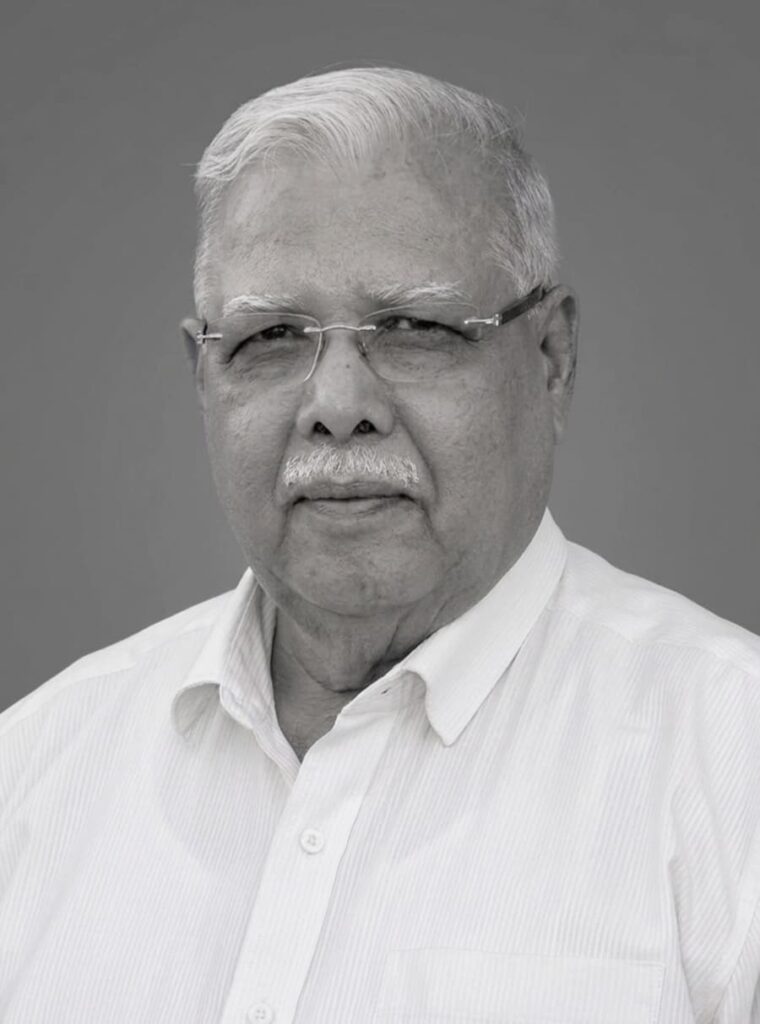
President, Kasturba Health Society
In the winter of 1966, the world of Indian finance was a kingdom of polished leather, starched collars, and an unspoken code of urban elitism. Into this world stepped Parmanand Tapdiya, a twenty-one-year-old who had just performed a feat of intellectual levitation: clearing the final Chartered Accountancy examinations on his first attempt. For a boy from Pimpalkhuta, a village so obscure it seemed to defy cartography, this was not merely a result; it was a miracle.
However, the “Everest of exams” was only the first gate. The second was aesthetic. To join the prestigious firm of K.K. Mankeshwar & Co. in Nagpur, Tapdiya was told he must abandon his rural attire. No pyjamas, no loose shirts. The firm, steeped in British professional tradition, demanded a visual manifestation of competence. Tapdiya, whose pockets were as empty as his ledgers were precise, had to borrow fifty rupees—a significant sum at the time—to buy his first pair of trousers.
This borrowed suit was more than a change of clothes; it was a uniform of a new life. It marked the birth of a man who would spend the next six decades ensuring that the grand, sprawling dreams of Sevagram were properly clothed in financial reality. While others in the Mahatma’s shadow spoke of grand visions and spiritual missions, Tapdiya understood a fundamental truth: even the most selfless institution requires a balanced balance sheet to survive the friction of the real world.
The Kerosene Lamp and the Discipline of Scarcity
To understand the President, one must understand the absolute silence of Wai—a village thirty kilometers south of Akola that in the 1950s lacked electricity, a post office, and a sense of belonging to the modern world. Here, Tapdiya learned what we might call the “mathematics of scarcity.” Water was not a utility; it was a hard-won prize from two shared wells where humans and livestock drank in a communal struggle for survival.
Strachey often looked for the moment a character’s “inner steel” was forged. For Tapdiya, it was the kerosene lamp. In the total darkness of rural Maharashtra, that small, flickering flame was his only ally against the night. It was here he learned his mother Dhanibai’s first commandment: Trust numbers, not guesswork. Unlettered and widowed when Parmanand was only two, she possessed a visceral understanding of accountability. She knew that in poverty, a single miscalculated paisa could lead to hunger.
By the age of fifteen, Tapdiya had ranked 24th out of 325,000 students. He was a boy moving at the speed of light in a world of mud paths. Yet, misfortune was his constant companion. Mentors like Principal Javadekar and Radha Krishnaji Toshniwal would enter his life, offer a glimpse of hope, and then be snatched away by death. These early losses created a man who did not rely on the permanence of people, but on the permanence of principles. He chose the CA path—where only one in fifty survived—not for the wealth it promised, but for the order it imposed on a chaotic world.
The Meeting of the Visionary and the Intern
The collision between the formidable Dr. Sushila Nayar and the nineteen-year-old intern Tapdiya in 1965 is the foundational myth of the MGIMS accounts department. Dr. Nayar was a colossus—a Gandhian revolutionary, a close associate of the Mahatma, and India’s Health Minister. She possessed an iron will and a visionary’s impatience. She had a British consultant’s report from Parsons and Company filled with dense, foreign projections for her proposed rural medical college.
She needed this report translated—not just into Indian rupees, but into the myriad languages of global donors: Yen for Japan, Lira for Italy, and Dollars for the United States. Tapdiya, the intern, was assigned the task. He sat in a modest room with a stone floor and a kavelu (tiled) roof. Without a calculator, without a spreadsheet, and with no formal degree yet to his name, he manually converted the lifeblood of the future MGIMS.
He was the “Human Computer” of Sevagram. He didn’t just translate currencies; he translated Dr. Nayar’s fierce drive into a 150-page document that the Vatican and the Japanese could understand. He typed and retyped drafts late into the night, the rhythmic clatter of the typewriter echoing the heartbeat of an institution yet to be born. When he finally cleared his exams in 1969, the “corporate czars” of Mumbai and Delhi came calling. They offered the prestige of the metropolis; they offered the fast track. Tapdiya looked at the corridors of power and then looked back at the dusty road to Sevagram. He chose the latter, becoming an honorary consultant—a man who would manage millions without ever drawing a salary.
The Trio of Malgudi: The Early Treasury
The early 1970s at MGIMS were a period of “Primitive Accumulation.” The accounts department bore no resemblance to the clinical, digital hubs of today. It resembled a scene from a R.K. Narayan novel—a small, dedicated group working in a world of paper and ink. There was Tapdiya, the young, sharp mentor, and a trio of unlikely disciples: Dadarao Shingare, Bhimrao Pradhan, and a man known simply as Kanakdas.
The story of Kanakdas is essential to the Stracheyan narrative of MGIMS. He was a wanderer from Kerala who had stepped off a train at Wardha, penniless and searching for food. Manimala Choudhary had noticed him and given him a bell to ring to mark the hours. From ringer of bells to Chief Accountant, Kanakdas’s journey was overseen by Tapdiya.
None of these men had studied beyond the tenth grade. None had formal training in finance. Yet, under Tapdiya’s tutelage, they became the “Guardians of the Paisa.” They worked with Remington typewriters and red pens, mastering the art of the ledger through sheer, dogged perseverance. In this Zen-like austerity, Tapdiya instilled a philosophy: Money is not currency; it is lifeblood. To misplace a single rupee was to bleed the institution. He taught them that in a rural hospital, a ledger entry was as vital as a surgeon’s knot.
The Iconoclast’s Marriage: A Rejection of the Gilded Age
In an era where educated grooms—particularly Chartered Accountants—were traded like blue-chip stocks, Tapdiya staged his most quiet and significant rebellion. As families lined up with lucrative dowry proposals, he made a stance that was unequivocally Stracheyan in its rejection of social vanity. He declared he would only marry into a family that could not afford a dowry.
Wealth held no appeal; status meant nothing. He sought a partner whose convictions matched his own “unyielding steel.” In 1969, he married Shobha Rathi in a ceremony that was a study in minimalist integrity. No gold, no lavish feast—just a coconut and a rupee.
Shobha, a scholar of Sanskrit and Political Science, became the silent partner in his mission. While he built the financial scaffolding of a medical college, she built a home that remained stubbornly simple. Their three children—Mugdha, Vaibhav, and Sourabh—grew up in an environment where “value” was measured in character, not in bank balances. This personal domestic “audit” ensured that Tapdiya remained unencumbered by the greed that often fells men in positions of financial power.
The Impatient Leader: Precision as a Weapon
The Tapdiya of the 1980s and 90s was not the mellowed elder we see today. He was described by colleagues as impatient, tough, and at times, unyielding. He was the “Grand Inquisitor” of the balance sheet. In a Gandhian institution where “service” could sometimes be used as an excuse for administrative sloppiness, Tapdiya was the corrective force.
He called a spade a spade, and if the spade was over-budget, he was merciless. He set a standard of perfection that few could meet. This “toughness” was not a character flaw; it was a strategic necessity. For thirty-one years, he served as the internal auditor, a hawk-like presence that saw through every inflated estimate and every misplaced expense.
Yet, as the decades passed, a transformation occurred—the “surgical” biographer’s favorite theme. The man who once demanded perfection began to practice patience. He learned to bend without breaking. He realized that to lead a community of doctors and teachers, one had to lead with the heart as much as the calculator. He shed the sharp edges of the auditor for the steady hand of the trustee.
The Presidency: Navigating the Gathering Storm
When Tapdiya took the baton as President of the Kasturba Health Society in 2024, at the age of seventy-seven, he was the third runner in a sixty-year relay. Dr. Sushila Nayar had been the Architect; Dhirubhai Mehta had been the Builder; Tapdiya became the Custodian.
The transition was not merely a change in name, but a change in “class.” Dr. Nayar was a political giant; Dhirubhai was a corporate titan. Tapdiya was, as he called himself, a “homespun” professional. He had neither political backing in Delhi nor a corporate network in Mumbai. He was a “Son of the Soil,” rooted in the realities of Wardha.
He inherited an institution facing unprecedented challenges. The “Golden Age” of government funding had passed. Private medical colleges were sprouting like weeds, offering salaries that a mission-based hospital could never match. Faculty recruitment became a battle; maintaining the Gandhian “Code of Conduct” in a consumerist age felt like holding back the tide.
Tapdiya met these challenges with the same “first principles” he had used in the 1960s. He didn’t look for flashy consultants; he looked at the numbers. He trimmed waste with a surgeon’s precision. He reminded everyone that medicine at MGIMS was a calling, not just a career. Under his stewardship, the budget, which once stood at a single lakh, now exceeded 250 crores. But to Tapdiya, the complexity hadn’t changed—the discipline remained the same.
The Guardian of the Future: An Unsentimental Legacy
In the final analysis, Parmanand Tapdiya’s life is a testament to the power of “Meticulous Integrity.” Most biographies of great leaders focus on their speeches or their grand gestures. Tapdiya’s greatness is found in the quiet of the night, in the thousands of ledgers he reviewed, and in the “No” he said to wasteful expenditures that would have compromised the hospital’s mission.
Dhirubhai Mehta once remarked that while he looked at the big picture, Tapdiya moved step-by-step. It is this “Zen of the Detail” that has saved MGIMS during its darkest financial hours. He is the leader MGIMS trusts because he is the only one who knows exactly where every brick is buried and how much it cost.
As he sits today in the President’s chair, the boy who once studied by a kerosene lamp is now the man who ensures the lights stay on for thousands of patients and students. He remains an iconoclast—a man who rejects the pretension of power in favor of the clarity of logic. In the history of MGIMS, many have provided the vision, but Tapdiya provided the ground upon which that vision could stand. For sixty years, he has been the man with whom the buck stops, and history bears witness: no challenge is too great for a man who turns adversity into the most disciplined form of opportunity.
Key Milestones
| 1944 | Born, Wai village, near Akola — no electricity, no post office |
| 1959 | Ranks 24th out of 325,000 students — age fifteen |
| 1965 | Arrives at MGIMS as CA intern — age nineteen |
| 1965 | Translates Parsons & Co. report into Yen, Lira, Dollars for Dr. Nayar |
| 1966 | Clears CA examinations — first attempt, first in class |
| 1966 | Joins K.K. Mankeshwar & Co., Nagpur — borrows ₹50 for first trousers |
| 1969 | Marries Shobha Rathi — ceremony: one coconut, one rupee |
| 1969 | Chooses Sevagram over Mumbai and Delhi — honorary consultant, no salary |
| 1970s | Trains Kanakdas, Dadarao Shingare, Bhimrao Pradhan — the accounts trio |
| 1982 | Arranges lunch with Nalinibhai Mehta — brings Dhirubhai Mehta to KHS |
| 1967 | Trustee, Kasturba Health Society |
| 1967 | Internal auditor — 31 years of hawk-eyed review |
| 2024 | Assumes presidency, KHS — age seventy-seven |