Dr. Ishar Dayal Singh
First Principal · Professor of Physiology · MGIMS Tenure 1969 – 1974 Lifespan 11 June 1913, Dharamsala, Himachal Pradesh — Not recorded Education B.Sc. Honors (Biology) (Christian College, Lahore, 1932)MBBS (King Edward Medical College, Lahore, 1937)
MD Physiology (Government Medical College, Amritsar / Punjab University, 1952)
PhD Physiology (University of Birmingham, UK, 1955)
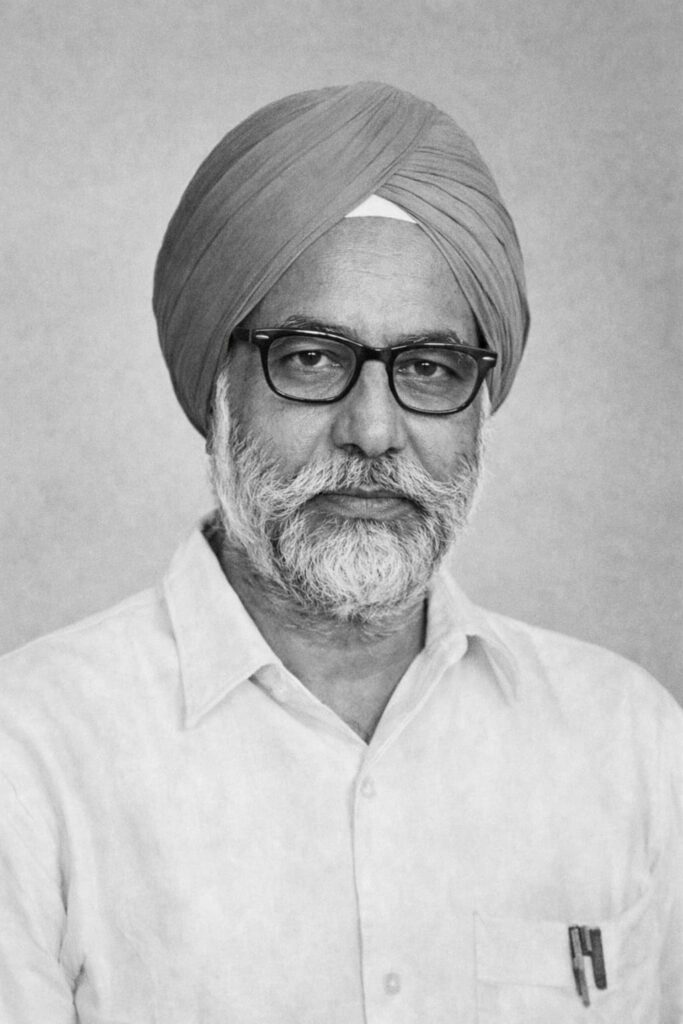
First Principal of MGIMS · Professor of Physiology · Soldier · Scientist · The Man Who Gave MGIMS Its Academic Spine
On September 1, 1969, a man in a neatly tied turban stepped onto the sun-baked platform at Wardha station. He had traveled a thousand kilometres from Punjab on a slow-moving train. He carried the quiet composure of someone who had already lived several demanding lives — soldier, researcher, teacher — and was now being asked to live another: the first principal of a medical college that did not yet fully exist.
Dr. Ishar Dayal Singh was not what people expected when they pictured a Punjabi. There was no bluster, no large presence filling the room. He was measured, deliberate, soft-spoken. He listened more than he spoke, and when he did speak, his words arrived with the particular weight of someone who had chosen them carefully. Dr. Sushila Nayar had asked the Punjab government to depute him for one year. He stayed for five. In those five years, he gave MGIMS its academic skeleton and something harder to name — a tone, a culture, a way of being an institution.
From Dharamsala to Lahore to Birmingham
He was born on June 11, 1913, in Dharamsala, in the cool hills of Himachal Pradesh. His lineage carried a remarkable distinction: he was descended from Bhai Nand Lal Goya, the seventeenth-century Persian poet and devoted disciple of Guru Gobind Singh, the tenth Sikh Guru. Bhai Nand Lal had migrated from Persia some three hundred years earlier and settled in Multan. After Partition, the family settled in Patiala.
Singh completed his BSc with honours in Biology from Christian College, Lahore, and his MBBS from King Edward Medical College, Lahore, in 1937 — standing first in Medicine, Ophthalmology, and Surgery. His MD in Physiology came in 1952, delayed by the interruptions of history. A PhD from the University of Birmingham followed in 1955.
Between his MBBS and his MD, the world had gone to war. Singh served in the British Indian Army Medical Corps, rising to the rank of Major. The war shaped him — his discipline, his steadiness under pressure, his ability to function in conditions of uncertainty and scarcity. These were precisely the qualities that Sevagram would demand of him.
After the war, he returned to academia. An ICMR-funded research project. A Colombo Plan Fellowship that took him to Birmingham. A Wellcome Trust Fellowship in 1961 that carried him across the United Kingdom, Europe, Australia, Singapore, and the United States, building the international network of a serious scientist. He guided more than twenty postgraduate students. He published thirty-four original papers. His work on hepatic coma, published in The Lancet in 1954, established him as a researcher of international standing. He served on the editorial board of the Indian Journal of Physiology and Pharmacology.
By 1969, he was a man of considerable academic achievement, settled in Punjab, with no obvious reason to uproot himself for a half-built medical college in a Vidarbha village. Dr. Sushila Nayar asked anyway. He said yes.
Sevagram, 1969
What he found when he arrived bore little resemblance to the institutions he had known. There were no grand lecture halls. Laboratories were rudimentary. The first batch of fifty students had arrived, eager and uncertain. Faculty members recruited from across the country were still adjusting to life in a village — to the dust and heat, to the absence of urban conveniences, to the particular demands of an ashram-influenced campus where khadi was worn and evening prayers were attended.
The hospital was finding its rhythm. Patients arrived from surrounding villages with conditions that reflected the full weight of rural poverty and neglect. Courses needed to be structured, hostels set up, university affiliations secured, a culture of learning built from almost nothing.
Singh met each challenge without drama. He walked through half-built corridors, checked classrooms still smelling of fresh paint, sat with young faculty under neem trees to discuss syllabi. He drafted letters to government officials and university administrators, navigated the bureaucratic requirements of affiliation, and ensured the academic calendar ran on time. He was simultaneously Head of the Department of Physiology — teaching, guiding students, maintaining the research standards he had spent a career establishing — and the administrative anchor of the entire institution.
His most significant academic contribution was structural: he championed and helped design a two-year postgraduate programme in Community Medicine, ensuring that MGIMS graduated doctors who understood healthcare not merely as clinical treatment but as service to communities. It was a vision entirely consonant with Dr. Nayar’s founding philosophy, and Singh gave it academic rigour and institutional form.
His salary was ₹1,710 per month, with a principal’s allowance of ₹50. He never mentioned it.
The Harmonium
There was another dimension to Dr. Singh that those who knew him in Sevagram remember with particular warmth.
He had been trained in Indian classical music since childhood. His instrument was the harmonium. In the evenings, when the day’s clinical and academic work was done, students and faculty gathered in the ashram-style campus. Voices rose in bhajans — the devotional songs that had been part of ashram life since Gandhi’s time.
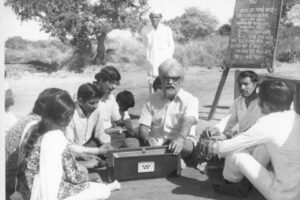
In their midst, seated cross-legged on the floor, turban neat, fingers moving effortlessly across the keys, was the Principal. He led them in Vaishnav Jan To — Gandhi’s favourite hymn, the one that describes the truly virtuous person as one who feels others’ pain as their own. It was a sight that stayed with every student who witnessed it. A senior scientist, a man of international academic standing, a former army officer — sitting on the floor, playing music with his students, in a village in Vidarbha.
It said something essential about the institution he was helping to build, and about the man himself.
The campus in those early years was, as one who was there described it, a mosaic of many Indias. Banias and Brahmins, Dalits and Thakurs, Sikhs, Punjabis, Bengalis, and Marathas walked its shaded paths. Language, caste, and region — the usual fault lines of Indian institutional life — gave way here to the quiet solidarity of shared purpose. Harmony was not an aspiration. It was daily lived experience. Singh embodied it and quietly enforced it, not through policy but through his own person.
Departure and Legacy
He retired as Principal in August 1974, handing over an institution that had found its footing. In 1975, his scholarly restlessness took him to Nigeria, where he joined A.B.U. Zaria as a visiting professor. When he applied for a professorship at the University of Ilorin, Dr. Sushila Nayar wrote him a letter of recommendation. It is worth reading in full for what it reveals — not just about Singh, but about how she assessed the people who had built something with her:
“Dr. I.D. Singh is an upright man of honesty, integrity, and ability. His conduct was always above board. He is an outstanding teacher whose research has received international recognition. He played a crucial role in establishing this institution, ensuring the primacy of community medicine and rural services. He is an able administrator and a fine human being.”
She was not given to effusive praise. That letter, in its restraint and precision, was the highest endorsement she offered.
His wife came from Jhelum, now in Pakistan. His son settled in the United Kingdom as a physician. His younger daughter was admitted to MGIMS and later moved to Srinagar, where she completed her MBBS.
Dr. Ishar Dayal Singh came to Sevagram as a man of science — a decorated researcher, an experienced teacher, a former soldier. He left as something the institution needed more urgently than any of those things: its first steady hand, the person who had held the building together while it was still deciding what it wanted to be.The students who gathered around him in the evenings, listening to the harmonium fill the Vidarbha night with Vaishnav Jan To, were learning medicine. They were also, without quite knowing it, learning what kind of doctors they were meant to become.
Key Milestones
| 1913 | Born, 11 June, Dharamsala — descended from Bhai Nand Lal Goya, poet-disciple of Guru Gobind Singh |
| 1937 | MBBS, King Edward Medical College, Lahore — first in Medicine, Ophthalmology, Surgery |
| 1939 | Joins British Indian Army Medical Corps — rises to Major |
| 1952 | MD in Physiology |
| 1954 | Paper on hepatic coma published in The Lancet |
| 1955 | PhD, University of Birmingham |
| 1961 | Wellcome Trust Fellowship — UK, Europe, Australia, Singapore, USA |
| 1969 | Arrives Wardha, 1 September — First Principal, MGIMS |
| 1969 | Designs two-year PG programme in Community Medicine |
| 1969 | Evening bhajans — harmonium, Vaishnav Jan To, students at his feet |
| 1974 | Retires as Principal, August — institution standing on its own |
| 1975 | Visiting Professor, A.B.U. Zaria, Nigeria |