Dr. Govind Manohar Indurkar
Professor & Head of Anatomy · MGIMS Tenure 1969 – 1973 · 1986 – 1988 Lifespan 12 June 1928, Nagpur — 31 August 2011, Nagpur Education LMP (Mayo Hospital, Nagpur) [1949]MBBS (Government Medical College, Nagpur) [1955]
MS Anatomy (Government Medical College, Nagpur) [1963]
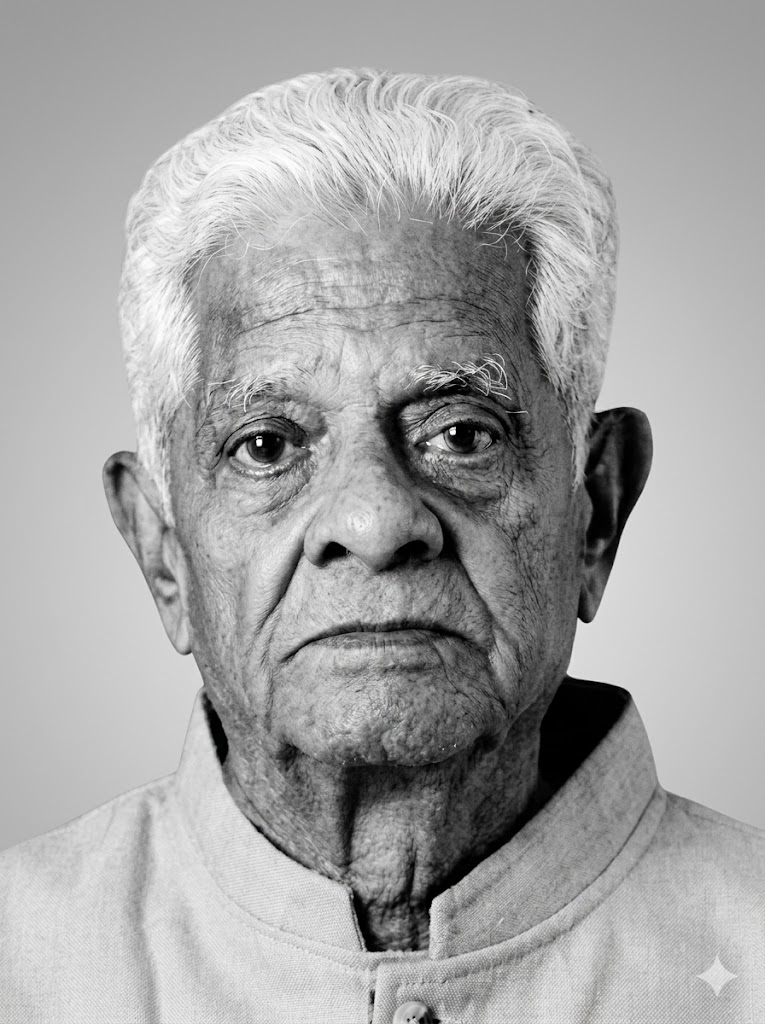
Professor & Head of Anatomy · Literary Critic · Playwright · Painter · The Anatomist Who Wrote About the Gita at 3am
At three in the morning, when Sevagram was entirely still, Dr. Govind Manohar Indurkar would sit at his desk and write about the Bhagavad Gita.
The house was quiet, the grandchildren asleep, the campus outside dark and unhurried. In those hours — before the dissection hall, before the students, before the day’s demands assembled themselves — he found the stillness he needed for reflection. He had been waking this early for years, long before the Gita writing began. It was simply how he was constituted: a man who needed the predawn hours to think, to read, to be alone with what mattered to him most.
What mattered to him, it turned out, was a great deal. Human anatomy, certainly — he had spent a lifetime in its precise service. But also Kalidasa’s poetry, Sanskrit scholarship, Marathi theatre, classical music, the flute, painting, anatomical illustration, and the philosophical teachings of the Gita which he eventually rendered into three books in Marathi, one written especially for young readers. He was an anatomist who could write literary criticism. A scientist who directed plays. A professor who painted murals.
He wore none of it for effect. He wore it all as naturally as he wore his simple white khadi kurta.
Nagpur, Railways, and the Long Road to Anatomy
Govind Manohar Indurkar was born on June 12, 1928, in Nagpur, into an orthodox middle-class Brahmin family. His father worked for the Indian Railways and was posted to Adra, a railway colony in the Purulia district of West Bengal, where young Govind spent his early childhood. When financial pressures and the desire to give him a traditionally Maharashtrian upbringing converged, he was sent back to Nagpur to live with his grandfather and step-uncle. He completed his schooling at New English High School, passing matriculation with distinction.
His maternal grandfather — a schoolteacher of quiet discipline and intellectual rigour — was the formative influence of his childhood. The values he absorbed from that relationship — the steady daily routine, the primacy of learning, the idea that teaching was a form of service — stayed with him for eighty-three years.
He began medical studies at Mayo Hospital, then Robertson Medical College, now Indira Gandhi Government Medical College, in Nagpur, earning his LMP in 1949. Eager to advance and support his family, he joined the first batch of the shorter MBBS course at Government Medical College, Nagpur, completing his MBBS in 1955. He worked as an MMS Class II officer at a primary health centre in Amravati district, as a Medical Officer at Nagpur Central Jail, and ran a private clinic — accumulating the early-career variety that characterised his generation before he found his true direction.
That direction was anatomy. He returned to GMC Nagpur and in 1963, under the guidance of Dr. D.K. Kadasne, completed his MS in Anatomy. His thesis examined the spatial arrangement of the hepatic artery, bile duct, and portal vein within the liver — meticulous, structural, characteristically precise. He began teaching as a Lecturer in Anatomy at GMC Nagpur in 1961, was transferred to the newly opened GMC Aurangabad in 1963–64, and became a Reader in 1968.
The First Years at MGIMS
In 1969, the Government of Maharashtra deputed Dr. Indurkar to the Mahatma Gandhi Institute of Medical Sciences, Sevagram — one of several faculty members sent to help establish what was to become India’s first rural medical college. He arrived as a Reader in Anatomy in July 1969, two months before the first batch of medical students, and helped build the department from the ground up.
The colleague he worked alongside most closely in those early years was Dr. M.G. Kane, the first Professor and Head of Anatomy. They could not have been more different. Dr. Kane was strict, disciplined, and exacting — a man who wore his standards on his sleeve and did not suffer fools. Dr. Indurkar was quiet, humble, and gentle — a warm presence who made students feel safe enough to be confused without shame. Their temperamental contrast almost certainly served the department well: the rigour and the warmth, in combination, producing the balance that a new institution needs to take root.
What Dr. Indurkar brought that no other faculty member could replicate was an artist’s eye applied to a scientist’s subject. He created an impressive collection of surgically carved specimens and worked with the local artist Gajanan Ambulkar to produce anatomical murals based on Gray’s Anatomy for the walls of the dissection hall. These murals — large, detailed, technically accurate, aesthetically considered — transformed a functional space into something more. Students memorising the brachial plexus or the branches of the aorta did so under the gaze of illustrations that had been made with care, not merely reproduced from a textbook. It was Dr. Indurkar’s way of saying that the human body was worth looking at beautifully, not just correctly.
He left MGIMS when his deputation ended in August 1973 and returned to government service — posted through GMC Aurangabad, then Pune, Ambajogai, and Solapur, finally serving his last government appointment at GMC Nagpur before retiring in June 1986.
The Return
He was fifty-eight when he retired from government service. Within a month, he was back in Sevagram.
In July 1986, he joined MGIMS as Professor and Head of the Anatomy Department — his second tenure at the institution, seventeen years after his first. Dr. G.R.K. Hari Rao was still present as Emeritus Professor, Mr. J. Anbalagan served as Reader, and Mrs. R.R. Fulzele as Lecturer. He led the department for two years, steadily transferring responsibility to the younger generation before passing the headship to Mr. Anbalagan in June 1988.
He was quieter this time, more observer than driver. He had supervised PhD scholars including Dr. Palikundwar and Dr. Khanzode, contributed to doctoral work across institutions, and now watched his students take the reins. The department he had helped found in 1969 was now eighteen years old and producing its own researchers. He had seen it grow from nothing to this. It was enough.
The Literary Anatomist
In 1972, during his first tenure at MGIMS, he contributed an eight-page essay to Sushruta, the college’s annual magazine. The essay was titled Meghadutatil Kavya-Saundarya — The Poetic Beauty of Meghaduta. It was a sustained literary-critical engagement with Kalidasa’s poem, quoting extensively from the Sanskrit, offering translations and interpretations that read not like an academic exercise but like the work of someone who had lived with the text for years and found in it a genuine emotional home.
It surprised his colleagues. How could a professor of anatomy — a man who spent his days in the dissection hall, working with cadavers and memorisation charts and blackboard diagrams — write with this literary grace?
The answer, in retrospect, was simple: he had always been both things. He wrote essays for college publications throughout his career, including a memorable contribution to the MGIMS batch of 1969–70 souvenir. He wrote a critical appreciation of Shanta Shelke’s Varsha Nayika. He contributed to a government project producing medical anatomy textbooks in Marathi. He translated Ratnakar Matkari’s play Eka Olya Raatri into Hindi as Ek Bhigi Bhigi Si Raat. He directed Marathi plays for college and public events. He was a classical singer and a flute player.
He was fluent in Marathi, Sanskrit, Hindi, English, and Bengali. Marathi remained closest to his heart — the language in which he wrote his three books on the Gita, the language of his literary essays, the tongue of his maternal grandfather’s household. The Gita books occupied his predawn hours for years, the third written specifically to make the text accessible to young readers.
There is a particular kind of person who moves with equal fluency between the rigour of science and the beauty of verse, between dissection and devotion, between structure and soul. They are rare. Dr. Indurkar was one of them, and the combination made him a richer teacher than either faculty alone could have produced.
The End of Teaching
After his second departure from MGIMS in 1988, he taught at Bijapur Medical College in Karnataka for about a year, then at Panjabrao Deshmukh Medical College in Amravati for two years, then at NKP Salve Institute of Medical Sciences in Nagpur. He stepped back from formal teaching around 1994–95, when the college shifted to a distant campus and his deteriorating vision and hearing made the travel unmanageable alone.
He did not stop teaching. He offered informal lessons at home to a few chosen students, free of charge, well into his later years. The last classroom was his own house. The students sat where his grandchildren sat. The textbooks were the same ones he had carried for forty years.
In June 2011, he was diagnosed with advanced metastatic cancer. He chose not to pursue aggressive treatment — a decision entirely consistent with the values that had guided his life. He died peacefully on August 31, 2011, the day before Ganesh Chaturthi. He was eighty-three.
He is survived by his wife Sushila, whom he married in 1952, their five children — three daughters, Sunanda, Vasanti, and the late Smita, and two sons — and his younger son Shrikant, who studied at MGIMS in the 1983 batch, sitting in the department his father had helped found fourteen years before he arrived.
Key Milestones
| 1928 | Born, 12 June, Nagpur |
| 1949 | LMP, Robertson Medical College (now IGGMC), Nagpur |
| 1955 | MBBS, Government Medical College, Nagpur |
| 1961 | Lecturer in Anatomy, GMC Nagpur — begins teaching career |
| 1963 | MS in Anatomy, GMC Nagpur — thesis on hepatic artery, bile duct, portal vein |
| 1968 | Reader in Anatomy |
| 1969 | Arrives MGIMS, July — Reader in Anatomy, helps build department from nothing |
| 1969 | Anatomical murals for dissection hall — with artist Gajanan Ambulkar |
| 1972 | Essay on Kalidasa’s Meghaduta published in Sushruta — surprises his colleagues |
| 1973 | Leaves MGIMS — deputation ends, returns to government service |
| 1986 | Retires from government service, June |
| 1986 | Returns to MGIMS, July — Professor & Head of Anatomy |
| 1988 | Passes headship to Mr. Anbalagan — second departure |
| 1994 | Steps back from formal teaching — deteriorating vision and hearing |
| 1994 | Continues teaching informally at home — free of charge |
| 2011 | Diagnosed with advanced metastatic cancer, June — declines aggressive treatment |
| 2011 | Dies peacefully, 31 August — eve of Ganesh Chaturthi, age 83 |