Dr. M.V.R. Reddy
Professor and Head of Biochemistry · MGIMS Tenure 1980 – 2017 Lifespan 1 July 1957, Karivemula, Andhra Pradesh — 9 April 2017, Sevagram Education MSc Biochemistry (Sri Venkateswara University) [1980]PhD (Nagpur University) [1987]
Professor & Head of Biochemistry · Thirty-Seven Years at Sevagram · The Gentlest Man Three Hundred Students Ever Met
The night before he died, he shared warmth and laughter with his family. By morning, he had slipped away — without struggle, without burdening anyone. He was fifty-nine years old, and he had not been ill. Death arrived quietly, as if it knew that any other manner of arriving would have been wrong for this particular man.
Three hundred students wrote tributes. Nearly every one of them used the same word: gentle.
***
Karivemula to Sevagram
Maryada Venkata Rama Reddy was born on July 1, 1957, in Karivemula, a village in Andhra Pradesh sixty-two kilometres west of Kurnool. His father Narsimha Reddy and mother Narsamma were the quiet strong foundation of a family in which he was the eldest of four children. He completed his schooling at IPH School in Kodumur in 1972, his intermediate studies at Osmania College, Kurnool, and his BSc and MSc from Sri Venkateswara University by 1980.
He arrived at MGIMS in November 1980 as a Junior Research Fellow, twenty-three years old, stepping into a world that was foreign in almost every dimension. Hindi and Marathi were unknown to him. English had entered his life only after childhood. He had never set foot in a medical school. The department around him was full of physicians and surgeons. He had an MSc in Biochemistry. The question that formed quietly inside him — did he belong here? — was one he did not answer by leaving. He answered it by staying, and working, and slowly becoming indispensable.
Dr. B.C. Harinath, a fellow Telugu-speaking academic from Tirupati, had brought him to MGIMS. The department at that time was a crucible of early research energy — Harinath at its centre, supported by Mr. C.B. Taori, J.N. Naidu, and doctoral scholars including Dr. A.K. Malhotra, I. Kharat, and G.B.K.S. Prasad. For Reddy, Prasad’s presence offered particular comfort — a familiar face in an unfamiliar place. Together they navigated the biochemistry laboratory and the research culture Harinath was building around filariasis. The lab became his refuge. From Patel Hostel to Kabir Colony, and eventually to MLK Colony, he moved through different quarters, each a witness to his growing confidence.
In December 1980, just a month after joining, he married Lakshmi Reddy, who came from Nagarur in the Kurnool district. She was also an MSc graduate, would later earn a BEd, and would eventually become Principal of Kasturba Vidya Mandir — a professional life built entirely in Sevagram. She joined him in 1982. They spent the next thirty-five years in this village together, raising two sons who would both study medicine at MGIMS and marry classmates who would also study medicine at MGIMS. The institution ran through their family like a thread.
***
Harvard, and the Return
He had not imagined, arriving in Sevagram, that he would one day sit in a laboratory at Harvard. But in August 1983, he secured a place in a WHO training programme at Harvard University’s Department of Tropical Public Health, working with Dr. W.F. Piessens on hybridoma techniques — a vital tool in biomedical research that was then at the frontier of immunological investigation.
Four months in Massachusetts. The contrast with Sevagram could not have been more complete — the scale of the institution, the resources available, the density of expertise in every corridor. He immersed himself, learned what he had come to learn, and took careful note of the standard against which his own work would need to be measured.
He returned to Sevagram in December 1983 noticeably different — more assured, more focused, carrying the specific confidence of someone who has seen the wider world of their discipline and found that they can hold their own in it. The question of whether he belonged had been answered, definitively, somewhere between Cambridge and the Wardha plains. He never asked it again.
He completed his PhD in immunodiagnostics — filariasis — from Nagpur University in 1987. He rose from Lecturer to Reader in 1989, Associate Professor in 1996, Additional Professor in 1999. When Dr. Harinath retired in 2000, Reddy took charge of the department — and of responsibilities that extended well beyond it, including oversight of the library and the central store, management of research grants, and the full range of administrative work that a department head in a rural medical college absorbs without the institutional support available in larger universities. He handled it with what everyone who worked with him described as quiet efficiency — never appearing burdened, never seeking recognition for the load he was carrying.
***
Research from a Village
The question he was sometimes asked — how could he win major research grants from international agencies while working from a small village like Sevagram? — had a straightforward answer: he had chosen to work on filariasis, an area that was critically important for public health in rural India and almost entirely neglected by biochemistry researchers in medical schools. The combination of genuine need, minimal competition, and serious scientific work produced exactly the recognition that those conditions reliably produce.
His research expanded from filariasis diagnostics into applied immunology and molecular biology, autoimmune diseases, and potential vaccine candidates — developing diagnostic tools and identifying targets that earned recognition from agencies operating far beyond Wardha district. He published more than 150 papers in indexed journals and mentored over a dozen PhD and MD students. He received further research training at Johns Hopkins School of Medicine and the University of Illinois College of Medicine in Rockford, accumulating expertise across hybridoma techniques, IRMS, and molecular biology.
He served as General Secretary of the Association of Clinical Biochemists of India from 2003 to 2009 and as Executive Council member of the Asian Pacific Federation of Clinical Biochemists from 2004 to 2010. He represented ACBI at the International Federation of Clinical Chemistry, served as Managing Editor of the Indian Journal of Clinical Biochemistry, and chaired the board of studies at Maharashtra University of Health Sciences. In 2011, MUHS awarded him its Best Teacher Award — making him the third MGIMS faculty member to receive the honour. He deflected the recognition with characteristic ease, crediting mentors, colleagues, and chance. Those who knew him understood that this was not false modesty. He genuinely did not experience his achievements as primarily his own.
His annual two-week workshops on immunodiagnostics drew thirty participants from across India, providing intensive hands-on training in diagnostic techniques for infectious diseases. They became nationally recognised, attracting more applicants than they could accommodate. He also brought third-year MBBS students into the research process through the ICMR Short-Term Studentship Programme — teaching them to collect data, analyse results, and write manuscripts — because he believed that early exposure to research changed how doctors thought about evidence for the rest of their careers. Many of those students found themselves drawn deeper into academic medicine because of those months in his laboratory.
***
The Teacher Students Remember
“Don’t guess,” he would say, eyebrows slightly raised, when a student reached for a shortcut. “Think. Then answer.”
He had no patience for memorisation without understanding, but he expressed this impatience without creating fear. His classroom manner was of a piece with everything else about him: precise in expectation, warm in delivery, genuinely interested in whether the person in front of him understood. Science, to him, was not about rote learning but about inquiry — the courage to question, the discipline to test, and the humility to accept when one was wrong.
First-year MBBS students — often overwhelmed, sometimes in genuine danger of failing — found in him someone who noticed their difficulty and addressed it without making them feel ashamed of it. He had a particular attentiveness to students from disadvantaged backgrounds, those who carried extra uncertainty about whether they belonged. He had known that uncertainty himself, arriving in Sevagram in 1980, and he had never forgotten what it felt like. He believed perseverance mattered as much as knowledge, and he communicated this belief in the specific way that is most persuasive: by behaving consistently as if it were true.
Many who came to him at the edge of failing found their footing because of him. He opened doors that he held open with one hand while continuing his other work with the other, because that is how generous people do it — without making the door-opening the main event. Ashalata Srinivasan, from the MGIMS class of 1989, put it simply: “A teacher takes a hand, opens a mind, and touches a heart.” He lived by this without ever having articulated it.
The word his colleagues used for him was Ajatshatru — one who has no enemies. He bore no grudges, held no envy, sought no power. There was a childlike quality to his affection — free from malice, free from calculation. In a department where the research culture could be competitive and the administrative pressures were substantial, this quality was rarer than it sounds.
***
The Last Photograph and After
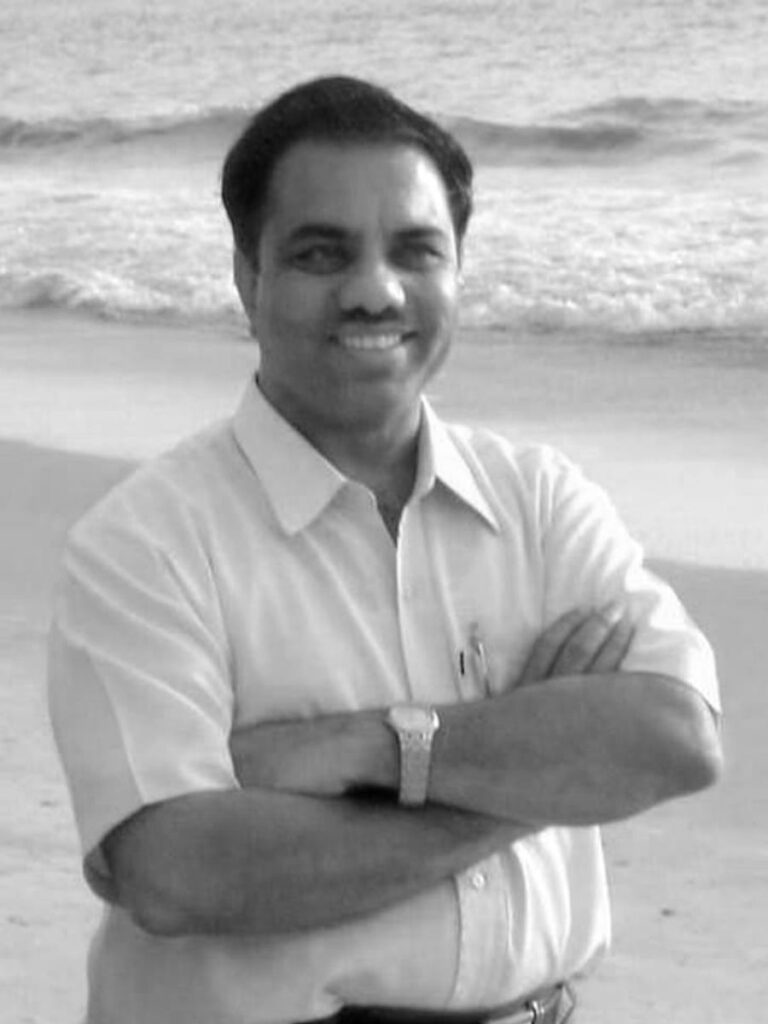
A photograph taken months before his death — set against the Bali sea — shows him serene and composed, modest and unassuming, radiating the particular grace of someone at peace with how they have spent their time. He had been to Bali with his family. He had come home to Sevagram. The following night, he was with his family in warmth and laughter. By morning, he was gone.
Dr. Manu Kothari once wrote that those who cannot live well cannot die well — that a good death is the crowning glory of a good, happy life. When Dr. Reddy’s time came, he was spared the torment of prolonged illness, the indignity of slow decline, the suffering of toxic treatment. He departed as he had lived: without fuss, without burden, with quiet dignity.
His wife Lakshmi, Principal of Kasturba Vidya Mandir, was the steady partner of thirty-six years. Their sons Srikanth — MGIMS 2001, MD in Psychiatry — and Sridhar — MGIMS 2008, MS in Orthopaedics — both married classmates from the same institution: Pooja, MD in Pharmacology, and Sakshi, MD in Radiology. Both couples were formed at the institution their father had given his working life to. After his death, the family relocated to Indore.
He was fifty-nine. It was not enough years. But the years he had were used with such care, and such consistent generosity, that three generations of students mourned him simultaneously. Dr. Anshu, Professor of Pathology, wrote: “You would not have known a gentler soul. You would not have encountered a more meticulous, silent, and hardworking person.”
Three hundred students said something similar, each in their own words, unprompted.
Mentored Students (MD/MS)
Development of immunoassays for diagnosis and monitoring of W.bancrofti infected cases
Immunodiagnostic and Immunoprophylactic evaluation of Brugia malayi filarial antigens
Evaluation of oxidative stress : antioxidant status immunological determinants in different clinical groups of lymphatic filariasis in an endemic area
Isolation, Purification and evaluation of mycobacterium tuberculosis excretory secretory antigens in Diagnosis of Extra-pulmonary tuberculosis
In vivo and in vitro maintenance of Brugia malayi filarial parasites and diagnostic evaluation of its purified antigens
Analysis of blood glucose, lipid profile and other biochemical parameters as risk factors for acute myocardial infarction in a rural population
Lymphatic filarial parasites: studies on morphological features, seroreactivity and enzymes character
Detection and follow up of children with occult filarial infection in an endemic area
Lymphatic filarial parasites: Studies on morphological figures, seroreactivity and enzymes character
Analysis of seroreactivity of filarial endemic population against antigens of different stages of filarial parasites
Production and evaluation of recombinant filarial antigens in Immunodiagnosis of filariasis
Protective Immunity in lymphatic filariasis : Role of B.malayi antigens as protective immunogens
Analysis of different immunological factors across the clinical spectrum of filariasis in an endemic area
Analysis of different immunological factors across the clinical spectrum of filariasis in endemic area
Comparative Evaluation of recombinant Sxp-1 antigen and B.malayi microfilarial antigens in detection and management of Bancroftian filariasis
Generation of Monospecific Polyclonal Antibodies to Recombinant Filarial Antigens Wb Gst and Wbl 2 and Comparative Evaluation of their Diagnostic Utility in Filariasis
Protective Immunity in Lymphatic filariasis : Identification and evaluation of vaccine candidates
Development and Evaluation of rapid formate tests for filariasis using rWbL1 and other recombinant filarial antigens and antibodies raised against them
Identification, characterization and evaluation of recombinant antigens as prophylactic tools in Lymphatic filariasis
A Study for detection of potential antimalarial therapeutics with possible proposition of oxidative rationale
Evaluation of Filarial Recombinant Enzyme Glutathione – S- Transferases (GST) and Ral Family Protein Wbl2 As A Combination Vaccine in Filariasis.
Evaluation of Recombinant Filarial Troponin and Paramyosin as Diagnostic Tools in Lymphatic Filariasis
Evaluation of Immunomodulatory Effect and therapeutic Role of Filarial Antigens on the Development of Type 1 Diabetes.
Assessment of Anti-inflammatory Activity and therapeutic Potential of Filarial Proteins in inflammatory Arthritis Using Rat Model.
Protective immunity in lymphatic filariasis: Identification, characterization and evaluation of recombinant filarial antigens
Anti-inflammatory potential of Cystatin and other novel Filarial derived Immunomodulators
Evaluation of the effect of filarial cystatin and other proteins in attenuating immune activation in experimental colitis
Exploration of a novel therapeutic approach targeting type 1 diabetes using the filarial derived WbL 2 and other immunomodulatory proteins
Study for exploration of effective formulation or lead molecule using herbal Extract and synthetic agents against Brugia malayi by in vitro as well as in vivo model and validation of therapeutic rationale
Study of Biochemical risk factors in Urolithiasis patients of an urban region in Central India
Key Milestones
| 1957 | Born, 1 July, Karivemula, Andhra Pradesh |
| 1980 | MSc, Sri Venkateswara University |
| 1980 | Arrived MGIMS as Junior Research Fellow, November |
| 1980 | Married Lakshmi Reddy, December |
| 1983 | WHO training programme, Harvard University — hybridoma techniques |
| 1987 | PhD in immunodiagnostics, Nagpur University |
| 1989 | Promoted Reader |
| 1996 | Promoted Associate Professor |
| 1999 | Promoted Additional Professor |
| 2000 | Took charge of department on Dr. Harinath’s retirement |
| 2003 | General Secretary, Association of Clinical Biochemists of India — until 2009 |
| 2011 | Maharashtra University of Health Sciences Best Teacher Award |
| 2017 | Died, 9 April, Sevagram — aged fifty-nine |