Dr. Nitin Gangane
Director-Professor & Head of Pathology · Dean · MGIMS Tenure 1987 – 2023 Born 11 June 1961, Kasturba Hospital, Sevagram Education MBBS (MGIMS, Sevagram) [1983]MD Pathology (MGIMS, Sevagram) [1987]
PhD (Umeå University, Sweden) [2009]
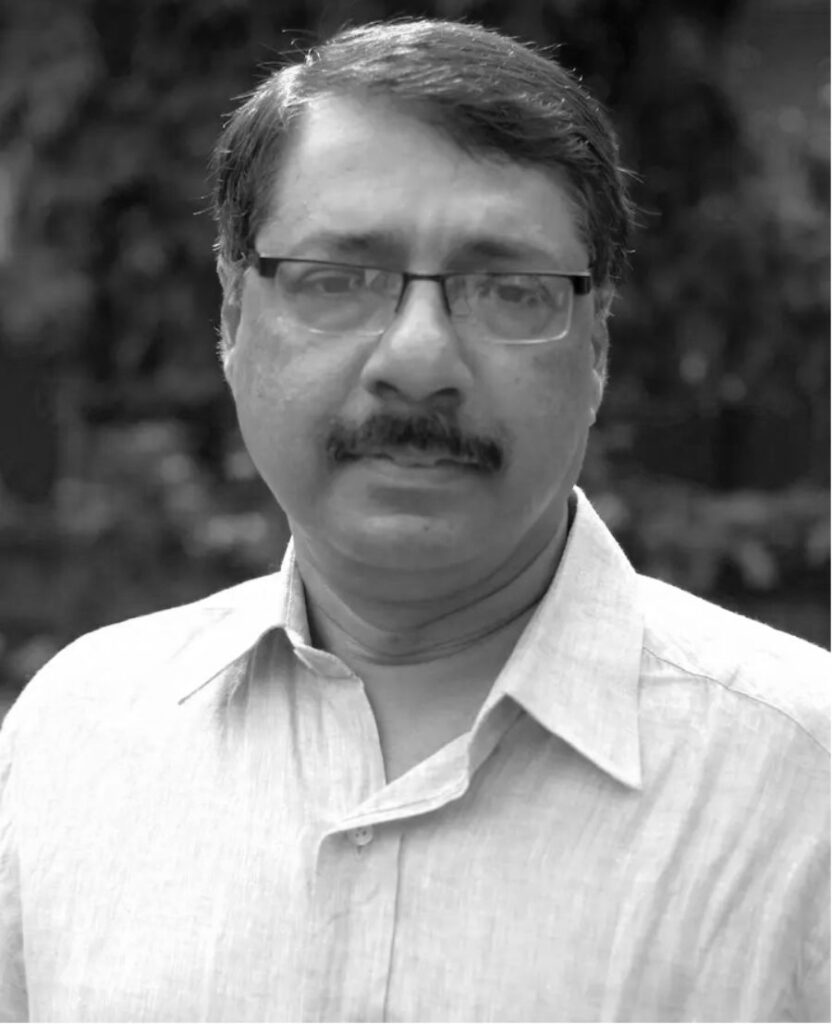
Sixty years after his birth at Kasturba Hospital, he left Sevagram as Vice-Chancellor of KLE Academy of Higher Education and Research in Belagavi — having served along the way as the first MGIMS alumnus to become Dean of the institution, having earned a PhD from Umeå University in Sweden, having published over 180 papers from a rural teaching hospital in a village, and having built the Population-Based Cancer Registry of Wardha district into a nationally recognised public health instrument.
His colleague Dr. Anshu, who worked alongside him for years in the Pathology department, said when he left: “The shock and tears that flowed were genuine.”
The Village, the Emergency, and the Remand Home
Nitin Gangane’s father Mrigrajendra came from Gulbarga, had been a freedom fighter in the Hyderabad Liberation Movement, had gone underground at sixteen to escape persecution under the Nizam, had worked alongside Vinoba Bhave and Baba Amte, and had moved to Sevagram in 1960 inspired by Annasaheb Sahastrabuddhe. His mother Prabha, orphaned young and raised by an aunt in Mumbai, worked in MGIMS’s Medical Records section until her retirement.
The family lived in Sevagram. The boy attended the government school, then Yeshwant High School, then Swavalambi Vidyalaya in Wardha. These were Marathi-medium institutions, rooted in the ordinary life of a small village. What they gave him, alongside his education, was a fearlessness about confronting systems that behaved badly — a quality his father had modelled at sixteen and that Nitin would find repeatedly necessary in his own career.
On June 26, 1976, the first anniversary of Indira Gandhi’s Emergency, he attended a resistance meeting in Wardha with his brother Bipin. Police raided. Nitin and Ashish Wele were arrested. Being minors, they were placed in a remand home under the Juvenile Act, where they remained — completing their schooling by attending college during the day and returning to the facility each night — until October 1977, seven months after the Emergency was revoked and the Janata Party had already taken power. The wheels of justice grind slowly. The experience forged something permanent in him.
The Path to Pathology
He entered MGIMS in 1978 with Roll No. 24, one of the last batches to face essay-style papers on Biology, Physics, Chemistry, and Gandhian thought in the entrance examination. He earned his MBBS in 1983.
After internship, he took house jobs in radiology and anaesthesiology and worked briefly as a research officer on a WHO filariasis project. He believed the house job admission process had been unfair to some classmates and took legal action over it — straining his relationship with the MGIMS administrative officer. When the postgraduate radiology course was not offered that year, he turned to Pathology. The turn was pragmatic. Under Dr. S.M. Sharma’s mentorship, he studied the histomorphology of malignant soft tissue tumours. He earned his MD in Pathology in December 1987 and his DNB two years later.
Promotion was slow in coming. In December 1991, he left MGIMS for Jawaharlal Nehru Medical College, Sawangi, where a newly established institution offered swift advancement. He completed a six-month oncology fellowship at Tata Memorial Hospital under Dr. Anita Borges and Dr. Kikkeri N. Naresh, and built his expertise in cancer pathology.
At JNMC, he uncovered gross irregularities in the examination revaluation process and reported them to the Vice-Chancellor. The friction with administration followed immediately. When MGIMS advertised a professorship in 1996, he applied. Dr. Sushila Nayar intervened to secure his appointment. He returned to his alma mater.
The Department He Led
Dr. Anshu’s assessment of his leadership as a teacher is precise enough to quote directly: “It is very difficult to teach diagnostic reasoning in Pathology, as it is both an art and a science. He is one of the very few teachers who could slowly lead a student from a wrong diagnosis to the right one, step by step, carefully demolishing one differential after another, until the student felt as if she had made the correct diagnosis herself.”
Beyond the seminar room, his pathology reports were models of clinical utility — concise, focused entirely on what the treating physician needed to begin treatment and determine prognosis, nothing more. His questions in teaching sessions were sharp, basic, and logical. He read continuously, regardless of how busy he was. These were not separate qualities but expressions of the same discipline: a mind that had learned to cut to what mattered and stay there.
The second source of respect was his fairness. He treated every person with respect regardless of their position in the hierarchy. He was present in good times and bad. He did not expect everyone to excel; he understood each person’s strengths and worked with those. If someone needed help — a university document, a last-minute recommendation, an introduction to a colleague — it was a phone call away. The department’s teaching and non-teaching staff were always willing to give more than they had to, because he had earned that willingness.
He kept a low profile. He rarely raised his voice. He spoke little. None of this prevented him from being the person everyone confided in, the person whose departure produced genuine shock and tears.
He led the department from 2004 to 2018, acquiring equipment and technology against persistent administrative resistance. He mentored eleven MD theses on cancers in Central India. He served as Principal Investigator on seven research projects and co-investigator on twelve, funded by IARC, UICC, NIH, ICMR, UGC, and DST. The Yamagiwa-Yoshida Memorial International Cancer Study Grant took him to IARC in Lyon and NIDCR/NIH in Bethesda. He served as President of the Maharashtra chapter of the Indian Association of Pathologists and Microbiologists from 2006 to 2009. And from a village in Vidarbha, without the institutional infrastructure available at urban research centres, he published over 180 papers in high-impact journals.
Sweden, the Deanship, and Beyond
In September 2011, Dr. Miguel San Sebastian and Dr. Bhoomikumar Jegannathan from Umeå University visited MGIMS. Their meeting with Nitin sparked an interest in the epidemiology of breast cancer that complemented the regional cancer data he was already assembling. Over the next five years, he made several trips to Sweden. He was awarded his PhD from Umeå University in 2018 — adding European doctoral training to a career built entirely in rural India.
Since 2010, he had led the Population-Based Cancer Registry of Wardha district — a systematic tracking of cancer patterns and trends across a rural population that would otherwise go unrecorded. The registry became a nationally recognised instrument for understanding cancer epidemiology in Central India.
In 2018, he became Dean of MGIMS — the first alumnus of the institution to hold the position. He had been born at Kasturba Hospital. He was now responsible for the institution that hospital anchored.
In 2021, he was appointed Vice-Chancellor of KLE Academy of Higher Education and Research in Belagavi. His PhD, his research record, his deanship, his engagement with MUHS governance, his national and international fellowships — all of it had prepared him for an appointment that was the culmination of a career built with consistent purpose across four decades.
In November 2025, he left KLE to become Executive Director of AIIMS Deoghar in Jharkhand. One does not walk away from a Vice-Chancellorship — a position of comfort and authority — without deliberate intention. Gangane is a man who knows his own mind. Having seen his work through in Belagavi, he chose a new frontier.
He has left Sevagram, even parted with his house there. The village shaped him. He did not need to stay in it to carry what it gave him.
Mentored Students (MD/MS)
Immunophenotyping of primary malignant nodal and extranodal lymphoid neoplasms: a prospective and retrospective study
Utility of cell block technique by microwave processing for rapid diagnosis in fluids and fine needle aspirates
Study of epidemiological factors in oral cancer
Population based cancer registry of Wardha district
Cytohistological discrepancies in carcinoma cervix
Study of epidemiological factors in esophageal cancer
Study of oxidant and antioxidant status in tubercular, reactive and metastatic lymphadenopathy
Association of Epstein Barr Virus (Ebv) infection with Non-Familial Breast Cancer in Women in Central india: An Immunohistochemical and Serological Study
Study of histologic profile of psoriasis
Expression of CD34, PCNA and VEGF in in-situ and invasive squamous cell carcinoma of cervix
Estrogen receptors, progesterone receptors and p53 expression in complex and/or atypical endometrial hyperplasia and endometrial adenocarcinoma
Expression of Her2/neu receptor in epithelial ovarian malignancies.
E-cadherin as a prognostic biomarker in oral squamous cell carcinoma
Role of P53 and her 2 neu as a prognostic biomarker in breast carcinoma
Comparison between automated and manual method of reticulocyte count
Role of p53 and Her-2/neu as a prognostic biomarker in breast carcinoma
Role of Caspase-3 as a prognostic biomarker in breast carcinoma
Role of Caspase-8 as a prognostic biomarker in breast carcinoma
Estrogen receptors, progesterone receptors, and p53 expression in complex and/or atypical endometrial hyperplasia and endometrial adenocarcinoma
To evalaute the diagnostic accuracy of CBNAAT in comparison to FNAC in suspected cases of tubercular lymphadmitis
Key Milestones
| 1961 | Born, 11 June, Kasturba Hospital, Sevagram — delivered by Manimala Chaudhary |
| 1976 | Arrested during Emergency, 26 June — attended resistance meeting in Wardha with brother Bipin |
| 1976 | Placed in remand home under Juvenile Act — completed schooling while under detention |
| 1977 | Released October — seven months after Emergency revoked |
| 1978 | Entered MGIMS — Roll No. 24, Class of 1978 |
| 1983 | Completed MBBS |
| 1987 | Completed MD Pathology, December — joined MGIMS faculty |
| 1989 | Completed DNB |
| 1991 | Left MGIMS for JNMC Sawangi, December |
| 1995 | Oncology fellowship, Tata Memorial Hospital — under Dr. Anita Borges and Dr. Kikkeri N. Naresh |
| 1996 | Returned to MGIMS — Dr. Sushila Nayar intervened to secure appointment |
| 2006 | President, Maharashtra chapter, Indian Association of Pathologists and Microbiologists — until 2009 |
| 2010 | Led Population-Based Cancer Registry of Wardha district |
| 2018 | Awarded PhD, Umeå University, Sweden |
| 2018 | Became Dean of MGIMS — first alumnus to hold the position |
| 2021 | Appointed Vice-Chancellor, KLE Academy of Higher Education and Research, Belagavi |
| 2025 | Left KLE — appointed Executive Director, AIIMS Deoghar, Jharkhand, November |