Dr. Arvind Bhake
Professor of Pathology · MGIMS Tenure 1988 – 2003 Born 12 January 1961, Wardha Education MBBS (Indira Gandhi Government Medical College, Nagpur) [1983]MD Pathology (Indira Gandhi Government Medical College, Nagpur) [1987]
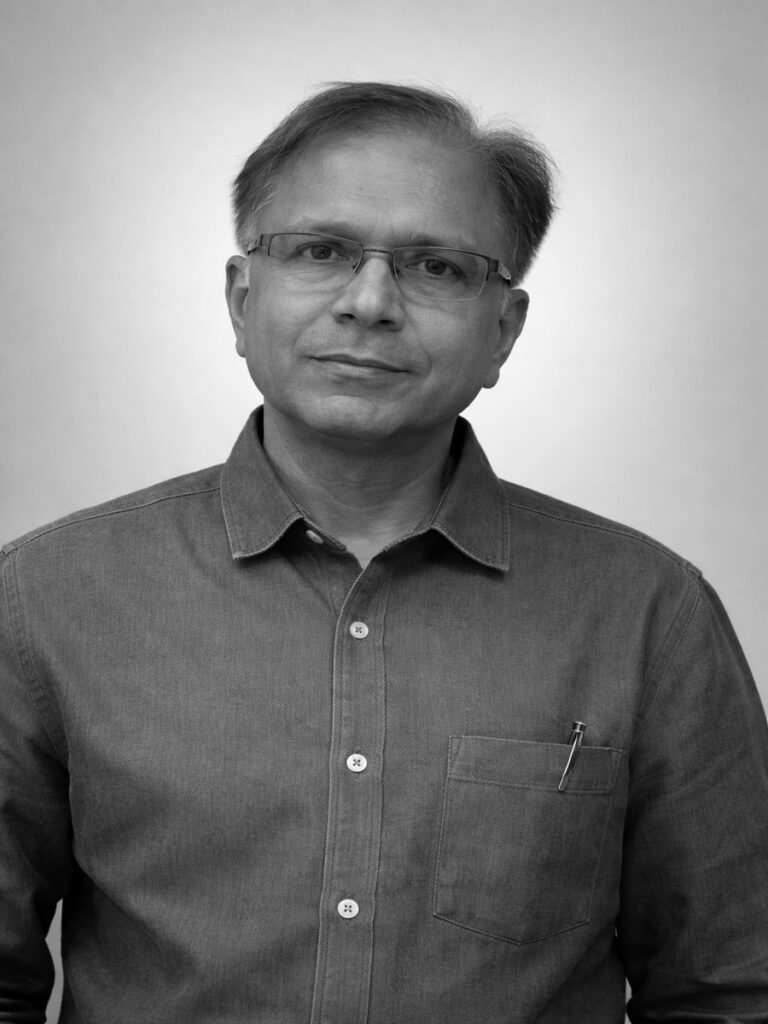
Professor of Pathology · Fourteen Years at Sevagram · The Pathologist Who Wrote About Cells the Way a Naturalist Writes About Birds
Before computers arrived at MGIMS, Dr. Arvind Bhake wrote his cytology reports by hand.
Each one was meticulous — the cell described, its cytoplasm detailed, its nucleus examined, the structure and any deformity rendered in prose that was both scientifically precise and, by the account of those who read it, almost lyrical. Old-timers at MGIMS still recall those reports. They remember them with the particular fondness reserved for things that have been lost — noting, without sentimentality but with genuine regret, that the reports generated today with the speed of a WhatsApp message have shed something that his carried.
He was a pathologist who wrote about cells the way a good naturalist writes about birds: with exactness, yes, but also with an evident pleasure in the thing being described. Cytopathology was, to him, the heartbeat of the discipline — the ability to distinguish health from disease in minutes, from a microscopic glance, which he thought was nothing short of magic. He had chosen pathology after watching anxious surgeons pace outside the laboratory waiting for biopsy reports. It struck him that before a single incision was made, it was the pathologist’s eye that determined the course of treatment. The power to diagnose, to unravel the unseen — this was the thing.
Wardha, a School Skit, and the White Coat
Arvind Bhake was born on January 12, 1961, in Wardha, the youngest of six children in a household shaped by his father Sridhar Madhav Bhake, principal of the local Government College of Education, and his mother Shalini, who managed the family with warmth and quiet efficiency. He passed through Government Practicing School and then the red-bricked corridors of Craddock High School in Wardha, completing his schooling in 1976, followed by two years at Jankidevi Bajaj College of Science.
Medicine announced itself, as it sometimes does, through a school skit. He played a doctor. His classmates called him “Doctor Saheb” afterward, and the name stuck long enough to become a direction. In 1978, he entered Indira Gandhi Government Medical College, Nagpur. He earned his MBBS in 1983, completed internship and house jobs in medicine and surgery, and then chose pathology — drawn there by the logic of the waiting surgeons and the microscope’s revelatory power.
His mentors were Dr. Khedikar and Dr. Anil Pendsey. Dr. Khedikar — a woman of remarkable simplicity — had a quality rare in teachers: the ability to distil the most complex diagnoses into perfect clarity. His MD thesis examined imprint cytology of lymph nodes, taking him deep into microscopic analysis. During that period, he formed an unlikely camaraderie with Mr. Srivastava, the photographer at Retina Studio in Nagpur — one a doctor, the other an artist, both committed to precision.
He earned his MD in Pathology in 1987 and spent a year sharpening his skills in histochemistry, molecular diagnostics, and haematology techniques. In 1988, MGIMS advertised a vacancy.
The Interview and the Department He Joined
MGIMS was not, to Arvind Bhake, merely a job opportunity. It was a place he had heard about since childhood — his brothers had spoken of Dr. Ulhas Jajoo with reverence, and the institution’s reputation as one that rivalled AIIMS, JIPMER, and PGI was part of the family’s understanding of what serious medicine looked like. He arrived for the interview with ambition and genuine respect for the place.
The selection committee was formidable: Dr. Sushila Nayar, Kamala Desikan, Dean K.S. Sachdeva, Dr. K.V. Desikan, Dr. Shobha Grover, and Dr. Narendra Samal. They examined him on histopathology, cytology, haematology, and staining techniques. He was selected.
He joined on a quiet November morning in 1988, entering a department led by Professor Narendra Samal, with Dr. Satish Sharma, Dr. Narayan Ingole, Dr. Kiran Swarup, Dr. Nitin Gangane, and Dr. Subir Mitra as colleagues. Dr. K.V. Desikan held an Emeritus Professorship. It was a department with depth and character, shaped by over a decade and a half of steady institution-building.
Sevagram became his home for fourteen years. He read widely and seriously — Anderson, Robbins, Wintrobe, Williams, Tietz, Walter, Bancroft, DeVita on molecular pathology, Dacie and Lewis, Christopher Fletcher, Ackerman, Allen Gibbs, Armed Forces Institute of Pathology updates. The MGIMS library was his second home. His cytopathology practice deepened. His reports grew in quality and in the particular quality of attention — precise and almost literary — that made them memorable to the clinicians who received them.
One episode captures the range of what pathology demanded in those years. Dr. Samal asked him to introduce coagulation tests in the department. There was no ready source of thromboplastin. He sourced a dead rabbit from the animal farm, worked with the Microbiology department to extract the rabbit’s brain, and obtained the thromboplastin he needed. The prothrombin time and INR tests followed — the department’s first step toward advanced coagulation diagnostics, improvised entirely from available materials. This is what building a department in a rural medical college required: not just knowledge, but the willingness to solve problems with whatever was to hand.
He diagnosed a case of pseudomyxoma peritonei alongside Dr. Kalantri in 1997 — a rare finding, published in Indian Practitioner — one of the small triumphs he remembers with particular pleasure.
Teaching and the Shape of His Work
He mentored MD residents in cytology-based research that advanced the department’s diagnostic capabilities: Rajiv Tangri on fine needle aspiration cytology in focal liver lesions, Nitin Shende on nucleolar organizer regions in breast cytology, Gupta on endoscopic brush cytology in upper gastrointestinal abnormalities, Naresh Gurbani on FNAC in prostate lesions, Ranbeer Singh on FNAC in soft tissue tumours, and Suniti Pathak on endometrial aspiration cytology. The common thread was cytology — the tool he loved — applied across the body’s systems with clinical questions driving each study.
He rose to Reader by 1992 and Professor by 1998. His teaching reflected his own formation: close attention to the specimen, insistence on the pathologist’s eye as the primary instrument, pleasure in the complexity of what cells could reveal. He believed that immortality in medicine lay not in titles or tenure but in publications and shared knowledge — a belief reflected in his consistent research output and editorial work.
The Person Beyond the Laboratory
He is drawn to Marathi drama and classical music with the same genuine engagement he brings to pathology. He played table tennis and football in his younger years, serving as a steadfast centre-back. He sings — Marathi and Hindi songs — and has considered, with the slightly amused self-awareness of someone who knows his own enthusiasms, starting a YouTube channel. He speaks of writing a book on lymph nodes for fellow “lymphomaniacs” — the self-coined term that captures how he feels about his specialty’s corner of the body.
He married Anita Savargaonkar, a physiotherapist from Pune, in 1997. Their son Adhokshaj is pursuing his MD in Medicine at Jawaharlal Nehru Medical College, Sawangi — the institution Arvind joined in November 2003 after fourteen years at MGIMS, where he continues to teach and lead and investigate.
About Sevagram, he says with the wry precision of someone who has earned the right to be both affectionate and funny about a place: “Sevagram will always have a special place in my memory — at least until old age brings some neurodegenerative disease and makes me forget it all.”
The reports he wrote by hand, detailing cells in prose that read like something worth reading, have not been forgotten by those who received them. In the era of automated outputs and rapid turnaround, they are remembered as a different mode of attention — slower, more thorough, more fully inhabited. He was a pathologist who looked carefully and wrote well about what he saw — a combination rarer than it should be, and more valuable than it is usually credited to be.
Mentored Students (MD/MS)
Fine needle aspiration cytology in diagnosis of focal liver lesions
Study of argyrophilic nucleolar organizer regions in breast cytology
Endoscopic brush cytology in diagnosis of upper gastrointestinal tract lesions
Fine needle aspiration cytology in diagnosis of lesions of prostate
Fine needle aspiration cytology in diagnosis of soft tissue tumors
Endometrial aspiration cytology in diagnosis of normal and abnormal endometrium
Key Milestones
| 1961 | Born, 12 January, Wardha |
| 1978 | Entered Indira Gandhi Government Medical College, Nagpur |
| 1983 | Completed MBBS |
| 1987 | Completed MD Pathology — thesis on imprint cytology of lymph nodes |
| 1988 | Joined MGIMS, November |
| 1992 | Promoted Reader in Pathology |
| 1997 | Married Anita Savargaonkar, physiotherapist, Pune |
| 1997 | Diagnosed pseudomyxoma peritonei alongside Dr. Kalantri — published Indian Practitioner |
| 1998 | Promoted Professor of Pathology |
| 2003 | Left MGIMS, November — joined Jawaharlal Nehru Medical College, Sawangi |