Dr. M.L. Sharma
Professor & Head of Pharmacology · Principal · MGIMS Tenure 1970 – 2010 Lifespan 12 July 1929, Barwani, Madhya Pradesh — 10 August 2015, Sevagram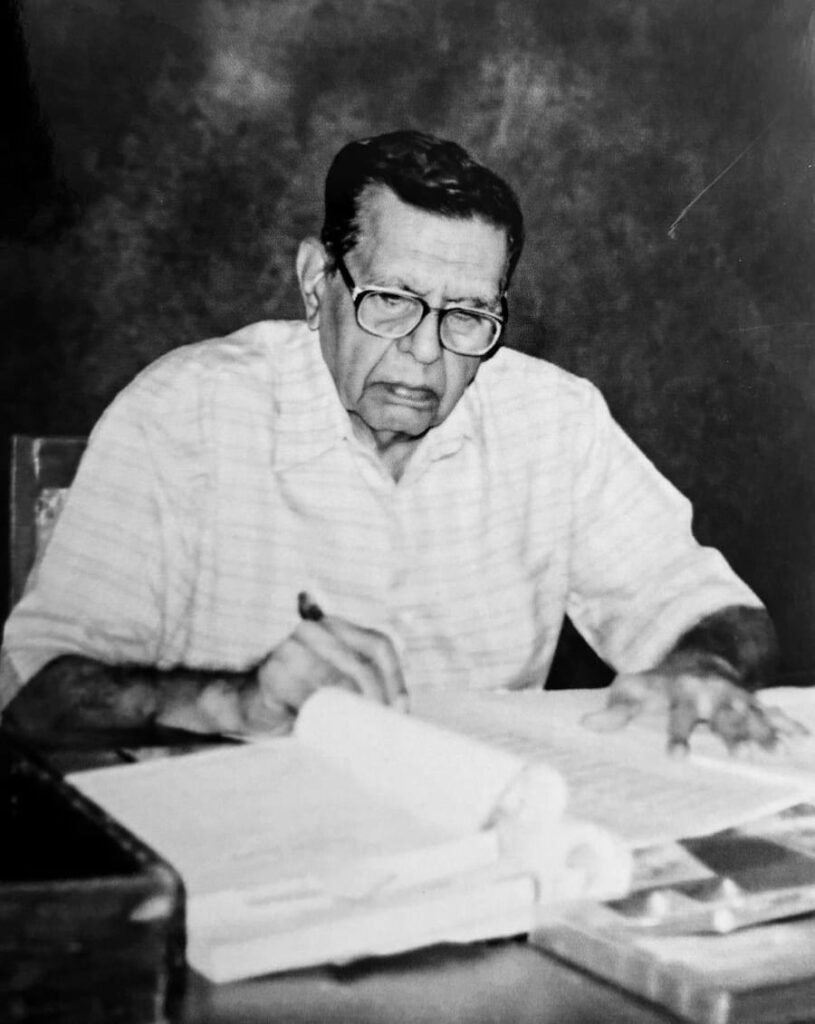
Professor & Head of Pharmacology · Principal · Forty Years at Sevagram · The Man Who Found the Place Where He Belonged
Twenty-five years after teaching their first pharmacology class, the 1970 batch of MGIMS invited Dr. M.L. Sharma to teach them again. He accepted. He was in his late seventies. His scalp hair was meticulously dyed, as it always had been. He stepped into the familiar classroom, now filled with former students and their families — the same people who had sat in those seats as nervous first-years, now doctors themselves, some of them senior enough to have students of their own. It was as if no time had intervened. The applause, as always, was thunderous.
This is a small story, but it contains the essential facts. A man who taught pharmacology at MGIMS for four decades was remembered well enough, and loved enough, that his former students wanted — decades later, with their own children present — to be in his classroom one more time. Not to honour him from a distance, not to give him a plaque, but to sit in the seats and hear him teach again. The invitation was itself a form of tribute: the highest one available, the one that said we want more of what you gave us.
“My class is an orchestra,” he used to say, “and I just make sure everyone plays their part.”
Barwani, Nagpur, and the Discovery of Pharmacology
Mohan Lal Sharma was born on July 12, 1929, in Barwani, a town in Madhya Pradesh on the banks of the Narmada. His father was an Ayurveda physician — a household immersed in the logic of remedies and their relationship to the body’s functioning, an early apprenticeship in thinking about how substances change the human condition. He graduated from Victoria High School in Barwani in 1947, distinguished in Mathematics and Chemistry.
In 1949, India had twenty-eight medical colleges. GMC Nagpur was the only one in central India, and he entered it at a time when Indian medical training was still finding its modern shape. He earned his MBBS in 1954, and it was during these years that Pharmacology asserted its claim on him — the discipline that examined not what was wrong with the body but what could be done about it, the science of mechanism and intervention, of how drugs acted at the cellular level and what they produced at the clinical level. He completed his MD in Pharmacology in 1958 under senior faculty at GMC, learning a discipline that was itself still developing its research identity.
His teaching career began during his postgraduate years and continued through a lectureship and then a Readership at GMC Nagpur. By 1970, he was forty-one years old, experienced, well-regarded, and formed in his understanding of what pharmacology education could be. That year, the Government of Maharashtra deputed him to Sevagram.
He arrived at MGIMS on December 24, 1970 — Christmas Eve — joining a founding group of faculty who were building an institution that was barely twelve months old. Around him were Dr. I.D. Singh in Physiology, Dr. B.V. Deshkar, Dr. K.N. Ingley, Dr. R.V. Agrawal, Dr. B.C. Harinath, and others — a collection of people who had agreed, for various reasons, to trade the established corridors of Nagpur for the dust and ambition of a Gandhian village. His departmental colleague Dr. M.D. Khapre would become the partnership that built Pharmacology at MGIMS. Their immediate task was teaching sixty first-year students — half from Maharashtra, the classroom a mix of Marathi, Hindi, and Punjabi speakers, all encountering medical pharmacology for the first time. Dr. Sharma and Dr. Khapre were the department’s all-rounders: batting, bowling, fielding at every position, no task too small, no undertaking too large.
The Performance of Teaching
Dr. V.K. Gupta, who studied Pharmacology under him, tried to explain what it was like: “He made it stick. It wasn’t just lectures. It was a show — funny, sharp, and always practical. A joke here, a story there, and suddenly, you understood. ‘Forget memorizing,’ he’d say, ‘think practical.’ He believed in showing us, not just telling us. Dogs, frogs — he brought the lab to life.”
He did bring the lab to life. He conducted experiments with dogs and frogs — the standard animal pharmacology of that era — and made the mechanisms visible rather than merely describable. He published research in the British Journal of Pharmacology on adrenaline receptors and in studies involving pigeons — doing genuine science in a rural medical college, contributing to a literature that extended beyond MGIMS’s walls.
His teaching method was deliberate. He understood that fear of a difficult subject was the first obstacle and that humour was not a distraction from learning but a dissolvent of the anxiety that prevented it. “People ask me how I teach,” he said. “Honestly, it’s as much about me learning as about them. You can’t take yourself too seriously. Don’t put yourself on a pedestal. A few jokes, even if they’re on me, loosen things up. Shows them you’re human, not some perfect figure with your own little quirks.”
This was not false modesty. It was a considered pedagogy, applied for four decades without variation. The mock seriousness, the sudden infectious laughter, the shift between gravity and playfulness — these were how he kept sixty students in the same room with a difficult subject and left them understanding it. He held special sessions before examinations not to cover additional material but to address anxiety — to sit with frightened students and rebuild their confidence before the moment of testing.
Holi in Sevagram in the 1970s and 1980s carried a particular meaning: Dr. Sharma’s jokes. He sat cross-legged on the ground while students drenched him in colour and spun stories that had the entire campus roaring. The teacher and the festival merged into a single composite memory that former students still carry decades later — the colours, his voice, the quality of the laughter, which was the laughter of people in the presence of someone who made them feel fully at ease.
The Principal and the Institution Builder
From 1970 to 1974, he served as Vice Principal. From 1974 to 1984, he was Principal — taking over from Dr. I.D. Singh and leading MGIMS through a decade of consolidation, when the institution was moving from its improvised founding energy into a more established shape. He was also Founder Principal of Amravati Medical College. As Principal, his office was a place where grievances were received with humour and empathy. He understood when mischief needed to be checked, when leeway could be extended, when something was better left to resolve itself. He put people at ease without abandoning authority — a combination that is rarer than it sounds and that he exercised without apparent effort across a decade of leadership.
His relationship with Dr. Sushila Nayar was one of deep mutual respect expressed in the daily, physical language of conduct rather than declaration. He never walked beside her — always a step behind, arms folded behind his back, matching her pace with deliberate slowness. An unspoken acknowledgement of her stature, sustained not as ceremony but as genuine feeling, repeated every time they walked together across the campus for decades. She called on him to recite the Sunderkand — the chapter of the Ramayana celebrating Hanuman’s devotion and strength — and he performed all the rituals with the meticulousness of a seasoned Brahmin: the pooja, the havan, the distribution of prasad.
The Life He Chose and the Man He Was
He spent forty years on the MGIMS campus in rented housing. He never purchased a flat, built a bungalow, bought a scooter, owned a car, or boarded a plane. He said this not with the performance of virtue but with a quiet pride in the consistency between his stated values and his actual conduct. “My students are my true wealth,” he said. “I’ve taught generations, and they’re my biggest contribution to the college and to the world. I didn’t practice medicine for money or obligation, but because I loved it.”
He wore simple khadi bush shirts, trousers, and sandals. His hair was carefully dyed — a vanity he never apologised for and which the campus found charming rather than incongruous, the one concession to appearance in an otherwise entirely unadorned life. His eyes were described by those who knew him as the most expressive feature: compassionate, warm, the part of him that communicated before he spoke.
In 2009, he suffered a severe heart attack requiring bypass surgery in Hyderabad. The recovery was difficult. He returned to MGIMS and continued contributing. Then his wife died in 2012. Her loss was the heavier blow. Loneliness came, and health steadily declined. He chose to spend his final years at home in Sevagram, surrounded by what was familiar — the campus, the lanes he had walked for four decades, the institution he had helped build.
He died on August 10, 2015, in his Sevagram home. He is predeceased by his wife and by his son Dinesh, who had been in the MGIMS 1972 batch. He is survived by his son Satish, Professor of Pathology at MGIMS, and grandsons Pavan and Vijay, both MGIMS alumni — the pharmacologist’s family embedded in the institution across three generations.
He had never left Sevagram in any meaningful sense. That was, perhaps, the truest thing that could be said about him: he had found the place where he belonged and stayed in it, completely, for forty years.
Mentored Students (MD/MS)
Mechanism of peristaltic activity its modification by drugs
Effect of some important group of drugs on peristaltic activation in frog stomach, guinea pig ileum, goat ureter
Effect of some important metals, drugs on peristaltic activity in frogs stomach guinea pig ileum, goat ureter
Some of the Pharmacodynamic effects of Calcium channel blockers and Dopamine antagonists
Effect of some anti diarrhoeal drugs on peristaltic activity in frog stomach and guinea pig ileum
Key Milestones
| 1929 | Born, 12 July, Barwani, Madhya Pradesh |
| 1947 | Graduated Victoria High School, Barwani — distinguished in Mathematics and Chemistry |
| 1949 | Entered Government Medical College, Nagpur |
| 1954 | Completed MBBS |
| 1958 | Completed MD Pharmacology, GMC Nagpur |
| 1970 | Arrived MGIMS, 24 December — founding faculty, established Department of Pharmacology |
| 1970 | Vice Principal, MGIMS — until 1974 |
| 1974 | Principal, MGIMS — until 1984 |
| 1974 | Founder Principal, Amravati Medical College |
| 2009 | Severe heart attack — bypass surgery, Hyderabad; returned to MGIMS |
| 2010 | Retired, 31 December — after forty years at MGIMS |
| 2012 | Wife died — the heavier blow |
| 2015 | Died, 10 August, at home in Sevagram |