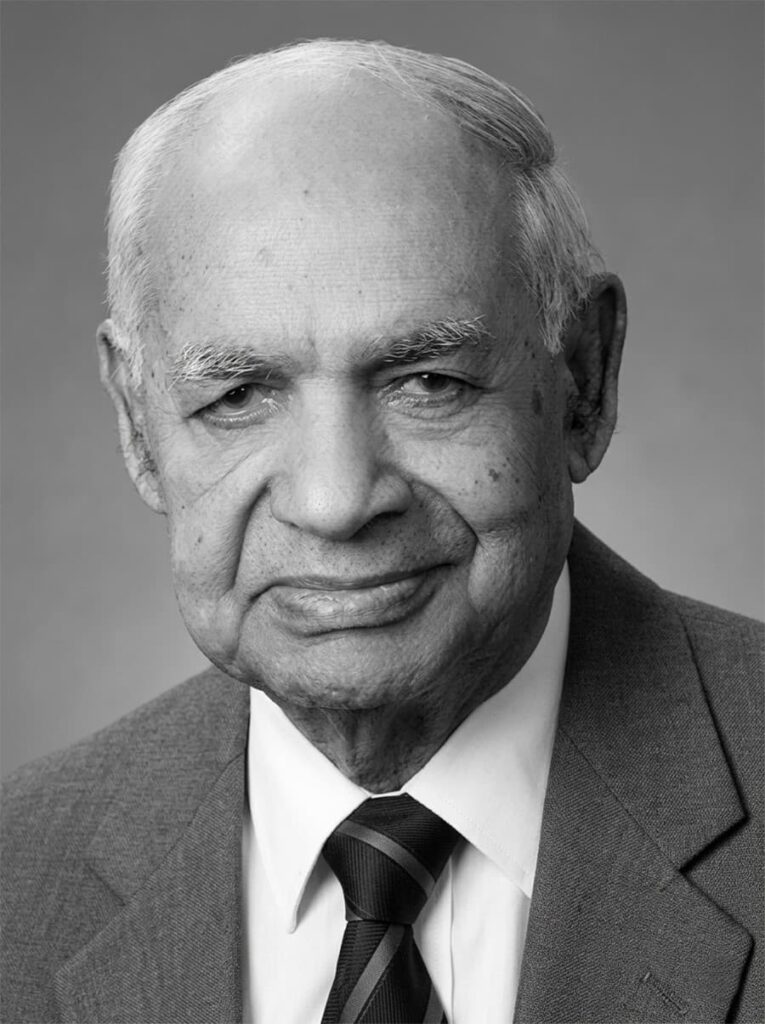
Dr. K.K. Ghuliani
Professor and Head, Community Medicine Tenure 1983–1991 Lifespan 16 September 1926 — 13 March 2015 Education MBBS, Government Medical College Amritsar, Punjab University (1950)MD Preventive and Social Medicine, AIIMS Delhi (1967)
The Scrabble Game
On most evenings in Vivekanand Colony, if you knocked on the Ghulianis’ door at the wrong moment, you would find a Scrabble board mid-game and two people quietly annoyed at the interruption—who would wave you warmly inside anyway.
By day, Dr. K.K. Ghuliani moved through the Department of Community Medicine with the unhurried precision of a man who had spent decades learning that urgency and panic were not the same thing. But in those evenings, he transformed into an animated storyteller and a fierce cricket enthusiast. His laughter, when it finally broke, was rich and entirely unguarded. Mrs. Mohini Ghuliani would place something hot on the table, effortlessly making the guest feel that their intrusion had, in fact, been the point of the evening all along.
This was the Ghuliani the department only saw obliquely. In the classroom and the office, he was someone else entirely: short in stature, invariably dressed in crisp khadi, economical with his words, and possessed of a deep, steady calm that no one dared confuse with weakness.
Mianwali, and the Border Crossed
He was born on September 16, 1926, in Mianwali, in the North-West Punjab that is now Pakistan. When Partition fractured the subcontinent in 1947, it took his geography from him. He crossed the border carrying only what he could hold, eventually securing his MBBS at Punjab University in 1950. At the time, Government Medical College in Amritsar—the single functioning medical college in northern India—was buckling under the overflow of a newly divided nation’s desperate need for doctors.
He joined the Army Medical Corps in 1951, serving as a Regimental Medical Officer through postings in Amritsar, Jubbulpore, Kirkee, and Jhansi. The military forged the architecture of his professional life. It instilled a permanent belief that rigorous preparation was the only reliable shield against chaos; that discipline was not a personality trait, but a clinical tool; and that a doctor who lost his composure under pressure was a doctor of limited use.
He chased the advancing frontier of science throughout his career, studying hygiene, preventive medicine, malariology, and statistical quality control whenever the army permitted, eventually earning his MD in Preventive and Social Medicine from AIIMS in 1967.
By the early 1980s, the Community Medicine department at MGIMS was in a precarious state. Dr. Mohan Gupte had left for Chennai, leaving Dr. S. Nagesh as a solitary lecturer carrying a weight no single academic should bear. A department of that size desperately needed a head. Dr. Ghuliani—recently retired from the Armed Forces Medical College in Pune and fresh from a WHO malaria evaluation team in northeastern India—was available.
He arrived on October 28, 1983, at a salary of Rs. 2,520 a month. He took the helm of the department and made absolutely no fuss about the condition in which he found it.
The Weight of Quiet Authority
The Department of Community Medicine had been built by men of considerable, affectionate noise. Dr. B.K. Mahajan was a classic Punjabi presence—broad, warm, and booming. Lt. Col. Chatterjee commanded rooms with the clipped, polished register of colonial-era military precision. Dr. Mohan Gupte was effortlessly magnetic, accumulating friends simply by existing.
Dr. Ghuliani was none of these things, nor did he try to be. His authority was never a performance. It resided entirely in his absolute consistency. What you saw on his first day was exactly what you saw on his last. His standards did not fluctuate with his mood, and he never raised his voice because he simply never needed to. Students and junior staff calibrated themselves to his quiet frequency quickly. They learned that his silence was not coldness; it was a profound form of respect. He assumed your competence until you proved otherwise, and he withheld both judgment and praise until they had been thoroughly earned.
Under his eight-year watch, his MD students systematically mapped the public health geography of Wardha district. They investigated maternal health, hypertension in business communities, occupational hazards in ginning mills, and trachoma in slums. This was not an eclectic list of academic curiosities; it was a deliberate, utilitarian index of the exact afflictions plaguing Vidarbha, designed to make the department useful to the people rather than just productive for journals.
He spoke Punjabi, Pashto, Urdu, and Hindi fluently. Marathi, however, remained beyond his grasp. He never pretended otherwise. This linguistic gap was the quiet hallmark of his generation—men who had crossed borders they had not chosen to cross, who rebuilt their lives in places that were not quite home, and who dutifully made those places home anyway.
The Letters from Pune
While Dr. Ghuliani anchored the department, Mohini Ghuliani anchored the campus. She played the sitar, she knitted, and she taught flower arrangement to the women of Sevagram with a patience that turned her into a neighborhood institution. Their home became a place of reliable, magnetic warmth—the kind of house people gravitated toward without planning to, and always left much later than they intended.
In July 1991, he handed the department over to Dr. G.V.S. Murthy and moved to Pune to support his daughter through her Paediatrics MD. He worked as a WHO consultant for the National Leprosy Eradication Programme, quietly following the institutional footsteps of Dr. Mohan Gupte once again.
After leaving Sevagram, he never returned to the campus. By his own quiet admission, he was too introverted for the managed emotions of a grand reunion or the self-consciousness of being perceived after a long absence. Instead, he kept his bonds alive in the way introverts often do: through the written word. Long, meticulous letters would arrive in Sevagram, the handwriting as precise as his military training, the sentiments as unguarded and warm as a Friday night Scrabble game.
He died on March 13, 2015, at the age of eighty-eight, survived by his wife.
The MD theses his students produced still sit on the department’s shelves, serving as a patient, quiet record of Wardha’s history. But his true legacy does not exist in institutional files. It lives in the memory of a steady man who stepped into a fractured department, offered eight years of undemonstrative brilliance, and asked for nothing in return except that the work be taken seriously. In Sevagram, that was always enough.
Mentored Students (MD/MS)
A study of child bearing and rearing practice in Anji village of Wardha district
An epidemiological study of trachoma in rural slum area of Wardha district
An epidemiological study of hypertension in business community of Wardha
An epidemiological survey among the employees of ginning mills in Wardha
An epidemiological study of morbidity of female breast in rural community in Wardha dist.
Study of the impact of health educational intervention on knowledge attitude practice of 7th class students regarding nutrition immunization general hygiene
Study of drinking water quality in rural area impact of health practice on the health of consumer
Key Milestones
| 1926 | Born, 16 September, Mianwali, North-West Punjab (now Pakistan) |
| 1947 | Partition — crossed the border with what he could carry |
| 1950 | Completed MBBS, Government Medical College, Amritsar (Punjab University) |
| 1951 | Joined Army Medical Corps — Regimental Medical Officer; postings in Amritsar, Jubbulpore, Kirkee, and Jhansi |
| 1967 | Completed MD Preventive and Social Medicine, AIIMS Delhi |
| 1980s | Retired from Armed Forces Medical College, Pune — WHO team evaluating falciparum malaria control, northeastern India |
| 1983 | Arrived MGIMS, 28 October — took over Community Medicine without fuss; salary ₹2,520 a month |
| 1991 | Handed department to Dr. G.V.S. Murthy, 1 July — moved to Pune to support daughter’s MD in Paediatrics |
| 1991 | WHO consultant, National Leprosy Eradication Programme, Maharashtra |
| 2015 | Died, 13 March, aged eighty-eight — wife Mohini survived him |