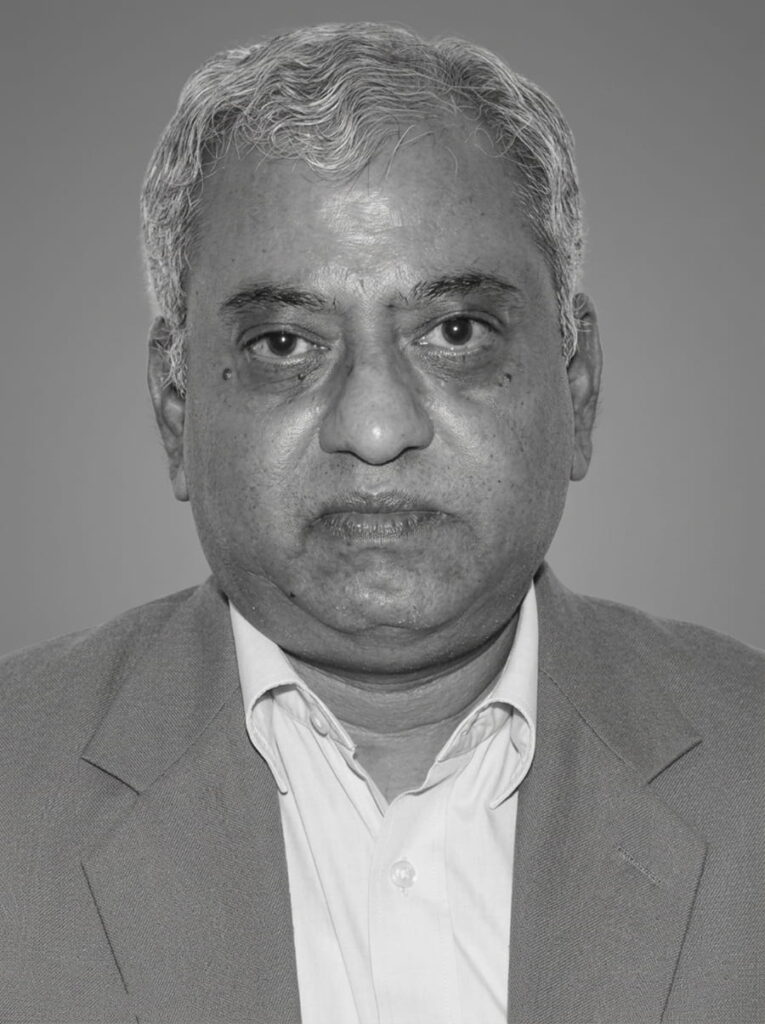
Dr. G.V.S. Murthy
Associate Professor of Community Medicine Tenure 1989–1992 Born 1 January 1956 Education MBBS: Guntur Medical College, Andhra Pradesh (1979)MD Preventive & Social Medicine: All India Institute of Medical Sciences, Delhi (1985)
The Exam He Failed
In his final MBBS examination at Guntur Medical College, a young G.V.S. Murthy sat down for the Preventive and Social Medicine (PSM) paper. He scored 75 out of 200. He failed. Six months later, he reappeared, scored 119, and quietly scraped through. The subject had beaten him once, and then, seemingly, released him.
Two decades later, that same young man was a full professor at the London School of Hygiene and Tropical Medicine. He was one of India’s foremost public health researchers, the man who built the country’s first Community Ophthalmology Department in the public sector, and the architect of a diabetic retinopathy screening program that would eventually safeguard the vision of 25,000 patients in Wardha district alone. The subject he had once failed had become the absolute cornerstone of his life.
An epidemiologist might describe this kind of irony as a confounding variable. Dr. Murthy preferred not to dwell on it. There was always the next project to build.
From Gudlavalleru to Bhutan
His full name—Gudlavalleti Venkateswara Satyanarayana Rao Murthy—carries his village inside it. Gudlavalleru, a town fifty kilometers southeast of Vijayawada, anchors the front of his name, a traditional Telugu marker tying identity permanently to geography. Born on New Year’s Day in 1956, he was schooled in New Delhi before returning south to Guntur Medical College in 1974.
When he graduated with competent, though unexceptional, marks in 1979, he did not follow the familiar, ambitious trajectory of a young Indian doctor. Instead, he went to the mountains of Bhutan. Serving as a Medical Officer at the Chukha Hydroelectric Project from 1981 to 1982, he learned something a classroom cannot teach: how to practice medicine when the supply chain is broken, the infrastructure is minimal, and the textbook answer is simply unavailable.
By the time he completed his MD in Preventive and Social Medicine at AIIMS in 1985—spending his residency moving between tribal villages, urban slums, and rural settlements—he had accumulated a depth of fieldwork rarely seen in purely institutional careers. He had seen the vast, painful gap between what public health promised on paper and what it delivered in practice, and he began to think seriously about how to close it.
The Arrangement That Brought Him
In October 1988, an elegant arrangement was proposed. Murthy’s wife, Vishala, a brilliant microbiologist, wanted to pursue her MD. MGIMS had a vacancy in Microbiology under Dr. P. Narang. Meanwhile, the Community Medicine department needed a researcher. The geometry was perfect: Sevagram would gain a brilliant mind, and the Murthys would gain an academic base.
He arrived on January 2, 1989, taking a Reader position at Rs. 1,200 a month. By December 1990, he was an Associate Professor. By 1991, Vishala had completed her MD thesis on Mycobacterium tuberculosis. The plan had worked precisely as designed.
What had not been part of the design was how deeply Sevagram would embed itself in him.
Epidemiology Made Legible
Short, stocky, with large expressive eyes, Murthy possessed an immediate, magnetic ease in the classroom. He could pivot seamlessly between polished English and fluent Hindi mid-sentence. His true genius lay in his ability to shatter a complex epidemiological concept into its simplest components, reassembling it in front of his students so the logic glowed visibly at every step. Students who had found public health statistics utterly opaque suddenly discovered that, under Murthy’s hands, the subject had a beautiful shape.
Beyond the lecture hall, he became the rare kind of academic that an institution quietly relies on to survive. He could hold a department head’s absolute confidence without ever seeming obsequious, and defend a junior colleague’s interests without appearing confrontational. He understood Sevagram’s Gandhian ethos not as a dusty historical footnote, but as the actual, living framework for practicing medicine. Whether navigating the unpaved village lanes of Anji or the academic corridors of the hospital, he was entirely at home.
The Ophthalmologist Who Came from Public Health
On May 2, 1992, after three and a half years, he resigned. Vishala’s MD was complete, his aging parents in Delhi needed him, and AIIMS had offered him a position at the Dr. R.P. Centre for Ophthalmic Sciences.
It was a narrow door, but it opened into a massive room. Because Murthy arrived at community ophthalmology through the lens of public health, he began asking questions no one else was asking. While India’s eye care system in the 1990s was laser-focused on adult cataracts, Murthy looked at the devastating, unaddressed gap of childhood blindness.
He built India’s first Community Ophthalmology Department in the public sector. He established a model pediatric eye care program that shifted national policy—a model later replicated in Indonesia and Nepal. From 2005 to 2015, as a full professor at the London School of Hygiene and Tropical Medicine (LSHTM), he worked with the WHO in Geneva, advised UNAIDS, and helped build the national monitoring system for India’s HIV/AIDS control program.
Returning to Wardha
His friends in Sevagram had always insisted that when Murthy left in 1992, the departure hadn’t quite taken. He returned too often; he slipped back into old conversations too easily.
They were right. Decades later, a conversation with a former MGIMS colleague evolved into a massive public health intervention targeting diabetic retinopathy—an epidemic quietly blinding rural India. On October 20, 2016, MGIMS launched the Diabetic Care Initiative for Wardha district, funded by the Queen Elizabeth Diamond Jubilee Trust and supported by LSHTM. Mobile screening units drove into communities that had never seen an eye specialist.
Twenty-five years after leaving the campus, the man who had once failed his PSM exam was back in Wardha, serving as the architect of a program that identified 25,000 diabetic patients to safeguard their vision. The subject had claimed him completely.
What Remains
Murthy is still active today, splitting his time between Hyderabad and London, still generating the crucial evidence that health policy in low-income settings requires but rarely receives. His elder son, Anirudha, a dentist with a master’s in social entrepreneurship, works at the intersection of disability and health systems, walking the same territory his father pioneered.
In March 2024, the family suffered the kind of loss that disrupts every accounting of a life. Their younger son, Aashrai, a neurologist practicing in the United States, died young. In his memory, the Gudlavalleti family established the Dr. Aashrai Sai Venkat Gudlavalleti Memorial Award in Neurological Sciences, turning their grief into a lasting mechanism for medical excellence.
Dr. Murthy still carries his village’s name at the front of his own, and it has traveled with him to Geneva, London, Lagos, and Kathmandu. He came to Sevagram for a brief three and a half years, failed to stay, and spent the next thirty years returning. His friends were right all along: he never really left.
Mentored Students (MD/MS)
Effect of supplementary nutrition in malnourished preschool (1-5 yrs) rural children of Dist. Wardha
Evaluation of conjunctival impression cytology in detection of vitamin A deficiency