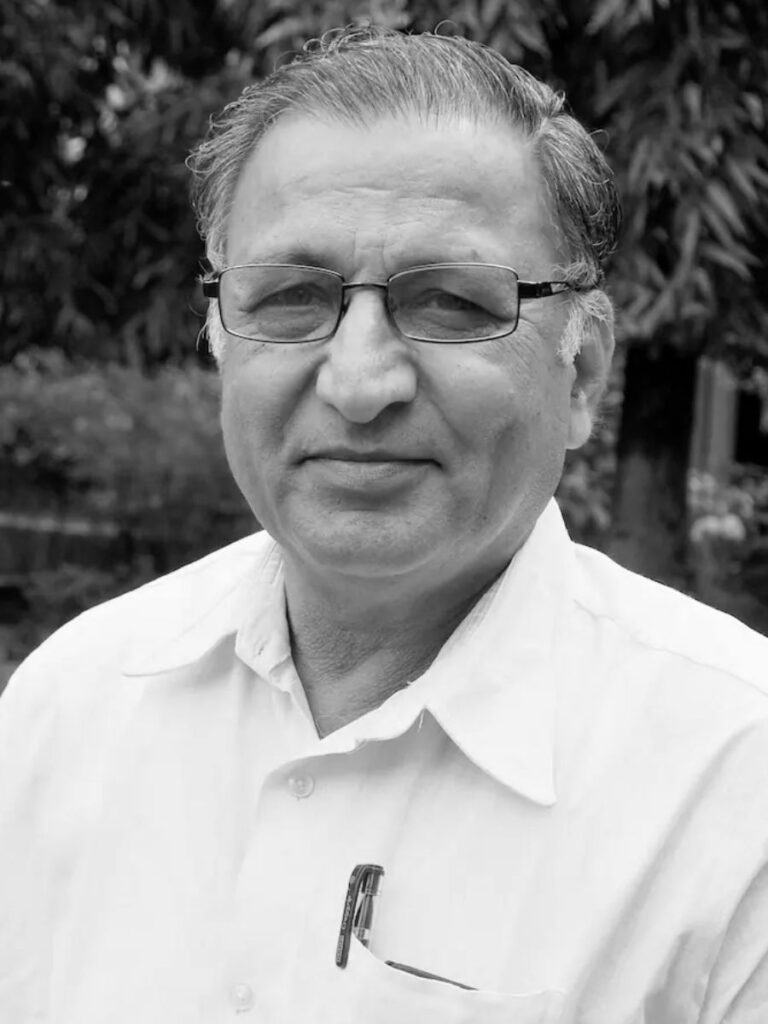
Dr. Ulhas Jajoo
Professor & Head of Department of Medicine Tenure 1977–2026 Born 14 February 1951 Education MBBS, Government Medical College Nagpur (1972)MD General Medicine, GMC Nagpur
The Terrycot Clothes
During his first year at Government Medical College in Nagpur, a seventeen-year-old Ulhas Jajoo was mercilessly ragged for wearing khadi. It was 1968. The fabric was crumpled, the cut was old-fashioned, and teenagers are rarely generous toward anything that marks a classmate as different. He endured the mockery for as long as he could bear it. Finally, defeated, he went to a shop and bought a white shirt and trousers in terrycot—synthetic, unremarkable, perfectly invisible.
He went home and told his father what he had done. His father listened quietly. Then he asked a single question: “How long will you allow fear to guide your path in life?”
Ulhas returned the terrycot clothes. He put the khadi back on. The ragging eventually stopped, as these things usually do. For the next fifty-eight years—through medical college, through his MD, and through a half-century career at MGIMS—he wore khadi every single day. He drove a simple scooter. He wore locally made chappals. He never owned a car. These choices were never a performance; they were simply the outward expression of a man who had decided, at seventeen, exactly who he was going to be.
The Engineer Who Feared Frogs
Born on February 14, 1951, in Wardha, Ulhas was a brilliant student who placed tenth in the state matriculation examination. He was admitted to the Laxminarayan Institute of Technology (LIT) in Nagpur to study mathematics and engineering. He had found his subject. He was ready to begin.
Then, Dr. Ramchandra Wardekar, founder of the Gandhi Memorial Leprosy Foundation and a close family friend, came to visit. When Ulhas mentioned his engineering plans, Wardekar went quiet. He then revealed that his own path into medicine had been entirely shaped by Ulhas’s grandfather, Shrikrishnadas Jajoo. The family possessed a deep history of healing that Ulhas had not inherited. Wardekar gently suggested that he should.
Ulhas confessed he was terrified of frogs and dissections. Wardekar assured him the fear would pass. Trusting the older man, Ulhas withdrew his admission from LIT, spent a year studying earthworms and cockroaches at JB Science College to conquer his squeamishness, and entered medical college in 1968. The fear of frogs did, in fact, pass.
He completed his MBBS in 1972 and his MD in general medicine shortly after. He chose internal medicine specifically because it could be practiced without heavy infrastructure, relying on nothing that was unavailable to the poor. Before joining any institution, he spent a month traveling across India to meet doctors who had chosen unconventional paths—Dr. Rajnikant Arole in Jamkhed, Harivallabh Parikh, and Narayan Desai. He needed to understand what a life in rural medicine actually looked like before he committed to it.
On April 26, 1977, he joined MGIMS as a Lecturer in Medicine.
The Four-Page Letter
Within a year of arriving, the twenty-seven-year-old Jajoo wrote a bold, four-page letter to Dr. Sushila Nayar. It outlined a radical vision for village healthcare, developed not in a library, but by riding a rented bicycle through monsoon rains to reach remote communities. Sitting in their homes, he had realized a fundamental truth: a villager’s priority is their daughter’s marriage, bank loans, and subsidized seeds—not their blood pressure.
He proposed a three-tier system: village health workers, a mobile health team, and the hospital. He advocated for community kitchens, people’s courts, and cost-price medication. His central argument was revolutionary for a clinician: charity is insufficient; a community must be actively involved in its own health.
Dr. Nayar recognized something incredibly rare in the young man: a physician with the brilliant diagnostic instincts of a clinician, but the deep systemic convictions of a public health worker. She repeatedly tried to persuade him to take over the Department of Community Medicine. He politely declined. He believed that a strong foundation in curative internal medicine was essential to any credible public health work. He refused to leave the wards. Instead, he did both, holding curative medicine and village outreach in the same hand without ever finding the combination unusual.
The Sherus
He called his medical residents sherus—lions. And he meant it.
He taught at the bedside with the ease of a man for whom the ward, not the seminar room, was the natural location of truth. He physically crouched to the patient’s level. He listened to the pauses in a patient’s history just as closely as the words. He employed Socratic questioning—refusing to hand a student the answer before they had worked through the reasoning themselves. He visibly delighted in being proven wrong by a resident who had looked more carefully than he had.
Between 1984 and 2013, he guided thirty-eight MD students, researching the exact diseases ravaging rural Wardha: heart attacks, strokes, hypertension, and diabetes. His lectures drew students who had no obligation to attend, holding them spellbound for hours.
Year after year, on his February 14th birthday, tributes pour in from across the globe. What is striking about these accounts is what they omit. They rarely dwell on his diagnoses or publications. Instead, they consistently return to his professional ethics, his unbreakable character, and his profound way of simply being present with a suffering person. With Dr. Jajoo, the medicine was always inseparable from the man.
The Postcard and the Microphone
He resisted email for years. He avoided Twitter, Facebook, and WhatsApp. He preferred to write letters by hand on simple postcards. The scooter he rode was not a loud political statement against cars; it was simply what he had always used, and he saw no logical reason to replace it.
He spoke Hindi, Marathi, English, and Marwari, moving between the languages in a crowded room the way one moves between rooms in a beloved house. For more than two decades, he organized the Tapodhan Shree Krishndas Jajoo Smriti Karyakram, an annual gathering honoring unpublicized social service. Standing at the microphone in his white khadi, translating stories for the villagers, he was frequently moved to tears. He never tried to hide them.
The Century-Old House
When his parents entered their late eighties, he moved them into the familiar walls of their century-old family home. Alongside his brother Suhas, a plastic surgeon, he provided total care. Because he had never separated his role as a son from his role as a physician, the care was simultaneously filial and medical.
Having deeply absorbed the writings of Dr. Manu Kothari and Atul Gawande on mortality, he understood that how a person dies is as profound a medical question as any other. He arranged for his father, and later his mother, to die with absolute dignity at home, surrounded by family. They were not rushed to ICUs. They were not subjected to tubes and interventions that would have prolonged their dying rather than their living. As a master physician, he knew exactly what those interventions would entail. He consciously chose otherwise.
Answering the Question
His legacy at MGIMS is deeply embedded. His wife, Kiran, taught school in Wardha, while his daughter, Namita, and son, Sumedh, both studied medicine at MGIMS and now work in the very department where their father spent his life.
On February 28, 2026, shortly after turning seventy-five, Dr. Ulhas Jajoo finally retired.
The students who passed through his unit are now the senior physicians shaping the next generation of Indian medicine. When they look back, they do not remember a specific paper or a complex technique. They remember a man in a crumpled khadi shirt, crouching at a villager’s bedside, listening to the silence after a sentence ended, and asking the exact question that made them look again.
At seventeen, his father asked him how long he would allow fear to guide his path. He returned the terrycot clothes that day. And for the next fifty-eight years, he never stopped answering the question.
Mentored Students (MD/MS)
A Clinico-epidemiological study of hypertension and coronary heart diseases in a rural community around Sevagram Vidarbha
Urine sugar as a tool for diagnosis and control of non insulin dependent diabetes mellitus ( NIDDM)
A clinical evaluation of prognostic factors of anti-tetanus Sclerotherapy in management of adult tetanus
Efficacy of clinical evaluation and role of radiography in the diagnosis of lower respiratory tract diseases
Clinical evaluation utility of fine needle aspiration biopsy as a diagnostic technique
The risk of cardiovascular. complication in patients under going major survey and its correlation with preoperative medical examination
Treadmill testing in asymptomatic subject with abnormal resting electrocardiogram
Correlations of bedside physical signs echocardiography in heart disease
Clinical profile of typhoid fever
An approach to patient of unexplained fever
Efficacy of clinical evaluation and role of chest radiography, ultrasonography in diagnosis and management of pleuritis
Clinical profile of complicated malaria in Kasturba hospital, Sevagram
Bed side prognostic factors in non traumatic adult patients admitted
Organizational aspects of medical intensive care unit at MGIMS Sevagram (an observational study )
Diagnostic approach for the patients of severe anemia in Kasturba Hospital Sevagram
Role of peripheral smear examination as a diagnostic tool, in the hands of medical residents ,in bedside evaluation of severe anemia
Bone – marrow examination in diagnosis of severe anemia
Detection of iron deficiency in cases of severe anemia
Study of indices indicating response to therapy in severe iron deficiency anemia
Evaluation of peripheral smear and culture indices in response to potential vitamin B12 and folic acid therapy in macrocytic anemia
Study of coulter indices in response to oral iron replacement and its comparison with parenteral iron therapy in severe iron deficiency
Evolving Bedside Diagnostic Approach to patients of Acute Onset Intracranial Neurodeficit, Stroke in particular
Study of profile of patients of megaloblastic anemia in rural population of central India
Clinical Profile of Complicated Malaria in Kasturba Hospital Sevagram
Utility of chest x- rays in the bedside diagnosis of acute pulmonary tuberculosis
Efficacy of Bedside Diagnostic Approach in Patients of Acute onset Intracranial Neurodeficit, particularly stroke: A prospective study
Correlation of Elevated ST Segment resolution and relief of Coronary Pain after Streptokinase in ST elevated Maiden Myocardial Infarction as a marker of Morbidity and Mortality
Drug Resistance Pattern in Bacillary and Bacillary (Radiologically diagnosed sputum-negative but culture-positive) Pulmonary Tuberculosis
Revisiting and Evolving Different Criteria to Differentiate between Transudative and Exudative effusions
Risk factor of Chronic Kidney Disease in Central Rural India
Prevalence of Hypertension in a Rural Community of Central india.
Prevalence of Diabetes Mellitus Type 2 in a Rural Population of Central india.
Total cholesterol, Triglycerides, Low density lipoprotein cholesterol and High density lipoprotein cholesterol as risk factor in Coronary Artery Disease in individuals above 60 years of age, in rural community of central India – A case control study
Prevalence of coronary artery disease in individuals above 60 years in rural community of Central India
Diagnostic accuracy of ADA in serous effusions.
Diagnostic accuracy of a drop hydrogen peroxide test to differentiate exudative and transudative pleural effusion
Prevalence of Nephropathy among adults in Central Rural India screened by proteinuria
Prevalence of metabolic syndrome and its risk factors among rural adult population (Age > 35 years) in central India
Key Milestones
| 1951 | Born, 14 February, Wardha — grandfather Shrikrishnadas Jajoo, Gandhian, declined Chief Ministership of CP and Berar |
| 1967 | Placed tenth in state matriculation — Craddock High School, Wardha |
| 1967 | Admitted Laxminarayan Institute of Technology, Nagpur — mathematics |
| 1968 | Withdrew from LIT — Dr. Ramchandra Wardekar redirected him to medicine; entered GMC Nagpur |
| 1968 | Ragged for wearing khadi — bought terrycot clothes; father asked the question; returned them |
| 1972 | Completed MBBS, GMC Nagpur |
| 1976 | Completed MD General Medicine — chose internal medicine for its proximity to the poor |
| 1976 | Travelled India before joining any institution — met Dr. Rajnikant Arole, Harivallabh Parikh, Narayan Desai |
| 1977 | Joined MGIMS, 26 April — Lecturer in Medicine |
| 1978 | Four-page letter to Dr. Sushila Nayar, 16 September — vision for village healthcare; three-tier system proposed |
| 1984 | Began guiding MD students — 38 students over three decades |
| 2003 | Founded Tapodhan Shree Krishndas Jajoo Smriti Karyakram — annual gathering of people in unpublicised service |
| 2026 | Retired, 28 February — 17,840 days after joining; still in khadi, still on the scooter, until the last day |