Dr. Shashi Prabha Ahuja
Reader, Department of Paediatrics · MGIMS Tenure 1973 – 1975 · 1977 – 1981 Born 19 December 1942, Ludhiana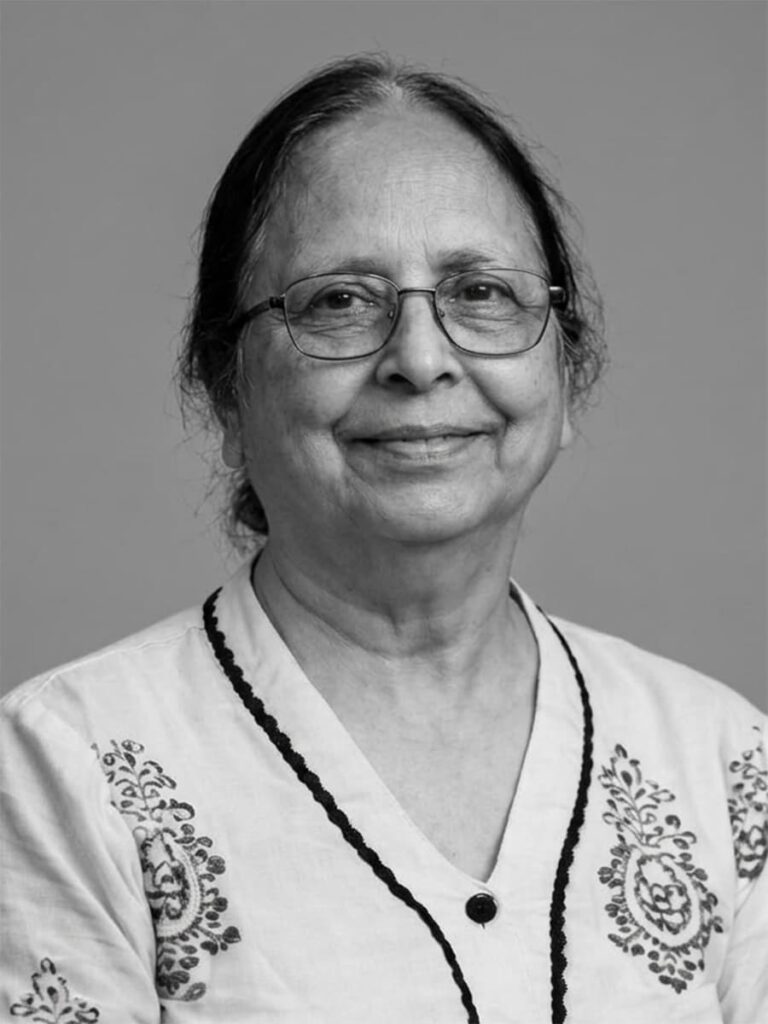
Reader, Department of Paediatrics · Eight Years at Sevagram · The Best Years of Her Life
She did not choose her sons’ names. Manimala Chaudhary — Chhoti Behenji, as she was known across Sevagram — decided them. The boys would be called Nitin and Tushar. There was no debate. In an era when life in Sevagram was built on trust and community, this was not an imposition but a gesture of belonging — an expression of the close-knit bonds that made the campus feel less like an institution than a large, occasionally complicated family.
Dr. Shashi Prabha Ahuja told this story with warmth rather than bemusement, because she understood what it meant. You did not give the naming of your children to someone else unless you trusted them completely, unless the community had absorbed you fully enough that its matriarchs felt entitled to weigh in on the shape of your family. Sevagram had done that to her and her husband within the first years. “We were comfortable in Sevagram,” she said. “Had we not been, we would never have stayed for eight years. We were vegetarians, we wore khadi, and we found profound serenity there. Those were our best years.”
They had come for a year. Eight years passed.
Ludhiana, Rohtak, and the Advertisement in The Hindu
Shashi Prabha Berry was born on December 19, 1942, in Ludhiana, into a household where medicine was the ambient condition. Her father, Dr. Ram Gopal Berry, was an ophthalmic surgeon. The path toward medicine was familiar and naturally taken.
She entered the medical college in Rohtak in 1960 — part of its first MBBS batch, the students who would define what the institution was before it had defined itself. She graduated in 1965. Among her classmates was Dr. Ravinder Narang, who would later become a surgeon at MGIMS. Fate was already arranging the Sevagram connections, though neither of them knew it yet.
She completed her MD in Paediatrics at Maulana Azad Medical College under the mentorship of Dr. P.N. Taneja, then spent three years at Christian Medical College, Ludhiana. A brief three months at CMC Vellore followed, and it was there, in passing, that she encountered a small advertisement in The Hindu: a teaching post at Kasturba Hospital, Sevagram. She applied. The call came. On September 1, 1973, she and her husband arrived in the village that would hold them for the next eight years.
The Department She Found
The Paediatrics department in 1973 was modest in the particular way that everything at MGIMS was modest in those years — not inadequate so much as in the process of becoming. There was no dedicated head; Dr. S.P. Nigam from the Medicine department managed it alongside his other responsibilities. A year after Dr. Ahuja’s arrival, Dr. G.S. Gurumurthy from CMC Vellore joined as department head and patient numbers began to climb.
The region had no alternative. Kasturba Hospital was the only teaching hospital serving rural Vidarbha, and its paediatric ward received babies from villages across a wide radius — infants and children whose families had travelled considerable distances because there was nowhere else to go. When the Civil Hospital in Wardha eventually ceased admitting infants, Sevagram became the region’s sole paediatric referral centre, and the numbers reflected the weight of that responsibility. From 5,000 outpatients and 300 admissions in the early years, the department grew to over 7,000 outpatients and 791 admissions by 1976 — a more than doubling of workload in three years, absorbed by a small team building its structure while simultaneously carrying its clinical burden.
The department organised itself into two units: one led by Dr. Chaturvedi and one by Dr. Ahuja. Together they ran the wards, conducted rural outreach clinics in Deoli and Pulgaon, and led immunisation drives into the surrounding villages — bringing paediatric care to children who would not otherwise have reached it. This was the Gandhian logic of MGIMS made practical: the hospital reaching toward the village rather than waiting for the village to reach the hospital.
Within a year of joining, Dr. Ahuja was promoted to Reader. The promotion recognised what her colleagues and students already understood — that she brought to the paediatric ward a quality that was both clinical and human, a capacity to hold the chaos of sick children and frightened parents with a steadiness that made the ward feel safe.
Iran, Return, and the Invisible Ceiling
In 1975, she left Sevagram on a two-year deputation to Iran, part of a team of Indian doctors addressing a healthcare crisis there. She returned to Sevagram in December 1977, was offered accommodation in Flat 3 of the newly constructed Vivekananda Colony quarters, and resumed her position in a department that had continued to grow in her absence.
By 1979, Paediatrics had thirty beds and twelve nursery beds. Weekly general club meetings, case discussions, and clinical reviews had become routine — the structural signs of a department that had found its shape. The clinical volume was large and the team was small, and the work was serious and unrelenting in the way that paediatric work at an understaffed rural referral centre is always serious and unrelenting.
But the career ceiling was equally real. Dr. Chaturvedi led the department, and the hierarchy offered no path beyond Reader for Dr. Ahuja. The professorship that might have come under other circumstances did not come here. When the MD Paediatrics programme began, no postgraduate student was registered under her guidance — a limitation that went beyond the professional to the pedagogical. What was an academic role if it offered no opportunity to mentor?
This tension had a particular texture. Dr. Ahuja and Dr. Chaturvedi were nearly the same age, both married to faculty members at the institute, both serious clinicians, both women navigating a professional hierarchy in which such positions were rare and the available space limited. Their presence under the same roof created what those who knew them described as an unspoken rivalry — not hostile, but real, running beneath the surface of their daily professional relationship, and pushing both of them toward the excellence that competition sometimes produces. They were not enemies. They were two capable women in a space designed for one, and they both knew it.
What Her Students Said
Dr. Ashok Mehendale, from the MGIMS class of 1976, remembered her with specific precision: “She was petite, loving, and gentle — a perfect paediatrician. The way she handled newborns and young children was remarkable. She brought calm to the chaos of the paediatric ward and taught us with grace and patience.”
Dr. Hariom, from the class of 1974, offered the clearest clinical tribute: “She was a soft-spoken yet sharp clinician. I was once amazed by her keen diagnostic skills when she identified a child’s painful swelling as scurvy — a diagnosis I had completely overlooked.” He added, with the specificity of genuine regret: “Had the Ahujas not left Sevagram, I would have been privileged to be her postgraduate student.”
The scurvy diagnosis is worth pausing on. It was not a dramatic case — no emergency intervention, no high-stakes procedure. It was a child with painful swelling, and Dr. Ahuja recognised what it was when the student in front of her had not. This is clinical teaching at its most essential: the supervisor’s eye seeing what the trainee’s eye cannot yet find, and the gap between them becoming the education.
Three students, three registers of memory: the clinical warmth, the diagnostic sharpness, and the quality of presence. Together they describe a paediatrician who was fully suited to her specialty — gentle enough for the children, precise enough for the diagnoses, present enough for the students to remember her decades later.
The Departure and What Remained
On February 6, 1981, Dr. Ahuja left Sevagram to take charge of the Paediatrics department at B.L. Kapoor Hospital in Ludhiana. She spent the next decade shaping paediatric care there before eventually moving into private practice. Research publications were not her hallmark; she did not leave behind a bibliography. What she left behind was the foundation on which others built — the generations of paediatricians who had learned to handle newborns under her guidance, the outreach clinics that had carried vaccines to Deoli and Pulgaon, the ward culture of calm competence in the face of the constant distress that paediatric medicine presents.
She had come for a year. Chhoti Behenji had named her sons. She had worn khadi and found serenity in a Gandhian village far from Ludhiana, and eight years had passed before she was ready to leave.
The best years, she said. The best years of her life.
Key Milestones
| 1942 | Born, 19 December, Ludhiana — father Dr. Ram Gopal Berry, ophthalmic surgeon |
| 1960 | Entered Medical College, Rohtak — first MBBS batch |
| 1965 | Completed MBBS — classmates included Dr. Ravinder Narang, future surgeon at MGIMS |
| 1965 | Completed MD Paediatrics, Maulana Azad Medical College — under Dr. P.N. Taneja |
| 1970 | Joined Christian Medical College, Ludhiana — until April 1973 |
| 1973 | Saw advertisement in The Hindu at CMC Vellore — applied for teaching post, Sevagram |
| 1973 | Arrived MGIMS, 1 September — with husband; promoted Reader within the year |
| 1975 | Left on two-year deputation to Iran |
| 1977 | Returned to MGIMS, December — Flat 3, Vivekananda Colony |
| 1979 | Department: 30 beds, 12 nursery beds — over 7,000 outpatients annually |
| 1981 | Left MGIMS, 6 February — took charge of Paediatrics, B.L. Kapoor Hospital, Ludhiana |