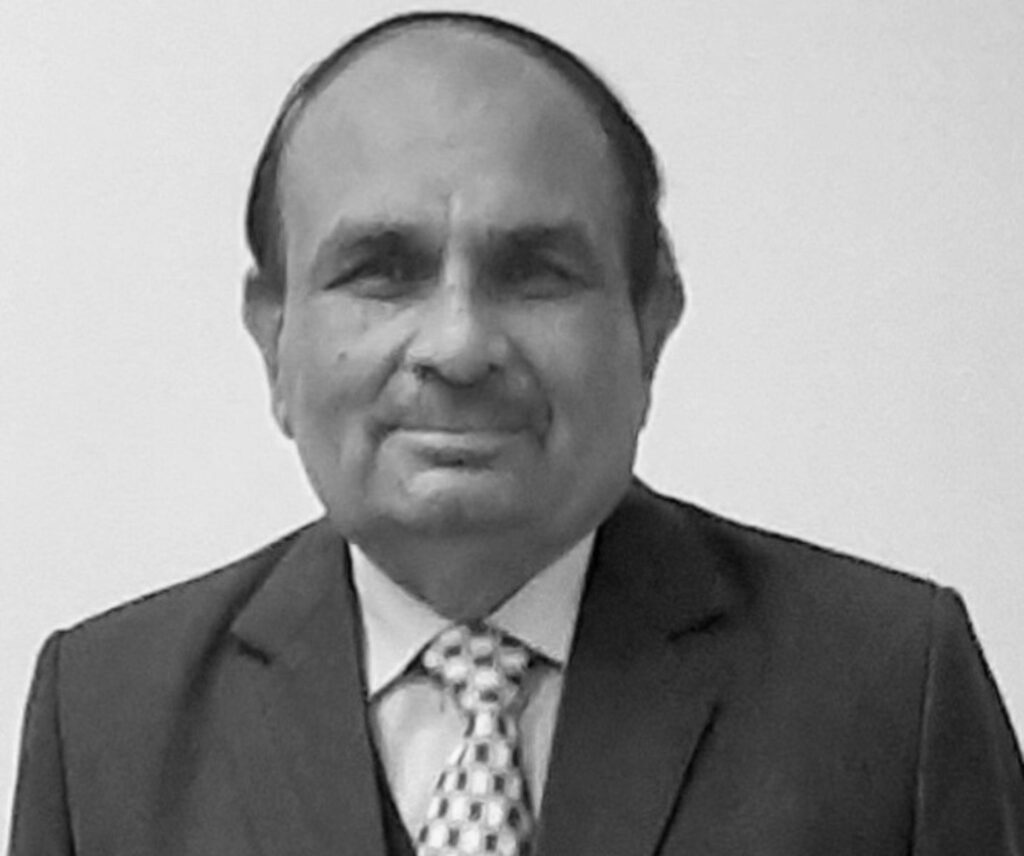
Dr. Anand Prakash Dubey
Reader, Department of Paediatrics Tenure 1980–1985 Born 2 September 1952, Khapariya, Narmadapuram district, Madhya Pradesh Education MBBS: Gandhi Medical College, Bhopal (1975)MD Pediatrics: Gandhi Medical College, Bhopal (1979)
The Choice in the Dean’s Chamber
When Dr. Anand Prakash Dubey entered the Dean’s chamber at Gandhi Medical College, Bhopal, to formally declare his postgraduate specialization, every professor of Medicine in the room had their eyes fixed on him. He had ranked second in his entire MBBS batch. The Medicine department desperately wanted him. He had spent the long walk to that room weighing his options—Medicine, which he genuinely loved, and Paediatrics, which had quietly captured something much deeper inside him.
He chose Paediatrics.
His Medicine mentors were visibly disappointed. The pediatricians quietly celebrated. They had gained, according to the immediate assessment of the room, an absolute gem.
What drew him to children was not complicated to explain. It was the irresistible pull of them—their directness, their inherent trust, and the highly specific quality of caring for patients who could not yet advocate for themselves. He had grown up in Khapariya, a tiny village of barely a hundred families in Madhya Pradesh, where his father, Ram Karan Dubey, was a traditional Ayurvedic practitioner. Long before he possessed the medical vocabulary for it, young Anand understood what it meant to be a small person in desperate need of someone’s competent, gentle attention. Paediatrics gave him the chance to be exactly that person for others.
Khapariya, Bhopal, and the PMT
Born on September 22, 1952, he was educated entirely through Hindi-medium schools—first the village school, then the Government School in Seoni Malwa Tehsil. He absorbed the complex rules of science and mathematics in the language he naturally thought in, rather than the language that carried institutional prestige.
When he reached Motilal Vigyan Mahavidyalaya in Bhopal for his BSc Part 1, a critical question arose: Should he take the Pre-Medical Test (PMT) in English or Hindi? His teacher’s advice was sharp and direct: Your strength is in the science. Master the concepts first. You have time for English later. He listened.
In the very first sitting of Madhya Pradesh’s newly introduced PMT—a massive, single examination for six medical colleges serving a state that then included present-day Chhattisgarh—Anand topped the entire Bhopal center and ranked eighth statewide. In his rural tehsil, this was as rare as a tailender scoring a Test century. His photograph was splashed across the local newspaper; his family was overwhelmed.
He entered the 1970 batch at Gandhi Medical College, Bhopal, sweeping medals in every examination. He completed his MD in Paediatrics in April 1979 under the mentorship of Dr. N.R. Bhandari. His thesis on iron status in children, comparing breastfed infants with those on top feeding, gave him his first rigorous encounter with clinical research. Soon after, he arrived in Delhi as a Senior Resident at Kalawati Saran Children’s Hospital.
The Pull of Sevagram
Delhi was only ever meant to be temporary. He was a brilliant young pediatrician without a permanent post, uncertain of what came next. His MBBS classmate, Dr. R.M. Raizada—who would later become Head of Otolaryngology at MGIMS—was already stationed in Sevagram, urgently pushing him to apply for a permanent Lecturer position rather than remain in flux in the capital.
The pull was geographical as much as professional: his maternal uncle lived in Nagpur, and his mother’s family roots were in nearby Chhindwara. A fortnight after Holi in 1980, he finally applied. Confirmation arrived within days. On July 1, 1980, he arrived in Sevagram.
He moved into 5 Guru Nanak Colony with rented furniture, a second-hand Bajaj Super scooter, a Kelvinator refrigerator, and an LPG cylinder. For a young doctor from a village in Madhya Pradesh, Sevagram felt less like a professional compromise than a spiritual homecoming. The stark simplicity of the campus did not unsettle him in the slightest; he felt instantly at home.
The Year He Held It Together
The Paediatrics department he joined consisted of exactly four members: Dr. Pushpa Chaturvedi, Dr. Shashi Prabha Ahuja, Dr. V.R. Deshmukh, and himself. Within months, both senior colleagues were gone—Dr. Ahuja left for Ludhiana in February 1981, and Dr. Chaturvedi departed for Libya in March.
Two young lecturers—Dr. Dubey and Dr. Deshmukh—were suddenly left alone to run the entire pediatric service of a massive regional referral center. They were supported only by two MD registrars: M.J. Khan, the first student to enter the MD program, and Arvind Garg.
For nearly a year, they held the hospital together by sheer force of will. Paediatric wards in that era offered fiercely basic care. Neonatology was still a nascent concept across India; pulse oximeters and mechanical ventilators were entirely unknown, and a dedicated pediatric ICU was non-existent.
In Sevagram’s frequent, torrential rains and snake-ridden nights, the faculty walked to the wards in pitch darkness. They were always first on call, simply because there was no one else to call. The work was brutally demanding, the staffing terrifyingly thin, and the sick children continuously arriving.
Dr. Dubey’s manner through this intense crucible was consistently described by those who worked alongside him: gentle, soft-spoken, and exceptionally mild-mannered. This gentleness was not a weakness—it was the exact quality that made terrified parents trust him and sick children allow him to examine them. For a pediatrician in a rural ward, it was the most essential instrument he possessed.
Departmental Maturity
In March 1982, Dr. Baldev Bhatia arrived from Banaras Hindu University as Reader and Head, finally restoring the department to adequate staffing. Dr. Narayan Bahadur Mathur joined six months later. A year after that, MGIMS students sat for their Paediatrics examination as a standalone subject in their final MBBS for the very first time—a crucial marker of departmental maturity, achieved by men who had spent years building toward it in impossibly difficult conditions.
On January 2, 1985, Dr. Dubey was promoted to Reader. But by December of that year, the department was in transition again, and Dr. Dubey felt the undeniable pull of further academic development that the MGIMS structure could not yet provide. He left with a heart full of nostalgia and profound gratitude.
His memories of Sevagram remained fiercely vivid forty years later: The exhausting Sirpur Kaghaznagar medical camp. The cine club in the anatomy lecture hall. The Madras Hotel, Indian Coffee House, and names of colleagues who became lifelong friends. On August 7, 1985, his elder son Ashwini had been born in his Type 2 Quarters. Sevagram had given him fatherhood as well as medicine.
The National Stage
He joined Maulana Azad Medical College (MAMC) in New Delhi as an Assistant Professor, eventually rising to become Director-Professor of Paediatrics in 2008 and Head of the Department from 2004 to 2014. After retiring from MAMC in 2017, he established the Paediatrics postgraduate program at the ESI Model Hospital in Delhi.
His contributions to national pediatric policy were monumental. He advised the DCGI on critical COVID-19 vaccination decisions, served as Executive Editor of Indian Paediatrics, and provided vital guidance to the National Technical Advisory Group on Immunisation (NTAGI) and the WHO.
The boy from Khapariya—who had topped the Hindi-medium PMT, chosen children over prestige in the Dean’s chamber, and held a rural department together through the snake-ridden Sevagram dark—had become one of the most consequential voices in Indian child health policy.
The trajectory was never accidental. It was the sheer accumulation of specific qualities applied consistently over a lifetime. Back in Bhopal, Dr. Bhandari had told his brilliant young student: Your brilliance deserves a larger stage. Dr. Dubey had gone to Delhi, then to Sevagram, then back to Delhi, and finally to the national bodies where health policy for millions of children was shaped. The stage had, indeed, been large enough.
Key Milestones
| 1952 | Born, 22 September, Khapariya, Narmadapuram district, Madhya Pradesh |
| 1970 | Topped Bhopal PMT centre — ranked 8th statewide; entered Gandhi Medical College, Bhopal |
| 1975 | Completed MBBS — medals in each examination; ranked second in batch |
| 1979 | Completed MD Paediatrics, April — under Dr. N.R. Bhandari; thesis on iron status in infants |
| 1979 | Senior Resident, Kalawati Saran Children’s Hospital, Lady Hardinge Medical College, Delhi |
| 1980 | Arrived MGIMS, 1 July — 5 Guru Nanak Colony |
| 1981 | Dr. Ahuja and Dr. Chaturvedi departed — held Paediatrics department with Dr. Deshmukh and two MD registrars |
| 1982 | Dr. Baldev Bhatia arrived from BHU as Reader — department restored to adequate staffing |
| 1984 | MGIMS students sat Paediatrics as standalone final MBBS subject for first time |
| 1985 | Promoted Reader, 2 January |
| 1985 | Elder son Ashwini born, 7 August — at 5 Type 2 Quarters, Sevagram |
| 1985 | Left MGIMS, December |
| 1986 | Joined Maulana Azad Medical College, New Delhi — Assistant Professor |
| 2004 | Head of Paediatrics, MAMC — until 2014 |
| 2008 | Director-Professor, MAMC |
| 2017 | Retired from MAMC — joined PGIMSR ESI Model Hospital, Basaidarapur, Delhi |
| 2018 | Established Paediatrics postgraduate programme at PGIMSR — served until 2022 |