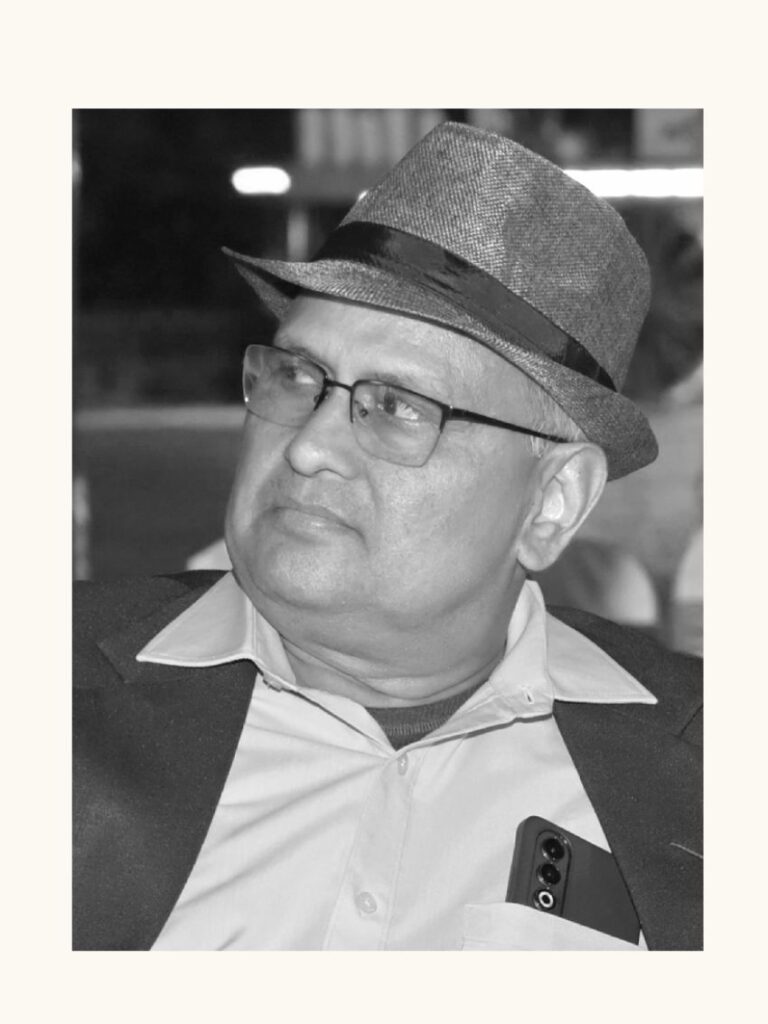
Dr. Mukesh Agrawal
Reader, Department of Paediatrics · MGIMS Tenure 1985 – 1991 Born 2 February 1959 Education MBBS. (Gandhi Medical College, Bhopal, 1981)MD Paediatrics. (Gandhi Medical College, Bhopal, 1985)
Five candidates from Bhopal had arrived in Sevagram for faculty interviews. None of them owned a single piece of khadi clothing. Under Dr. Sushila Nayar’s strict regime, wearing khadi on campus was a non-negotiable requirement, particularly for a job interview. As panic rapidly spread among the applicants, a kind soul in Sevagram quietly produced a single khadi shirt. What followed was a highly coordinated relay race: one candidate put on the shirt, walked into the interview room with an expression of appropriate Gandhian gravity, walked out, and immediately passed the garment to the next man. Five men, one piece of fabric, and the exact same practiced expression of propriety repeated five times in succession. If the shirt had a voice, the candidates later agreed, it would have laughed out loud.
This story has been told and retold by the Bhopal cohort who came to Sevagram in the mid-1980s, always with the particular fondness of people who survived something mildly absurd together. Dr. Mukesh Agrawal was one of those relay runners. He got the position. He stayed for five and a half years.
He helped build a functioning pediatric department from modest foundations, published fifteen research papers, and eventually left for Mumbai. There, he rose to become Professor and Head of Paediatrics at KEM Hospital—one of India’s most prestigious teaching institutions—and published a textbook of pediatrics that is now in its third edition.
But the borrowed khadi shirt was the beginning.
Sehore, Lantern Light, and the PMT
Mukesh Agrawal was born on February 2, 1959, in Sehore, Madhya Pradesh. The eldest of three children, his father was a primary school teacher who was frequently transferred across the rural tehsils. The family moved with the postings through Shikarpur, Bhatkhedi, and Ichhawar.
In these small villages, Mukesh studied by lantern light in Hindi-medium schools, absorbing the complex rules of science in the language of his thinking rather than the language of professional advancement. These humble conditions produced a highly specific kind of resilience—not the dramatic overcoming of sudden adversity, but the quiet absorption of ordinary difficulty, day after day, until the difficult simply becomes the normal.
He cleared the Madhya Pradesh Pre-Medical Test (PMT) and entered Gandhi Medical College (GMC), Bhopal, in 1976. When asked why he chose medicine, his answer possessed a characteristic directness: it was simply the natural choice for a boy who had studied biology during a time when doctors seemed almost magical to village children. They were the only ones who could give injections; they were the ones who arrived when things were deadly serious.
He earned his MBBS in 1981 with medals and secured a postgraduate residency in Paediatrics under Dr. N.R. Bhandari—the exact same mentor who had guided Dr. A.P. Dubey five years earlier. In Bhopal’s medical culture of the early 1980s, academic research was almost nonexistent. Doctors were entirely absorbed in clinical work and private practice; the idea of writing and publishing papers was practically unknown.
This baseline reality would matter immensely later, when Sevagram changed his relationship to academic medicine entirely.
Kabir Colony and the Night of the Thermos
The 1984 Bhopal gas tragedy had many doctors urgently reconsidering their futures in the city. Meanwhile, the MGIMS Paediatrics department had simultaneous vacancies following the departures of Dr. Dubey and Dr. Mathur. (The running joke among applicants was that the train from Bhopal to Sevagram was always full of job candidates). Dr. Agrawal applied in July 1985 and joined on November 5.
He settled into Kabir Colony with a cohort of unmarried doctors—Raj Shrivastava, S.K.T. Jain from ENT, B.M. Loya from Surgery, and Padmakar Tripathi from Microbiology. They formed an impromptu joint family bound tightly by friendship, extreme frugality, and the communal management of their modest salaries. Meals were shared. Debates were spirited. The question of whether spending an extra rupee for a cup of tea constituted reckless financial extravagance was a recurring philosophical problem.
In May 1986, he married Reena, who arrived from Indore with an MSc in Chemistry, a razor-sharp mind, and an immediate ability to navigate the peculiar demands of Sevagram life.
In 1987, their daughter Paankhi was born. The night of her birth remains one of his most vivid Sevagram memories—not just for the overwhelming joy of fatherhood, but for what Dr. S. Chhabra did. When Reena went into labor, Dr. Chhabra stayed by her side through the entire night, armed only with a thermos of hot tea and an English novel. She flatly refused to leave until the delivery was safely completed the next morning. This was the true quality of the Sevagram community: a senior colleague staying awake the entire night simply because that was what you did for your own.
The Department and Dr. Chaturvedi’s Insistence
When Dr. Agrawal joined, the department was led by Dr. Pushpa Chaturvedi. It was a small, fiercely dedicated team managing a 30-bed ward. The Neonatal Intensive Care Unit (NICU) was a compact cubicle adjacent to the maternity complex, caring for premature neonates with incubators and radiant warmers. Mechanical ventilators were a distant dream; the team compensated with raw clinical skill, resourcefulness, and constant vigilance.
Dr. Chaturvedi’s absolute insistence on research became the defining feature of his academic environment. She quizzed her junior faculty relentlessly: What manuscript are you working on? Have you submitted your paper? How is the data collection going? In Bhopal, Dr. Agrawal had never written a single paper. In Sevagram, under this sustained, inescapable pressure, he discovered he actually had something to say.
In 1990, he published “The Infant’s Cry in Health and Disease” in the National Medical Journal of India (NMJI). Under the editorship of Dr. Samiran Nandi, the journal was offering ₹1,000 per accepted article as a powerful incentive for young researchers. The sum was hardly trivial; it covered a full month’s worth of books and meals. More importantly, the publication was a profound intellectual vindication. He quickly followed it with “Hypnotherapy in Children,” also in NMJI.
By the time he left Sevagram, he had fifteen publications to his name—a rock-solid research foundation built almost entirely under the influence of a department head who simply refused to accept the absence of scholarly output as a normal condition.
The Invisible Ceiling and the Move to Mumbai
Three things prompted his departure in 1991. First, his daughter Paankhi was growing up, and the English-medium schooling options in Sevagram were severely limited. Second, the gravitational pull of Mumbai—a vastly larger professional stage with complex clinical cases and deep institutional resources—was undeniably real. Finally, the promotion structure at MGIMS had created an invisible ceiling: he had reached Reader, but the rank of Professor seemed inaccessible, as the hierarchy above him was occupied and unlikely to shift.
He took the Maharashtra Public Service Commission examination, entering a massive wave of recruitment as Brihanmumbai’s teaching hospitals transitioned to full-time faculty positions. He passed. On May 10, 1991, he left Sevagram. (His successful departure inspired others; Dr. S.K.T. Jain and Naresh Kumar soon followed the exact same route).
What followed was thirty-five staggering years across Mumbai’s premier teaching institutions. He rose to become Professor and Head of Paediatrics at Seth G.S. Medical College and KEM Hospital from 2010 to 2022. He mentored more than seventy postgraduate students, contributed to massive vaccine trials for rotavirus and influenza, and chaired Mumbai’s Adverse Events Following Immunisation committee during the COVID-19 pandemic. His textbook of pediatrics is a standard national reference.
The village boy who had studied by lantern light in Sehore, who had passed the single khadi shirt in the interview relay race, and who had been ordered by a determined department head to start writing manuscripts, had become one of the country’s most significant pediatric educators.
“Those were truly golden days,” he said of his time in Sevagram. He was not talking about Mumbai, with its prestigious legacy institutions and large salaries. The golden days were the evening badminton matches, the sugary tea and pakoras, the communal dinners in Kabir Colony, the cramped NICU, and the one borrowed khadi shirt passed desperately from candidate to candidate.
Key Milestones
| 1959 | Born, 2 February, Sehore, Madhya Pradesh |
| 1976 | Entered Gandhi Medical College, Bhopal — cleared Madhya Pradesh PMT |
| 1981 | Completed MBBS — with medals |
| 1984 | Completed MD Paediatrics under Dr. N.R. Bhandari, GMC Bhopal |
| 1985 | Arrived MGIMS, 5 November — Kabir Colony |
| 1986 | Married Reena, May — MSc Chemistry, Indore |
| 1987 | Daughter Paankhi born — Dr. S. Chhabra stayed the entire night with thermos of tea and a novel |
| 1990 | Published “The Infant’s Cry in Health and Disease” — National Medical Journal of India |
| 1990 | Published “Hypnotherapy in Children” — NMJI |
| 1991 | Left MGIMS, 10 May — Maharashtra Public Service Commission; S.K.T. Jain and Naresh Kumar followed |
| 2010 | Professor and Head of Paediatrics, Seth G.S. Medical College and KEM Hospital — until 2022 |
| 2022 | Retired from KEM — textbook of paediatrics in its third edition |