Dr. Ramakant Nagesh Shetti
Professor of Anaesthesiology · Vice Principal · MGIMS Tenure 1975 – 1984 Lifespan 24 March 1939, Gulbarga — 28 September 2004, Bengaluru Education MBBS, Mahatma Gandhi Medical College Osmania University (1963);MS Anaesthesiology, Amritsar (1968)
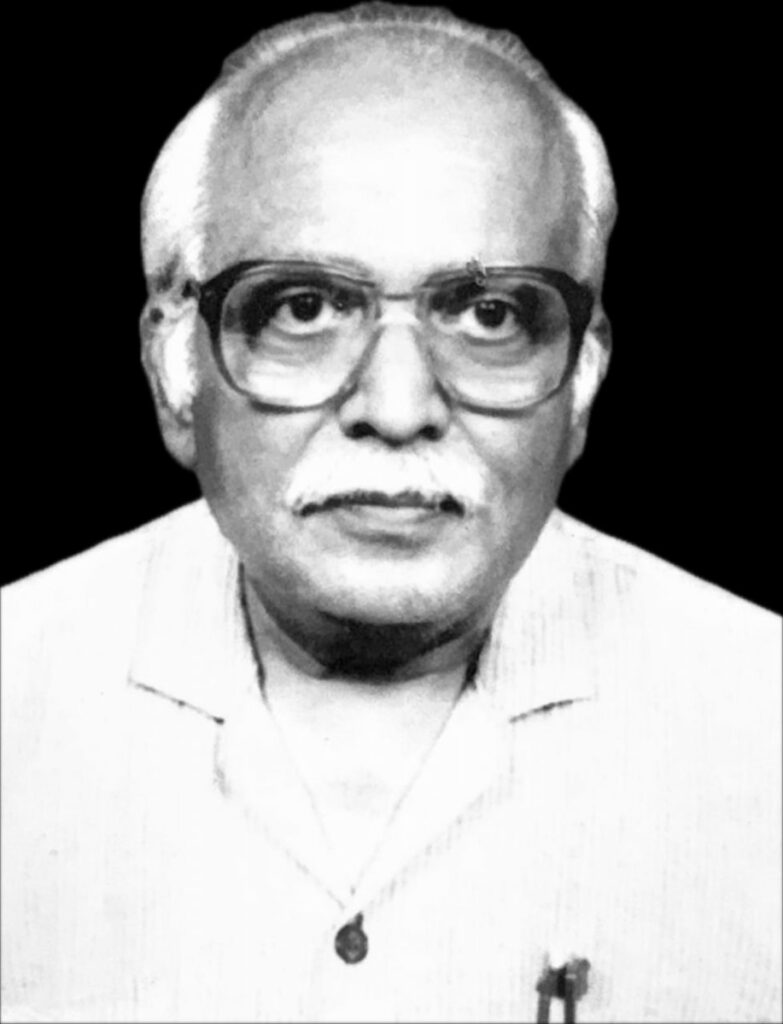
Dr. Ramakant Nagesh Shetti—called Babu by his family and R.N. Shetti by the world—was born on March 24, 1939, in Gulbarga. He was the eldest of ten children born into a household that prioritized education. His father, Dr. Nagesh Subrao Shetti, was a self-made physician of the British era who had walked barefoot out of Ankola as a boy. Mentored by a distant relative and eye surgeon, Dr. Ekanth, the elder Shetti trained in Bijapur and was certified at the Henderson Eye Institute before establishing a practice in Gulbarga.
His mother, Sushilabai, taught mathematics and lived by strict logic. At her husband’s urging, she traveled alone to Hyderabad in the 1940s to complete her degree, leaving her younger children in the care of young Babu and his elder siblings for two years. She eventually retired as the headmistress of the Kanya Government High School. This decision permanently planted in the household the belief that knowledge was the greatest inheritance. It was also a household where Sushilabai could rarely find the cream to make buttermilk; growing up surrounded by the family’s buffaloes, young Babu had a voracious appetite for dairy and usually swooped in to eat the cream first.
Shetti excelled academically, topping the Pre-University Certificate for the Gulbarga district. He completed his XII standard from Bombay University in 1958 and entered Mahatma Gandhi Medical College under Osmania University, graduating with his MBBS in 1963. Anaesthesia—the silent, high-stakes art of keeping life suspended between breath and blade—drew him in completely. He began as a tutor at Osmania General Hospital, followed by stints at Gandhi Hospital and the Cancer Hospital in Hyderabad, before joining the General Hospital in Guntur in 1965. That same year, he earned his Diploma in Anaesthesiology.
He secured a teaching post at H.K.E. Society’s Mahadevappa Rampure Medical College in Gulbarga in 1966. In 1968, he traveled to Amritsar to train under the legendary Dr. Pritam Singh, earning his MS and FICS. His thesis examined chloroform’s effects on the heart rate and blood pressure of dogs. He returned to Gulbarga in 1968, rising to the rank of Associate Professor.
He married Rajani, a devoted homemaker from Ankola. Shetti was her most ardent admirer, encouraging her passion for the arts. She painted for the annual exhibition in Sevagram and learned classical music from Mr. Ambulkar at the Gandhi Ashram. At his insistence, she wrote poetry in Kannada, which was published on the first anniversary of his passing. Together, they raised four children: Namrata, Nagesh, Nivedita, and Nikhilesh. He instilled in them a love for travel; today, they live across different continents, though none pursued medicine.
On February 14, 1975, Dr. Shetti arrived at the Mahatma Gandhi Institute of Medical Sciences (MGIMS) in Sevagram by bus and train. His appointment was Professor of Anaesthesiology at a salary of ₹2,632.20. That year, he was elected a Fellow of the International College of Surgeons. His luggage consisted of two bags: one for clothes, and a massive second bag filled entirely with books and journals.
The Operating Theatre He Commanded
His arrival at the hospital each morning was heralded by the roar of his Vespa scooter. At the first sputter of its engine, orderlies would scramble to mop already gleaming floors to ensure they appeared busy the moment the professor entered. The department was then in its infancy, comprising Dr. A.C. Tikle, Dr. Naphade, and Dr. K.B. Jain. Working with Boyle’s machines and manual BP monitors, Shetti administered cardiac anaesthesia for open mitral valvotomy and pericardiectomy performed by the surgeon and Medical Superintendent, Dr. K.K. Trivedi.
In the theatre, Shetti commanded absolute authority. Pin-drop silence prevailed the moment he entered. Under his strict supervision, he guided the MD postgraduate studies of S.M. Srivastava (bupivacaine and post-spinal headaches), R.K. Tiwari (infection risks from anesthesia equipment), and S.S. Khot (centbucridine). This standard extended beyond the theatre. One Sunday, discovering a duty resident had slipped away to watch the television serial Mahabharata, Shetti drove to the hospital and summoned the doctor back immediately. The rule he enforced—that no doctor leaves a ward unattended without the next shift arriving—is followed to this day.
His dedication was absolute. When a student named Alex suffered a grievous head injury in a road accident, Dr. Shetti cancelled a fully planned family holiday, with tickets already booked. Leaving his lunch table, he rushed to the hospital for the brain surgery. When colleagues coaxed him to continue his vacation, he replied, “Vacations can wait… cities and palaces will not disappear.” He stayed by the student’s side for the forty-eight critical hours that followed.
The Editor, the Vice Principal, and the Cooperative
On November 17, 1977, he became Vice Principal of MGIMS, receiving a monthly allowance of ₹150. Collaborating with Dr. M.L. Sharma, he maintained strict academic discipline. From 1982 to 1985, he edited the Indian Journal of Anaesthesiology. Assisted by his resident Dr. Sanjay Khot and stenographer Kuljeet Singh, he meticulously reviewed manuscripts. Each month, they traveled to Nagpur to source paper, oversee printing, and mail copies.
His administrative brilliance was immortalized in the Sevagram landscape. Partnering with three technicians—Kiran Munjewar, Jaipal Yelwatkar, and Mr. Khodke—he successfully negotiated with the Kasturba Health Society to form a residential cooperative for staff. He disarmed resistant clerks to ensure technicians, nurses, and paramedics received plots of land. He acquired a plot for himself but never built on it; years later, he quietly transferred it to Dr. Sushil Verma of Pharmacology.
The Man in Full
Shetti was a polymath, fluent in Kannada, Hindi, Marathi, Telugu, English, and Urdu. He possessed a discerning ear for Hindustani classical music, identifying gharanas and ragas from maestros like Mallikarjun Mansur and Bade Ghulam Ali Khan. He found peace in the voices of Pandit Bhimsen Joshi, Kishori Amonkar, and Jagjit Singh, and adored the ghazals of Mehdi Hassan and Ghulam Ali. He would visit Rhythm House in Bombay just to record his choice of music onto cassettes.
His library spanned Shakespeare and Gandhi to Ayn Rand and Mario Puzo. He followed the news daily across multiple languages and curated the Sevagram cine club, organizing fortnightly screenings in the anatomy lecture hall. He watched The Guns of Navarone eleven times and admired actors like Gregory Peck and Dev Anand.
At home at 13 MLK Colony, he helped his wife in the kitchen and watered the garden. Children were drawn to his ability to make them laugh. He held an intense passion for cricket and shared a vibrant camaraderie playing tennis with Dr. Trivedi. He was an unapologetic foodie, traveling to the Wardha railway station for fresh vadas and favoring the India Coffee House at MGIMS. Frequently reminded by his wife to lose weight, he would set out on long walks from Sevagram to Wardha, or later, a six-kilometer trek from Bambolim to Panjim.
His life mantra was “Work is worship,” and his mornings began with devotion to Guru Raghavendra Swami and Shirdi Sai Baba. From the puja room, he would recite “Om sahana vavatu…” and “Poojyaya Raghavendraya…” before eating his first morsel of food. Influenced by Gandhian philosophy, he wore khadi. He also took a deep interest in Vinoba Bhave’s Gitayee. He treated Vinobaji medically and attempted to establish a society with the Aggarwals of Warud to spread the book’s teachings.
His loyalty to his staff was legendary. He forged a deep bond with Ram Bhau, a technician who called him “Doctor Sahib.” When Shetti underwent complicated kidney stone operations at MGIMS and Osmania Hospital, Ram Bhau traveled with him to attend to his needs. Shetti would reciprocate by visiting the technician’s home to enjoy bondas prepared by Mrs. Ram Bhau. Another silent soul, Chandorkar, worked diligently beside him in the theatre.
On December 15, 1983, at the age of 44, Dr. Shetti left the MGIMS operating theatre for the last time. He moved to Goa Medical College (GMC) as Professor and Head of Anaesthesiology. His student, Dr. Sanjay Khot, followed him to Goa to serve as a senior resident. In Goa’s humid climate, khadi shirts crumpled within an hour, yet Shetti wore them every day.
During his 17-year tenure in Goa, he was appointed Honorary Consultant to the Armed Forces for Goa State, chaired the International Conference of Anesthetists in Amsterdam in 1993, and delivered the Venkat Rao Oration in 1995. He helped form GOMECO, a residential society for GMC doctors, and often opened his home to poor families traveling from afar. When he retired in 2000, receiving the Millennium Achiever Award, his photograph was installed outside the GMC operating theatre.
He then became Dean at D.Y. Patil Medical College in Kolhapur, where his efforts to instill discipline led to a physical assault by class IV employees. Despite a grievous neck injury, he remained undeterred, finishing his career at MVJ Medical College in Bengaluru and acting as a project consultant for hospitals in Margao and Bangalore.
The Diagnosis
In June 2004, he was diagnosed with acute myeloid leukaemia. His haematologist at CMC Vellore, Dr. Mammen Chandy—who helped establish India’s first bone marrow transplantation program at Christian Medical College, Vellore, in 1986—recorded in his case notes that he was “a determined professional… aware of the disease,” who chose to forgo chemotherapy, fully understanding its side effects. Dr. Shetti did not wish to burden his family in the final stage of his illness and decided to face the cancer on his own terms.
Confined to his bed, he spent his final days reading Dan Brown’s The Da Vinci Code and having his children read the Sai Satcharitra to him. He listened to the music of Bhimsen Joshi and Mehdi Hassan. He had once inscribed Robert Frost’s lines in his diary: “The woods are lovely, dark and deep. / But I have promises to keep, / And miles to go before I sleep.” He had kept those promises. He died three months after his diagnosis, at sixty-five. He met the end exactly as he had lived—on his own authority and without flinching.
Mentored Students (MD/MS)
Study of the concentration effect ratio of hyperbaric Bupivacaine in spinal analgesia its relation to postspinal headache
Anesthesia equipment as a source of infection
Evaluation of centbcridine for spinal analgesia: A double blind study
Key Milestones
| 1939 | Born, 24 March, Gulbarga — first of ten children |
| 1963 | Completed MBBS, Mahatma Gandhi Medical College, Osmania University |
| 1965 | Completed Diploma in Anaesthesiology |
| 1968 | Trained under Dr. Pritam Singh, Amritsar — MS and FICS; thesis on chloroform’s cardiac effects in dogs |
| 1975 | Arrived MGIMS, 14 February — Professor of Anaesthesiology; salary ₹2,632.20; one bag contained only books and journals |
| 1977 | Appointed Vice Principal, 17 November |
| 1978 | Established housing cooperative society — negotiated with Manimala Chaudhary; plots for technicians, nurses, clerks, paramedics |
| 1982 | Appointed Editor, Indian Journal of Anaesthesiology — until 1985; monthly trips to Nagpur for printing and dispatch |
| 2004 | Diagnosed with acute myeloid leukaemia, June — declined chemotherapy; died three months later, aged sixty-five |