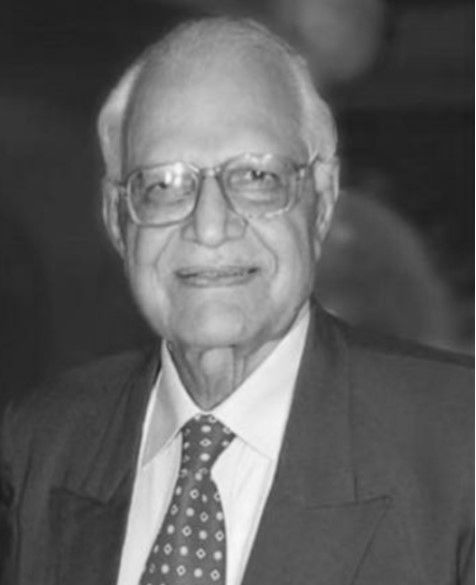
Dr. Raj Kumar
Professor & Head of Surgery · MGIMS Tenure Lifespan 12 December 1930, Gujranwala — 25 June 2019 Education MBBS, Amritsar Medical College (1953)FRCS Edinburgh (1959) · FRCS London (1959)
The Destroyed Examination
In 1947, a young Raj Kumar was diligently preparing for his twelfth-grade Zoology examination in Lahore when the brutal reality of Partition arrived. His family had anticipated the violence and managed to move ahead to Ambala.
Then came a specifically cruel addition to the general catastrophe: his college principal, who had bravely returned to Lahore to collect the students’ examination papers, was killed in the raging riots. The documents were entirely destroyed. Raj Kumar, instead of sitting his examination and moving forward, was forced to retake the entire grueling year.
He did not lose hope. He emerged as a top student, secured admission to the inaugural class of the newly established Amritsar Medical College in 1947, and spent the next decade building a surgical career that would take him across the globe. By the time he arrived in Sevagram in June 1972 to build a surgery department from absolute nothing, he was forty-one years old, possessed a double FRCS, and had already survived far more disruption than most careers encompass in a lifetime.
The story of the Partition examination is told at the beginning because it establishes something essential about his character: this was a man who treated devastating setbacks merely as the next problem to be solved, rather than the end of the road. He would need that exact quality in Sevagram, though for very different reasons.
Gujranwala to Amritsar
Raj Kumar was born on December 12, 1930, in Gujranwala, an hour’s drive from Lahore, where his father served in the British Army. He deliberately dropped his surname—Chopra—as an Arya Samaji practice that he maintained fiercely throughout his entire life.
At Amritsar Medical College, his classmates included Dr. Jagdev Singh Guleria (later a renowned cardiologist) and Dr. Panangipalli Venugopal (the eminent cardiac surgeon). He obtained his MBBS in September 1953. During this period, he played football and aggressively boxed, representing the medical college in state tournaments. That physical confidence and competitiveness would remain highly visible in his clinical manner throughout his career.
He began as a house surgeon in Amritsar in 1954, worked in orthopaedic surgery in Delhi in 1956, and then made the massive leap to England.
A Decade in Britain and the Steel Town
He spent nearly a decade training across the United Kingdom’s finest, most demanding surgical institutions: pediatric surgery at Royal Manchester Children’s Hospital and Great Ormond Street Hospital; thoracic surgery at Brompton Hospital in London and Alder Hey Hospital in Liverpool. He obtained his FRCS from Edinburgh in March 1959 and from London in May 1959, qualifying in both within a staggering two-month window. He had established himself as a consultant surgeon of genuine, undeniable standing.
In 1962, the call of home prevailed. He returned to India as a Pool Officer in Surgery at AIIMS, New Delhi. After another brief stint in London, he caught the attention of Dr. Santokh Singh Anand and joined PGIMER in Chandigarh as an Assistant Professor in 1965. His elite surgical expertise, forged across the hospitals of northern England, was now being actively applied to build India’s premier postgraduate medical center.
In 1968, he made a highly unexpected move. He had successfully treated a sick newborn at PGIMER, deeply impressing the child’s father—who happened to have the power to envision a full hospital for the massive Bhilai Steel Plant in central India. Dr. Raj Kumar helped make that vision a reality. The double FRCS from Edinburgh and London was now administering heavy-duty industrial healthcare to steelworkers in Chhattisgarh. He was nothing if not adaptable.
The Double FRCS Arrives in Sevagram
Dr. Sushila Nayar had been treated by Dr. Raj Kumar at PGIMER. Remembering his brilliant hands, she invited him to Sevagram to build a surgery department from scratch. He came on deputation from the Bhilai Steel Plant—a strategically sensible arrangement that offered both the surgeon and the rural institute a safety net if the match failed.
He arrived on June 1, 1972, with a monthly salary of ₹2,250.
The transition was, by his own frank admission, intensely difficult. Sevagram’s established code of conduct—mandatory khadi, strict vegetarianism, absolute prohibition of alcohol—was utterly foreign to a man shaped by a Punjabi upbringing, British surgical training, and the rough culture of a steel township. The language was unfamiliar. The food was unfamiliar. The fierce Gandhian austerity was a massive, daily adjustment.
What he found in the Surgery department was equally challenging. There was no postgraduate program, no resident doctors, and notoriously high turnover. With 110 beds split between Kasturba Hospital and the Wardha District Hospital, the monthly workload ran to around eight major and sixteen minor surgeries—a microscopic volume by his standards.
He built what he could within these crushing constraints. He conducted theory classes and bedside clinics with the relentless commitment of a man who had trained at Great Ormond Street and believed medical education should look exactly like that.
His examination standards were notoriously high and rigidly consistent. In 1975, only fifteen of twenty-six surgery students managed to pass under his scrutiny. When a student from a highly influential family failed, heavy administrative pressure arrived from above demanding the boy be passed. Dr. Raj Kumar flatly refused. His counter-argument was surgically precise: If this student is to pass, then every other student who failed must also be passed. The administrative pressure instantly dissolved. The fairness held.
The Man in Guru Nanak Colony
In the sun-drenched Sevagram of the early 1970s, he was entirely distinctive. Tall, handsome, with salt-and-pepper hair and expressive eyes behind spectacles, he carried himself with the quiet, unshakeable confidence of someone who had survived Brompton Hospital and was therefore not particularly intimidated by rural administrative friction. An Arya Samaji who shunned idol worship, he nonetheless appeared every Tuesday at the local Hanuman temple to recite the Hanuman Chalisa softly. His devotion was simple and entirely his own.
He and his wife, Anjana—a gifted classical musician from Delhi—lived in Guru Nanak Colony. Anjana ran the cooperative store in Sevagram and taught nursery children with patient attention. Their home constantly echoed with the deep resonance of a tanpura and the voices of their two sons, Shiv and Gautam.
The boys experienced a magical Sevagram childhood, scaling the massive jackfruit tree in their backyard and watching local snake charmers catch cobras with daring ease. Shiv would go on to become a successful laparoscopic surgeon in Delhi, while Gautam completed IIT and IIM to settle in Mumbai. The surgeon’s sons carried the immense discipline their father had modeled, successfully applying it to different fields.
The Breaking Point and the Long Career After
Four years in, the profound cultural tensions between Dr. Raj Kumar’s formation and Sevagram’s strict code became irresolvable. The khadi, the vegetarianism, the prohibition—these things had never truly become comfortable for him. On July 31, 1976, just a few months past his forty-sixth birthday, he resigned.
He returned briefly to Bhilai, secured voluntary retirement from the Steel Plant, and moved to Delhi. At Holy Family Hospital, he served for nearly three decades. It was the long, stable second act of a career that had already included Britain’s finest surgical centers, AIIMS, PGIMER, and the grueling, foundational years of MGIMS.
He died peacefully in his sleep at his Delhi home on June 25, 2019, at the age of eighty-nine. Those who knew him reported that he remained sharp and deeply committed to his values until the very end.
He was the man who had rebuilt his life after the Partition riots destroyed his exams, who had adapted to more institutional cultures than most surgeons encounter in three lifetimes, and who had flatly refused to pass an influential student. His Sevagram years were only four out of eighty-nine, but they were difficult, vital years that produced something incredibly durable: a Surgery department where none had existed, built to standards that a double FRCS considered acceptable.
The jackfruit tree is gone now. The snake charmers have vanished. Anjana’s tanpura fell silent years before the end. But what remains in Sevagram is a functioning surgical department, and the lingering memory of an examination standard that was applied without the slightest regard for who was asking for an exception.
Key Milestones
| 1930 | Born, 12 December, Gujranwala — father served in British Army; dropped surname Chopra as Arya Samaji practice |
| 1947 | Partition — examination papers destroyed in Lahore riots; forced to retake the year |
| 1947 | Admitted to inaugural class, Amritsar Medical College — classmates included Dr. P. Venugopal and Dr. J.S. Guleria |
| 1953 | Completed MBBS, September |
| 1954 | House surgeon, Amritsar |
| 1956 | Orthopaedic surgery, Delhi — then moved to United Kingdom |
| 1956 | Training — Royal Manchester Children’s Hospital, Great Ormond Street, Brompton Hospital London, Alder Hey Liverpool |
| 1959 | FRCS Edinburgh, March · FRCS London, May — both within two months |
| 1962 | Returned India — Pool Officer in Surgery, AIIMS New Delhi |
| 1965 | Assistant Professor, PGIMER Chandigarh — under Dr. Santokh Singh Anand |
| 1968 | Joined Bhilai Steel Plant Hospital, Chhattisgarh |
| 1972 | Arrived MGIMS, 1 June — on deputation from Bhilai Steel Plant; salary ₹2,250 |
| 1975 | Refused to pass influential student who had failed — administrative pressure dissolved |
| 1976 | Resigned, 31 July — returned to Bhilai, then moved to Delhi |
| 1976 | Joined Holy Family Hospital, Delhi — served nearly three decades |
| 2019 | Died peacefully in his sleep, 25 June, Delhi — aged eighty-nine |