Dr. Karunakar Trivedi
Professor & Head of Surgery · Medical Superintendent · MGIMS Tenure 1970 – 1972 · 1977 – 1984 Born 29 April 1938, Wardha Education MBBS, MGM Medical College Indore (1960)MS Surgery, MGM Medical College Indore (1963)
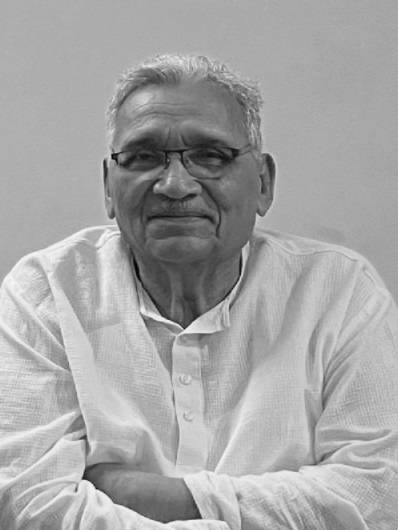
It did. Karunakar Trivedi became a surgeon, a Department Head, a Medical Superintendent, and an elite cardiac surgeon trained in Cleveland and New York. He became a man who performed highly complex mitral valve surgeries in a bare-bones rural teaching hospital in Vidarbha, relying on a nurse named Alice and a technician named Rama Rao Ugale to help hold the operation together.
His mother offered her prayers to the Narmada. The vow was kept.
A Childhood with Giants
The inheritance that shaped him was far more profound than just a nickname.
His father, Kashinath, had met Mahatma Gandhi in 1925, immediately left his teaching career, became the joint editor of Navjivan, and dedicated himself entirely to the Nai Talim (Basic Education) movement in Sevagram. His mother, Kalavati, had faced brutal lathi charges in protest, led fierce agitations against liquor shops, and answered Gandhi’s call for personal satyagraha in Ajmer. She was sentenced to three months in prison—while pregnant with her first child.
The Trivedi family had lived in the Sabarmati and Sevagram ashrams alongside Gandhi, Kasturba, Sardar Patel, Vinoba Bhave, and Jayaprakash Narayan. Kalavati had taken Sanskrit lessons inside the ashram and learned how to ride a bicycle—taught personally by Bapu himself.
Into this extraordinary family, and in this highly specific place, Karunakar was born on April 29, 1938.
Indore, the ECFMG, and the Road to Cleveland
He was educated in Indore and entered MGM Medical College in 1955, completing his MS in Surgery in 1963. During his clinical rotations, cardiothoracic surgery captured his imagination completely: the meticulous craftsmanship required in the operating room, and the terrifying, unforgiving precision demanded by the human heart and its chambers.
He longed for advanced training in the United States. In a time before the internet flattened distances, he relied on instinct and persistence—poring over thick hospital directories, sending applications into the unknown, and preparing for the demanding ECFMG examinations. One acceptance led to another: a surgical residency at Norwalk Hospital, followed by advanced cardiac training at the Lahey Clinic in Boston between 1967 and 1968. Each step widened his horizon and sharpened his craft.
When he returned to India, the country itself seemed to be in the midst of building anew. He joined the newly established medical college in Raipur, but his journey was already being quietly redirected.
A few months earlier, in March 1970, Dr. Sushila Nayar had written to Shri Shyama Charan Shukla, then Chief Minister of Madhya Pradesh, requesting that Dr. Trivedi be deputed to the fledgling medical college in Sevagram. As a Member of Parliament who knew Shukla well, her word carried weight. The request was accepted.
Once she realised that she could use her influence to write directly to chief ministers and senior officials, she began to do so with purpose and regularity. It became one of her most effective ways of building the institution—one letter at a time. Through such interventions, Dr. Prabhat Kumar Acharya was deputed as a dermatologist to MGIMS in July 1972, following a letter from Shri Prakash Chandra Sethi, then Chief Minister of Madhya Pradesh. Years later, in 1978, Dr. H. N. Khattri was similarly deputed from PGI Chandigarh.
And so, in August 1970, he arrived at MGIMS as a Reader in Surgery—among its very first clinical teachers, at a time when even the inaugural batch of students had yet to set foot on campus. The institution was still an idea taking shape; he would help give it form.
The invitation to Sevagram had come after Karunakar visited the campus, walked the empty wards, observed what was there (and what was missing), and confided his deep doubts to Dr. Wardekar. Dr. Wardekar asked a simple, piercing question: “You’re thirty-seven—don’t you want to explore, take on new challenges, and truly live?” By morning, Karunakar and his wife had decided. Sevagram would be their home.
He had married Dr. Mrudula Naik on May 26, 1969. She was a gifted obstetrician. Their fathers had arranged the union, they had worked in the same hospital as interns and registrars, and now they would build their careers in the exact same rural institution—she heading Obstetrics and Gynaecology, he Surgery. A Gandhian family twice over, joined in both marriage and service.
The First Innings: Building and the Abrupt End
Dr. and Mrs. Trivedi were among the very first clinical teachers at MGIMS. Kasturba Hospital was then a deeply modest fifteen-bed facility, run by compounders holding training certificates personally signed by Gandhi.
Dr. Trivedi was promoted to Associate Professor in July 1971. As the hospital began to expand, he took on the additional responsibility of Medical Superintendent and plunged into the demanding task of building a department of surgery from the ground up.
There was nothing to inherit—only space, need, and resolve. He helped set up operating theatres, equipped wards, and trained students who often had to assist in surgeries simply because there were no house officers yet. Learning and service unfolded side by side, each necessity shaping the other.
Beyond the hospital, he led large rural surgical camps where, over a few intense days, more than a hundred procedures were performed. Even now, after more than five decades, those days return to him with striking clarity. He recalls working alongside Dr. Anant Damodar Ranade—an Ayurvedic physician by training, not an ophthalmologist—who performed cataract surgeries in villages around Sevagram. Together, they operated tirelessly, sharing skills, improvising when needed, and responding to an overwhelming burden of untreated disease
Then, completely without warning or consultation, the management appointed Dr. Raj Kumar—an impeccably credentialed double FRCS—as Head of the Department, abruptly replacing him.
There was no discussion. There was no explanation. It was a brutal decision made entirely behind closed doors. It was not that Dr. Raj Kumar was unqualified; he was superbly qualified. What stung was the sheer manner of the act—a dedicated captain replaced mid-series without being told, without even the chance to respond. Dr. Trivedi wrestled with the humiliation for days. In June 1972, with a heavy heart, he left Sevagram and returned to Madhya Pradesh.
America, Again
He returned to thoracic surgery at MGM Medical College in Indore. He successfully performed closed-heart procedures, including mitral valve surgery. But he knew, with the harsh self-assessment of a master craftsman, that he needed more formal training to perform the work at the elite level he demanded of himself.
He was accepted for a highly coveted cardiac surgery residency at St. Vincent Charity Hospital in Cleveland, Ohio, under Dr. Earl B. Kay—a legendary pioneer who had developed the Kay-Suzuki valve prosthesis. He then moved to St. Francis Hospital in New York for pediatric cardiac surgery. When he finally returned to India, he was an entirely different surgeon—not just technically, but in his absolute confidence and clarity of purpose.
The Return and the Second Innings
In 1976, Dr. Sushila Nayar was visiting her niece in Long Island, New York. One quiet evening, reflecting on the past, she asked a question: Would Dr. Trivedi and his wife ever consider returning to Sevagram?
Time had softened the old, bitter wounds. The Emergency had upended lives across India; several Trivedi family members had been imprisoned, and their government positions revoked. The future was terrifyingly uncertain. Dr. Nayar’s offer felt like both an opportunity and a deeply needed homecoming. The Trivedis agreed.
In September 1977, Dr. Trivedi returned to MGIMS as Professor and Head of Surgery, and Medical Superintendent—his simultaneous reinstatement serving as a clear, institutional signal that his initial departure had been a massive mistake. He returned older, and considerably more skilled. Cleveland and New York had armed him with cardiac surgery capabilities at a level that Sevagram had never previously seen.
He rebuilt what needed rebuilding. Equipment was relentlessly procured until the operating theatres could actually support his ambitions. He performed closed mitral valve surgeries, pericardiectomies, and hydatid cyst removals. Alice, the first staff nurse to assist in Sevagram’s cardiac surgery, and Ram Rao Ugale, the OT technician with preternaturally steady hands, became the human infrastructure of something genuinely pioneering.
The Strike, the Effigy, and the Letters
His leadership was soon tested. A resident who had won his postgraduate seat through a bitter court order returned to Sevagram hoping to begin afresh. The hospital management, deeply stung by their legal defeat, spitefully denied him married accommodation and assigned him a room in the boys’ hostel instead. The grievance was undeniably real, and it caught fire.
Residents organized. Demands rapidly accumulated. And then, in an act that shocked many who intimately knew the man, an effigy of Dr. Trivedi—the Medical Superintendent—was burned on campus.
He remained completely calm. He absolutely refused to retaliate. He simply kept the hospital running and ensured the patients were cared for. Weeks passed. Tempers finally cooled. And then, one by one, handwritten letters of profound apology began arriving on his desk—acknowledging his integrity, expressing deep remorse, and recognizing the ugliness of what had been done. The strike ended not in a triumphant crushing of the residents, but in genuine reconciliation. They had found their way back through the sheer clarity of his restraint.
The Final Departure and the Narmada
But leadership always extracts a heavy price. As Medical Superintendent, he had upheld discipline in ways that inevitably created distance. Colleagues who had once shared easy camaraderie became cautious; conversations grew measured.
By early 1984, a new administrative order abruptly downgraded the Medical Superintendent’s position without consultation, eroding the autonomy he had painstakingly built and trusted. His famous candor, once deeply valued by the institution, had begun to discomfort those newly in power. Whispers replaced the respect that had once been genuine.
He requested to be relieved in 1983. The resignation was not accepted. He stayed until he simply could not remain without compromising his own self-respect. On June 15, 1984, wearing simple khadi, he walked away from Sevagram for the last time.
Returning to Indore, he joined a charitable trust hospital and spent the next four decades performing surgeries that far exceeded in number what Sevagram had ever required. He stepped down from administration in 2008 but continues as an honorary consultant to this day, operating three days a week at an age when most surgeons have long since put down the scalpel.
In 1998, Dr. Sushila Nayar appointed him as a trustee of the Kasturba Gandhi National Memorial Trust in Indore. By 2016, he became its Chairperson.
His children flourished globally: Rajshree as a pediatric intensive care specialist in Australia; Anita with a master’s in design building a career at Thomson Reuters; and Apoorv, an IIM graduate managing portfolios in Singapore.
The family that had carried its son through a Gandhian ashram childhood—through nights sitting with Gandhi, Patel, and Vinoba; through his mother’s prison sentence and his father’s dedication to Basic Education—had produced a master surgeon. He performed cardiac operations in a rural teaching hospital, endured displacement, returned in triumph, endured displacement again, and continued operating into his eighties.
His mother had offered her prayers to the Narmada. She had been absolutely right to do so.
Mentored Students (MD/MS)
A clinical study of surgical manifestation of filariasis
A clinical study of post operative wounds
To study the prevalence of surgical diseases in rural population around Sevagram
A Clinicopathological study of the effect of hydrocele on spermatogenesis
Key Milestones
| 1938 | Born, 29 April, Wardha — father Kashinath joint editor of Navjivan; mother Kalavati imprisoned while pregnant with first child |
| 1955 | Entered MGM Medical College, Indore |
| 1963 | Completed MS Surgery |
| 1967 | Surgical residency, Norwalk Hospital, USA |
| 1967 | Advanced cardiac training, Lahey Clinic, Boston — until 1968 |
| 1969 | Married Dr. Mrudula Naik, 26 May — obstetrician; would head OBG at MGIMS |
| 1970 | Joined MGIMS, August — Reader in Surgery; among first clinical teachers |
| 1971 | Promoted Associate Professor, July — Medical Superintendent |
| 1972 | Left MGIMS — replaced as Head of Surgery without consultation; returned to Madhya Pradesh |
| 1973 | Cardiac surgery residency, St. Vincent Charity Hospital, Cleveland — under Dr. Earl B. Kay |
| 1975 | Paediatric cardiac surgery, St. Francis Hospital, New York |
| 1977 | Returned MGIMS, September — Professor and Head of Surgery; Medical Superintendent |
| 1984 | Left MGIMS, 15 June — walked away in khadi after administrative autonomy was eroded |
| 1984 | Joined charitable trust hospital, Indore — four decades of surgery |
| 1998 | Appointed trustee, Kasturba Gandhi National Memorial Trust, Indore — by Dr. Sushila Nayar |
| 2008 | Stepped down from administration — continued as honorary consultant |
| 2016 | Chairperson, Kasturba Gandhi National Memorial Trust |