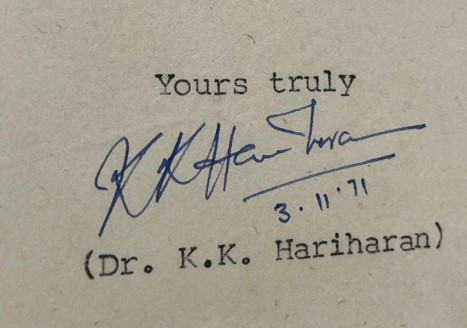
Dr. K.K. Hariharan
Associate Professor of Dental Surgery · MGIMS Tenure 1971 – 1983 Lifespan 10 February 1944, Lahore — 2006, Patiala Education BDS, Grant Medical College Mumbai (1967)MDS Dental Radiology, Grant Medical College Mumbai (1970)
Associate Professor of Dental Surgery · Eleven Years at Sevagram · The Man Under the Tamarind Tree
Lahore, Mumbai, Kerala, and the Homoeopath
Kalapathi Krishnagiri Hariharan was born on February 10, 1944, in Lahore — delivered by a dai rather than a doctor, a detail that remained a core part of how he understood his own roots. When Partition tore the country apart, the family relocated: first to Mumbai, then Kerala, and finally back to Mumbai, where his father R.K. Giri worked for the Life Insurance Corporation. Young Hari wanted to join the Navy; his father flatly refused. He enrolled in dental school instead, earning his BDS from Grant Medical College in 1967 and his MDS in Dental Radiology from the same institution in 1970.
Unconventionally, he began his career not under a senior dentist, but as a junior to Dr. Rohit Mehta, a well-known homoeopathy practitioner in Mumbai — an early, widening encounter with clinical empathy that he would carry effortlessly because it was simply embedded in his nature. He was a Thalayali by heritage, from the Palghat Brahmin community, speaking Thalayalam — a charming amalgamation of Tamil and Malayalam — alongside Hindi, Marathi, and English, switching between them with the fluency of someone for whom adaptation had become instinct.
He came to Sevagram in October 1971 not because he was chasing a grand Gandhian dream, but because he simply needed a steady job. He packed his bags without much fuss.
Claiming Patients Off the Bus
Under the old tamarind tree, on slow, heavy afternoons when the bus had not yet come, the young doctors gathered. Dr. Narang, Dr. Dhawan, Dr. Ahuja, and Hariharan would sit for hours — half in easy conversation, half in patient watchfulness — studying the new arrivals as the State Transport bus finally groaned into the campus. A man stepping down with a walking stick meant a patient for Dr. Ahuja. A hand pressed to a swollen cheek, a sudden grimace of toothache? There was no question. That was Hariharan’s man, already destined for the old, rickety dental chair.
He had arrived on that same bus in October 1971 with a sharp gaze, restless energy, and a wide, disarming smile that would become his signature across twelve years. He adapted fast — moved into the college quarters, made friends over endless cups of tea, got the bare-bones dental OPD running, and became the local expert not just at painless extractions, but at putting terrified patients at ease with the exact same quick wit he used on his colleagues.
The One-Man Department
The dental department he arrived at was a department in name only — a creaky chair, a few battered tools, and a waiting room of rural patients who understood dental treatment purely as brute extraction. No wards. No X-ray machine. Though he had specialised in dental radiology, he was forced to work by touch, sight, and raw instinct. He got the OPD running and slowly grew the patient numbers. In a region where roadside tooth-pullers were the standard norm, he became the trusted, educated alternative — the monumental difference between having a tooth blindly yanked and having it treated by a man who understood the anatomy of the jaw.
On November 7, 1973, he married Chella Iyer, a brilliant young gynaecologist from Mumbai. By 1974, he had risen to Reader in Dental Surgery. Research and publications were never where his heart lay — in nearly a decade, he co-authored exactly one case report, and he offered no apologies. His real domain was people: the conversations, the friendships, the small everyday theatre of human life that he inhabited with the full, crackling energy of someone who found other people genuinely fascinating. He was at the absolute centre of faculty theatrical productions, card games, and casual gatherings. He was the man around whom things instantly became livelier.
He could sit across the card table from the formidable Badi Behenji, cracking jokes that made her laugh freely and forget her legendary sternness. He was brilliant, difficult, generous, and entirely consuming — hated and loved in equal measure, the two faces coexisting in the exact same person, sometimes within the exact same afternoon.
The Departure and the Global Canvas
On March 28, 1983, he packed up the life he had built in Sevagram and left it for good. He joined Malad Suchak Hospital in Bombay, then came West Africa — six years that his daughter Anuradha would later call the best years of her life. At West End Hospital, he built a stellar reputation quickly, earning wide respect in the medical community. Africa finally gave him a canvas large enough for the many talents that Sevagram’s scale had not fully required. After West Africa, he spent years in Riyadh, adapting with characteristic quickness to a radically different healthcare system.
He returned to India in 1992, briefly returning to MGIMS in the hope that his daughter might secure admission under the faculty quota. When that did not materialise, he joined Sharad Pawar Dental College as Professor of Oral Medicine and Radiology. Students admired his diagnostic precision and spoke in hushed, terrified tones of his famous temper. He cycled through Solan, Akola, and Amravati before finally settling in Patiala.
The Dimming and the End
Somewhere along the way, alcohol took hold. The sharp-witted, quick-footed man who had filled rooms with effortless laughter began to fade. By his sixties, he had become a shadow of the man the Sevagram years had known. In 2006, at sixty-two, a massive heart attack struck him down in Patiala.
He had loved dogs and cats with fierce, unapologetic tenderness — a love he passed to his daughters that continues to shape their lives today. His daughter Manisha wrote: “I have never met anyone in my life with so much talent and passion.” Sevagram had been a sanctuary — the place where, for a while, his spirit could soar before the heavy burdens of life drew him back down to earth.
He had arrived on a State Transport bus in October 1971 with a sharp gaze, restless energy, and a wide smile that became his signature. The man who could make Badi Behenji laugh at the card table, who claimed his patients by their grimaces from under the tamarind tree, who built a one-man dental department in a village that did not yet understand that dentistry was more than brute extraction — that man deserved a longer and less shadowed ending. What he got was sixty-two years and the honest record of what they contained: the brilliance, the warmth, the talent, the extreme difficulty, and the aching gap between what was, and what could have been.
Key Milestones
| 1944 | Born, 10 February, Lahore — delivered by a dai; family relocated to Mumbai via Kerala after Partition |
| 1967 | Completed BDS, Grant Medical College Mumbai |
| 1970 | Completed MDS Dental Radiology, Grant Medical College Mumbai |
| 1971 | Joined MGIMS, 1 October — arrived by State Transport bus; one-man dental department; creaky chair, no X-ray |
| 1973 | Married Dr. Chella Iyer, 7 November — gynaecologist; another of Dr. Nayar’s paired appointments |
| 1974 | Promoted Reader in Dental Surgery |
| 1980 | Applied for Government Dental College, Bombay — did not work out; remained in Sevagram |
| 1983 | Left MGIMS, 28 March — joined Malad Suchak Hospital, Bombay |
| 1983 | West Africa — six years at West End Hospital; built stellar reputation |
| 1989 | Riyadh, Saudi Arabia — years in Middle East healthcare |
| 1992 | Returned to India — briefly returned to MGIMS; then Professor, Sharad Pawar Dental College |
| 1995 | Solan · Akola · Amravati · Patiala — each town receiving some part of him |
| 2006 | Died, Patiala — massive heart attack; aged sixty-two |