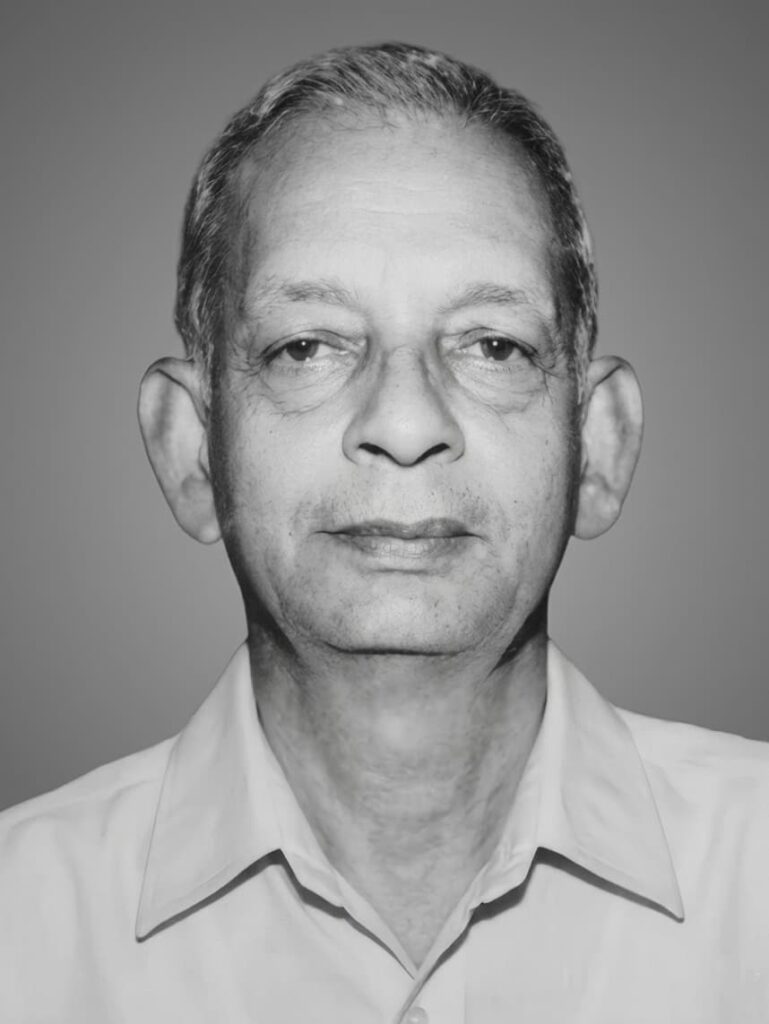
Dr. Virendra Kumar Mehta
Professor of Surgery · MGIMS Tenure 1978 – 2003 Born 24 October 1942, Mandsaur, Madhya Pradesh Education BSc, Holkar College IndoreMBBS, MGM Medical College Indore (1966)
MS General Surgery, MGM Medical College Indore (1969)
Shriman
He could not afford a bicycle in Bhopal. When he arrived in Sevagram and finally started earning a steady salary, he bought one. And then he rode it through the campus for twenty-five years, long after his colleagues had upgraded to scooters and cars.
The bicycle was never an affectation or a performance of austerity. It was simply who he was: a man who had discovered that simplicity was not a sacrifice, but a profound form of freedom. He saw absolutely no reason to abandon it just because academic promotion and seniority had offered him the conventional alternatives.
He addressed his colleagues and his medical residents alike as Shriman—Sir. He rigorously avoided parties, skipped the cinema, and rarely, if ever, spoke of his own achievements. He did not laugh easily, did not publicly display sorrow, did not celebrate victories, and never performed his grief. He dressed his patients’ wounds personally in the surgical ward at two in the morning—not because the resident on call was unavailable, but because the patient sitting in front of him needed it done, and he happened to be there.
These things were not empty gestures. They were the highly consistent expressions of someone who had decided very early in life what actually mattered, and who had found absolutely no reason to revise that decision across a quarter-century of surgical practice in a Gandhian village.
Mandsaur, a Grandfather’s Death, and the Path to Surgery
Virendra Kumar Mehta was born on October 24, 1942, in Mandsaur, Madhya Pradesh. His father, Shri Sajjanlal Mehta, was a first-class LLB graduate who never practiced law simply because his own mother believed he would be forced to be dishonest in a courtroom. Instead, he became a grain merchant. The household was orthodox Jain; the values were clear, rigid, and highly consistent.
Young Virendra attended school in Mandsaur, pursued a BSc at Holkar College in Indore, and entered MGM Medical College in 1961.
When asked why he chose medicine, he never offered a general, soaring aspiration. He answered with a single, sharp memory: when he was a small child, his grandfather had died simply for lack of medical care. That was the reason.
He graduated with his MBBS in 1966, ranking seventh on the final merit list. He completed his house jobs in Surgery and returned to MGM for his MS in Surgery from 1967 to 1969. During his residency in Indore, he met Jyoti, a nurse from Kerala. After a quiet five-year courtship, they married in 1971. His orthodox Jain family fiercely opposed the union—Jyoti was Christian—but Virendra stood absolutely firm. Holding his ground in the face of intense family opposition was entirely consistent with everything that followed: he was a man who knew his own mind and refused to be deflected by social pressure.
In Bhopal, they built a stable life. They secured a government quarter in Idgah Hills. Their two children, Manoj and Sonali, were born there. They had good schools and the comfortable amenities of a city. And then Dr. K.K. Trivedi, who was actively building the Surgery department at MGIMS, invited him to Sevagram.
On March 14, 1978, he arrived.
The Department He Joined
He arrived as a Lecturer, became a Reader in 1981, and was promoted to Professor in December 1995. The titles marked the administrative passage of time, but they failed to capture the specific quality of his daily presence that made him the doctor he was.
In the operating theatre, Dr. Narang—who led the Surgery department for most of Dr. Mehta’s tenure—described him as reserved, small, and slender. He was entirely content to support rather than lead, vastly preferring to let his actions speak. This assessment was fiercely accurate. Dr. Mehta never sought the spotlight. He sought only the patient.
Between 1985 and 2004, he mentored twenty-four surgery residents, investing in each of them with the painstaking thoroughness of a man who understood that teaching was simply a form of patient care extended into the future. He built incredibly strong relationships with the nursing staff, valuing their bedside experience in ways that resident doctors sometimes failed to do. This mutual respect naturally produced a highly efficient, deeply patient-centered ward environment.
The Rural Surgery Conviction
He believed fiercely in cost-effective, humane surgery. Aligning himself with Dr. N.H. Antia’s vision—accessible surgery for patients who simply could not afford market rates—he contributed heavily to the Association of Rural Surgeons of India’s (ARSI) manual of rural surgery.
The ARSI’s core position, which he endorsed without a single reservation, was that rural surgery was not about second-rate surgeons providing second-rate care to second-rate citizens. It was about providing the absolute best possible care within the severe constraints of what rural patients could actually afford, and what rural settings could actually sustain.
He was highly skeptical of market-driven healthcare—the creeping commercialization that prioritized revenue over clinical need. He was equally skeptical of the reflexive adoption of new surgical technologies in settings where the latest innovation was not actually the most appropriate choice. (He could occasionally be resistant to new technologies beyond what was strictly warranted, a limitation that those who worked alongside him freely acknowledged). But his underlying conviction was unshakeable: in a rural hospital serving farmers who had traveled considerable distances with limited resources, the only question that mattered was what was affordable, effective, and genuinely beneficial—not what was newest.
He also served as the chief editor of the MGIMS annual reports from 1995 to 1999, and edited the Journal of Rural Surgery—administrative contributions that reflected his deep seriousness about documentation and the institutional life of the campus.
Jyoti and the Loss
Jyoti Mehta served as a nursing supervisor at Kasturba Hospital for over a decade. The nurse from Kerala who had become the Jain grain merchant’s daughter-in-law against the family’s wishes had made Sevagram her home with the exact same quiet determination that had brought her there. At Christmas, she warmly welcomed guests with sweets and gifts, her gentle hospitality serving as the perfect counterpoint to her husband’s reserved, monastic solitude.
On January 24, 2000, she died in Sevagram after a brutal battle with breast cancer. She had been diagnosed and treated in the exact same hospital where her husband practiced surgery.
It was the kind of devastating loss that those who do not show emotion publicly must absorb in the only way available to them: by continuing, without any visible alteration, the daily work that had always been the center of their universe. He continued to ride his bicycle. He continued to dress wounds at two in the morning. He continued to respectfully call his colleagues Shriman.
Their son, Manoj, graduated from MGIMS in 1990 and specialized in Ophthalmology. Their daughter, Sonali, graduated in 1991 and pursued Obstetrics and Gynaecology. Both had been educated in Sevagram at Kasturba Vidya Mandir, on the exact same campus where their parents had built their careers. The fierce instinct toward medicine that had been ignited in Virendra by his grandfather’s tragic death had moved, through him and Jyoti, safely into the next generation.
What the Bicycle Meant
He left Sevagram for Ujjain in October 2003. He had been there for twenty-five years—longer than almost anyone in the Surgery department other than Dr. Narang. He had operated relentlessly, taught twenty-four residents, edited two publications, dressed thousands of wounds in the dark, and ridden his bicycle through the campus in the early morning while the rest of the faculty was still asleep or backing their cars out of their garages.
He had not been able to afford a bicycle in Bhopal. In Sevagram, he bought one and kept it for a quarter of a century. As those who watched him understood, it was far more than transport. It was the daily, physical expression of a philosophy: that the gap between what is strictly necessary and what is merely comfortable is rarely worth filling. That simplicity is not deprivation, but precision. And that a man who has decided what actually matters can spend twenty-five years doing exactly that, without ever needing the other things.
His grandfather had died for lack of medical care. He had gone into medicine because of that unnecessary death. And he had spent his entire career ensuring that the patients who arrived at his ward—whatever hour they arrived, and whatever the terrible condition of their wounds—received from him the exact same careful, deeply personal attention that his grandfather had never received from anyone.
Mentored Students (MD/MS)
A comparative study of biological dressing (placentas) conventional dressing thermal burns
Changes in coagulation system and SDPS test following surgical operations
Effect of hydrocele surgery on spermatogenesis
A clinical profile of head injury cases with gastric acid secretory pattern studies in selected cases
Sclerotherapy for hydrocele using oxytetracycline
Primary closure in acute abscesses.
Clinical evaluation of aqueous extract of human placenta in treatment of non healing wounds
Effect of antineoplastic drugs on wound strength in : an experimental study
Evaluation and clinical correlation of serum amylase in acute abdominal conditions in rural population
An experiment study of intestinal anastomosis in rats using an internal stent
Prevalence of anorectal diseases in rural population
Effect of topical application of phenytoin in different wound
Correlation of Clinico radiological findings with operative or USG findings in rural population
Fila test in surgical manifestation of filariasis
Clinico-immunological correlations of surgical filariasis
Antibiotic prophylaxis in wound infection : an experimental study
Clinico-immunological monitoring of patients of lymphatic filariasis on extended DEC treatment
The effect of neem ointment in wound healing
Comparative study of aloederm ointment with neem cream with sesame oil conventional dressings in wound healing
Prospective retrospective Clinicopathological study of tuberculosis as seen in rural based institution
Changing Clinicopathological trends in acute appendicitis as seen in rural based institution of Vidarbha
Trends in hernia : rural experiences
Pyocele : A rural experience
Trends in trauma : A rural experience
Trends in peritonitis – A rural experience
Key Milestones
| 1942 | Born, 24 October, Mandsaur, Madhya Pradesh — Jain household; father a grain merchant, first-class LLB who chose not to practise law |
| 1961 | Entered MGM Medical College, Indore — chose medicine because his grandfather had died for lack of care |
| 1966 | Completed MBBS, MGM Indore — seventh on merit list |
| 1969 | Completed MS General Surgery, MGM Indore — trained under Dr. S.D. Sharma, Dr. A.M. Ghooi, and Dr. Hissamuddin |
| 1971 | Married Jyoti — nurse from Kerala; family opposed the union; he stood firm |
| 1978 | Arrived MGIMS, 14 March — Lecturer in Surgery; bought his first bicycle |
| 1981 | Promoted Reader, February |
| 1985 | Began mentoring surgery residents — twenty-four students between 1985 and 2004 |
| 1995 | Promoted Associate Professor, September; Professor, December |
| 1995 | Chief editor, MGIMS annual reports — until 1999; also edited Journal of Rural Surgery |
| 2000 | Jyoti died, 24 January — breast cancer; diagnosed at Kasturba Hospital where she had served as nursing supervisor |
| 2003 | Retired and left for Ujjain, 9 October — twenty-five years after arriving; still riding the same bicycle |