Dr. Kush Kumar
Professor & Head of Orthopaedics · MGIMS Tenure 1976 – 1977 · 1982 – 1987 Lifespan 8 August 1950, Nainital — 24 May 2019 Education MBBS, King George Medical College Lucknow (1971)MS Orthopaedics, Institute of Medical Sciences Varanasi (1976)
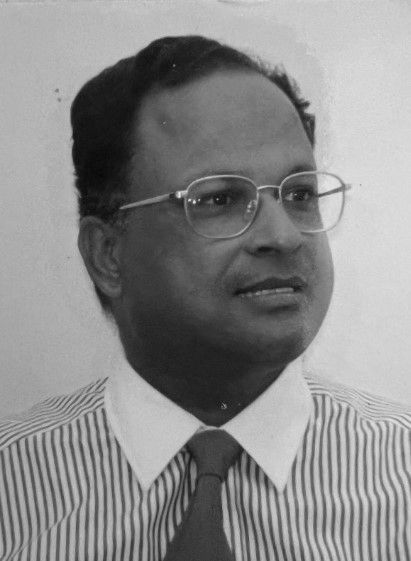
Nainital, Lucknow, Varanasi, and the Making of an Orthopaedic Surgeon
Kush Kumar was born on August 8, 1950, in Nainital, his parents Gopal Narayan and Maheshwari Srivastava carrying the gentleness the hills of that city are associated with. He entered King George Medical College, Lucknow, in 1966 — one of India’s oldest and most prestigious medical institutions — and graduated MBBS in 1971. Orthopaedics drew him with the particular pull of a specialty that combines mechanical precision with restorative purpose: bones that had broken could be set and healed; deformities that had limited a person’s movement and dignity could be corrected. He pursued his MS in Orthopaedics at the Institute of Medical Sciences, Varanasi, under the renowned Dr. Tuli, completing in 1976.
He joined MGIMS on May 8, 1976, as Lecturer in Orthopaedics — his first posting, the ink barely dry on his MS degree. He was twenty-five years old and arrived into a department in flux, Dr. Ahuja away on deputation to Iran, Dr. Belsare managing what he could. His first tenure ended in December 1977 when he left for Iran — following, in reverse sequence, the path Dr. Ahuja had taken.
The Return and the Five Years That Built the Department
He returned to MGIMS on November 10, 1982, joining as Reader in Orthopaedics and taking charge as department head following the sequential departures of Dr. Ahuja, Dr. Belsare, and Dr. Farooq. The department he inherited had been through a period of sustained instability — three heads in the space of two years, a workload that had reached 1,458 admissions annually managed by a skeleton team. Stability was the first requirement; expansion was what followed.
In the operating theatre, he brought the exquisite technique that Dr. Chauhan would remember across decades. His photographic memory made him a resource not just in the clinical domain but in the educational one — able to cite the relevant textbook passage, locate the applicable anatomy, recall the published series that informed a particular surgical decision. He emphasised to his postgraduates the primacy of normal anatomy. “You cannot discern the abnormal without a thorough understanding of the normal.” On written communication, he was uncompromising: “You can never become a good orthopaedician if you can’t write perfect English.”
He illustrated his publications by hand — the same hand that manipulated tissues in the operating theatre producing the diagrams that explained what that manipulation had achieved. His research focused on deformities of the hand and spine, fracture repair, and bone plating. In January 1987, having built the department into something substantially more stable than what he had inherited, he left for Karad and the Krishna Institute of Medical Sciences.
The Long Peripatetic Career and the American Reinvention
From Karad, the trajectory became genuinely extraordinary. He served as consultant to the Ministry of Health in Saudi Arabia, then joined the University of Medical Sciences in Kuwait. He served as Dean at PVNR Medical College in Dehradun, then flew across continents to the University of the West Indies in Trinidad and Tobago for four years. He visited Malawi with Rotary International, worked in Zimbabwe, carrying across all of these the same steady hands and the same commitment to a medicine that respected the dignity of each patient.
In 2000, he and his wife Dr. Vibha Kumar made the most audacious decision of their career together: they migrated to the United States, well into middle age, and began again. “Those years were marked by immense challenges,” Dr. Vibha Kumar said. “We went to the USA well beyond middle age. We had to start over — write exams, train again, and prove ourselves in a competitive system. It was perseverance and hard work that carried us through.”
He completed three orthopaedic fellowships and then pursued a residency in nuclear medicine at Emory University, where he won the Outstanding Resident Researcher Award. The pivot from orthopaedics to nuclear medicine was not random — his research focus was rooted in orthopaedic applications, particularly the early detection of bone infections and the identification of culprit vertebrae for kyphoplasty. He became Chief of the Radiology Department at the Carl Vinson VA Medical Center in Dublin, Georgia. Eighty publications. Seven book chapters. One book under consideration at the time of his death. Each article illustrated, where appropriate, with his own hand-drawn diagrams.
The Glioblastoma and the End
He had loved cricket, chess, and cards. He had attended kavi sammelans and mushairas, finding in poetry the same elegance and discipline that marked his professional life. In his later years, glioblastoma — aggressive, relentless, ultimately unanswerable — depleted his strength. He underwent chemotherapy and radiation. He died on May 24, 2019, aged sixty-eight.
His former trainee Dr. Vijendra Chauhan, who had watched him operate and called it an art form, had recorded the tribute that now stands as the most complete summary of what he was: extraordinary photographic memory, exquisite dissections, gifted orator, unique illustrator, visionary whose far-sightedness was not always fully appreciated. The institutions that failed to fully appreciate the vision were not the whole of the record. They were the beginning of it.
Mentored Students (MD/MS)
Comparative analysis of tissue effect of dexamethasone and colchicine following intra-articular injection : an experimental study
Histological study of human Intervertebral dice of normal abnormal embryos and fetuses
Evaluation of fibro-osseous tunnel pressure in human beings health diseases
Experimental production of articular tuberculosis in laboratory animals
Medial open wedge high tibial osteotomy
Key Milestones
| 1950 | Born, 8 August, Nainital — parents Gopal Narayan and Maheshwari Srivastava |
| 1966 | Entered King George Medical College, Lucknow |
| 1971 | Completed MBBS |
| 1976 | Completed MS Orthopaedics under Dr. Tuli, IMS Varanasi |
| 1976 | Joined MGIMS, 8 May — Lecturer in Orthopaedics; aged twenty-five |
| 1977 | Left for Iran, December — following the international opportunity that era regularly offered Indian surgeons |
| 1979 | Married Dr. Vibha Kumar, October — Lady Hardinge Medical College graduate |
| 1982 | Returned MGIMS, 10 November — Reader and Head of Orthopaedics |
| 1986 | Wife Dr. Vibha Kumar completed MD Community Medicine, MGIMS |
| 1987 | Left MGIMS, 17 January — joined Krishna Institute of Medical Sciences, Karad |
| 1988 | Completed PhD in Orthopaedics |
| 1990 | Visited Malawi with Rotary International · worked in Zimbabwe |
| 1990 | Consultant, Ministry of Health, Saudi Arabia · University of Medical Sciences, Kuwait |
| 1995 | Dean and Professor, PVNR Medical College, Dehradun |
| 1996 | University of the West Indies, Trinidad and Tobago — St. Augustine and Mount Hope Hospital, four years |
| 2000 | Migrated to USA — sat USMLE, retrained, completed three orthopaedic fellowships |
| 2000 | Residency in Nuclear Medicine, Emory University — Outstanding Resident Researcher Award |
| 2000 | Chief of Radiology, Carl Vinson VA Medical Center, Dublin, Georgia |
| 2019 | Died, 24 May — glioblastoma; aged sixty-eight |