Manimala Choudhary
Secretary, Kasturba Health Society Tenure 1948 – 2002 Lifespan 1923, Bengal — 26 February 2002, Sevagram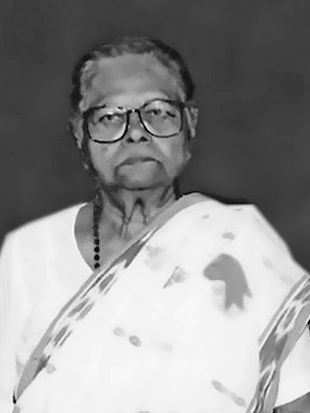
Founder of Kasturba Health Society • Builder of MGIMS • Chhoti Behenji of Sevagram
A Woman of Sevagram
The year 2023 marked the birth centenary of Manimala Roy Choudhary — “Chhoti Behenji” of Sevagram. Hers was a remarkable life: one of struggle, dedication, and quiet devotion.
She was born in Bengal in 1923, though the exact date of her birth is not known. Her early years were spent in Calcutta. She came from an elite family of judges, but her childhood was shadowed by absence. After her mother’s death, her father renounced the world and left as a sanyasi, leaving behind four young children. Manimala, her sister, and her two brothers were raised by their maternal uncle — Chhoto Mama, a distinguished High Court judge — and their aunt, Shejo Mashi, who had been a neighbour of Subhash Chandra Bose in Cuttack. Under their careful guidance, Manimala grew into a woman of compassion, resilience, and determination. Both brothers were sent to England to study law, and returned as barristers — but also brought back tuberculosis. The younger brother did not survive.
Marriage, Illness, and the Road to Nursing
After completing her matriculation, Manimala was married to a doctor employed by the French government in Kakinada District. Within a few years, she too contracted pulmonary tuberculosis. Still in her teens, she was compelled to leave her one-year-old daughter in the care of her mother-in-law and travel to a tuberculosis sanatorium in Kausani, Uttarakhand, for treatment. This was an era before antitubercular drugs — before Streptomycin, Isoniazid, Rifampicin, and Ethambutol. The only remedies available were rest, fresh air, and nourishing food.
She remained in Kausani for nearly four years. Her family could sustain her expenses for only a year or two. Realising that her recovery would require a longer stay — and eventually a lobectomy — she turned to herself for support. She began knitting sweaters and shawls, and took to educating fellow patients about their health. Her zeal caught the attention of the surgeon in charge, who offered to send her to Lahore for nursing training at the medical college there. She accepted without hesitation, staying four years to complete the course. During that time, she also learned to read and write both Gurmukhi and Urdu.
The Wandering Years: From Lahore to Sevagram
Driven by an indomitable spirit, Manimala continued to push herself further. From Lahore, she travelled to Patna and Solapur to acquire skills in nursing administration and surgical nursing. By now her daughter, aged around ten, was waiting in Kakinada for her mother to come home.
Manimala did return — for a few months. She lived as a respected doctor’s wife, comfortable and secure. But the comfort felt like a cage. Something in her remained restless, unsatisfied, unable to settle. It was at this point that she came in contact with Padmaja Naidu — a distant relative through her sister’s marriage — daughter of Sarojini Naidu, the celebrated poet and political leader. Padmaja suggested that Manimala visit Mahatma Gandhi at the Sevagram Ashram, which lay close to Nagpur, where her sister lived.
Barely twenty-seven years old, and with her sister’s help, Manimala made her way to Sevagram. Gandhiji advised her to work with Dr. Sushila Nayar, who had recently established a modest five-bed facility called Kasturba Hospital at Sevagram. The encounter transformed her. She chose to give up a comfortable, well-established life and take a path few would have chosen — much to the dismay of her family and society. Yet both her husband and mother-in-law gave her their blessing, a generosity she never forgot. Having made her choice, she worked, for the rest of her life, to keep her family relationships whole.
The Assassination, and an Unshaken Resolve
Manimala had returned to Calcutta after meeting Gandhiji, to pack her belongings. On her way back to Sevagram, she heard the news of his assassination. She did not waver. She arrived at the Ashram and began her nursing career under the tutelage of Barbara Hartland — renamed Vasantiben by Gandhiji himself — who had been running the Ashram’s dispensary and self-help groups since 1945. When Barbara returned to England after Gandhiji’s death, she handed all responsibilities to Manimala. Manimala assumed the role of Matron, overseeing both the hospital and the maternity and child welfare centre at Kasturba Hospital.
Learning to Belong
Coming from a privileged background, Manimala was initially shaken by the poverty around her — the scarcity of water, the sparse diet, the unfamiliar customs of Vidarbha. She bristled at being called “Bai,” a word she understood as derogatory in northern and eastern India. But she learned Marathi quickly, and before long the villagers were calling her “Mothi Daktarin Bai” — the big lady doctor — a reference to her height compared to Dr. Sushila Nayar. With time, she came to understand that in this part of the country, “Bai” carried deep respect. The word had humbled her.
She worked closely with Dr. Sushila Nayar, with Asha Devi Aryanayakam — founder of the Nayi Taleem Sangh — and with Prabhakarji, Secretary of the Ashram, who was intimately involved with the hospital’s affairs. Together they approached the local government and established a nursing school for ANM training at Kasturba Hospital — one of the first of its kind in rural India.
Beyond the Hospital Walls
Manimala’s commitment to healthcare extended well beyond the wards. She worked in villages to promote microinsurance, self-help groups, disease prevention, and health education. Through these efforts — steady, unhurried, year after year — she rose from Matron of Kasturba Hospital to Nursing Superintendent, and eventually to Secretary of the Kasturba Health Society, established in September 1964.
The formation of that Society was itself a milestone. After Gandhiji’s death, Dr. Sushila Nayar had left for the United States in June 1948 to pursue a degree in public health at Johns Hopkins University. During her absence, Kasturba Hospital passed through several phases of management — first under the Sevagram Ashram with Prabhakarji, Dr. Wardekar, and Dr. Ranade; then under the Gandhi Smarak Nidhi. Manimala was a trusted associate through each of these transitions. When the time came to give the hospital a permanent, independent home, it was Manimala, together with Shri R.R. Diwakar, Dr. A.D. Ranade, and Nalinbhai Mehta, who persuaded Dr. Sushila Nayar to lead the newly constituted Kasturba Health Society. On September 11, 1964, the Society came into existence. The Gandhi Smarak Nidhi transferred to it the land, buildings, equipment, and a founding contribution of ten lakh rupees. A new chapter had begun.
Building a Medical College
Dr. Sushila Nayar’s vision reached further still. In August 1969, the Mahatma Gandhi Institute of Medical Sciences — MGIMS — admitted its first batch of students, becoming India’s first rural medical college. What followed was a decade of extraordinary labour. Together, Dr. Nayar and Manimala undertook the daunting work of constructing the hospital, designing lecture halls, outpatient departments, hostels, and laboratories — equipping every department, recruiting every faculty member.
Their temperaments were opposite, and perfectly matched. Dr. Sushila Nayar blazed with impulsive energy; Manimala moved with serene calm. Together — “Badi Behenji” and “Chhoti Behenji” — they functioned like yin and yang. Manimala personally supervised the construction of operation theatres, wards, the kitchen, the library, the water supply, and the solar electric installations. Together they turned an audacious vision into a functioning institution.
A Trusted Confidante
Manimala’s bond with Dr. Sushila Nayar was one of deep mutual trust. She was among the very few people who could speak her mind to Dr. Nayar without reservation, offering honest counsel where others might have held back. She served as a sounding board, a conscience, and a quiet anchor.
Dr. Nayar’s vision for MGIMS was not merely medical. It was Gandhian — rooted in austerity, simplicity, and humility. She asked Manimala to ensure these values lived in the institution’s daily rhythms. Every appointment, every purchase, every construction decision, she insisted, must serve society first. In this spirit, Manimala was willing to bend conventional rules — to the irritation of her more formally qualified colleagues — when she recognised in a man or woman from a neighbouring village a talent or dedication that no certificate could confer. She had a gift for seeing potential in ordinary people, and she used it to make MGIMS an institution that belonged to its surroundings.
Nurse, Builder, Visionary
Manimala was pivotal in establishing a partnership with the Catholic Mission to advance general nursing training, and helped found the first nursing school in rural India — an institution that has since grown into a degree college. She also created Kasturba Vidyamandir, a school for the children of the hospital’s doctors and staff, sustained in its early years by the voluntary effort of the senior doctors’ wives. She encouraged her staff to form a cooperative housing society, enabling families to own homes after retirement.
A Gandhian in both letter and spirit, she wore khadi, took part in community meals, convened prayer meetings, promoted shramdaan, yoga, and Ayurvedic sciences. MGIMS, under her stewardship, became a health resource not only for its own community but for neighbouring ashrams such as Vinoba Bhave’s Ashram at Pawnar.
Her influence over the institution’s administration was singular. Beginning with Dr. B.G. Kane, MGIMS’s first principal, successive principals — Dr. I.D. Singh, Dr. M.L. Sharma, Dr. K.S. Sachdeva — all reported, in practical terms, to a nurse. They respected her not because of a degree but because of her integrity, her transparency, and the quiet authority of a life lived without compromise.
Stepping Back
In the mid-1980s, her health beginning to fail, Manimala handed over her responsibilities to Ms. Kamala Desikan — a trusted colleague from the Ashram’s earliest days. By then, MGIMS had seen sixteen batches of medical students graduate, with over a thousand trained within its walls. She continued to live in Sevagram as a life member of the Kasturba Health Society, remaining close to the institution she had helped build for another seventeen years.
The doctors and staff of MGIMS were, in every meaningful sense, her family. Her only daughter, Bithika — who had grown up without her mother and harboured, for a long time, a resentment towards medicine and Gandhiji for the same reason — chose not to enter the profession. Yet Manimala lived to see her two granddaughters, Prabhati Lahiri (1983 batch) and Deepika Lahiri (1990 batch), receive their degrees from MGIMS. Something had come full circle.
A Gracious Farewell
Manimala Choudhary, twice nominated for the Jamnalal Bajaj Foundation Award for lifetime achievement, passed away peacefully at her home in Guru Nanak Colony, Sevagram, on 26th February 2002. Nearly all of Sevagram, along with people from the surrounding villages, came to pay their respects. The woman they mourned had arrived among them more than half a century earlier as an outsider — a Bengali widow from Calcutta — and had given herself entirely to the land and its people.
She left behind no institution in her name, no endowed chair, no statue. She left behind MGIMS.
Key Milestones
| 1923 | Born in Bengal |
| 1940s | Tuberculosis — four years in Kausani sanatorium |
| ~1944 | Nursing training, Lahore Medical College |
| ~1946 | Pulmonary lobectomy — recovered |
| 1948 | Gandhi assassinated — she came to Sevagram anyway |
| 1948 | Matron, Kasturba Hospital |
| 1950s | Bullock cart insurance rounds with Dr. Ranade |
| 1964 | Secretary, Kasturba Health Society (founding) |
| 1969 | Supervised construction of MGIMS |
| 1969 | Co-founded first nursing school in rural India |
| 1970s | Founded Kasturba Vidya Mandir school |
| 1983 | Granddaughter Prabhati Lahiri graduates MGIMS |
| 1988 | Stepped down as Secretary |
| 1990 | Granddaughter Deepika Lahiri graduates MGIMS |
| 2001 | Dr. Sushila Nayar dies — present at her side |
| 2002 | Died 26 February, Guru Nanak Colony, Sevagram |