Dr. Pratibha Narang
Director-Professor & Head of Microbiology. Secretary, KHS. Dean Tenure 1973 – 2026 Born 9 September 1947, Srinagar Education MBBS (Lady Hardinge Medical College, New Delhi) [1966]MD Microbiology (Lady Hardinge Medical College, New Delhi) [1971]
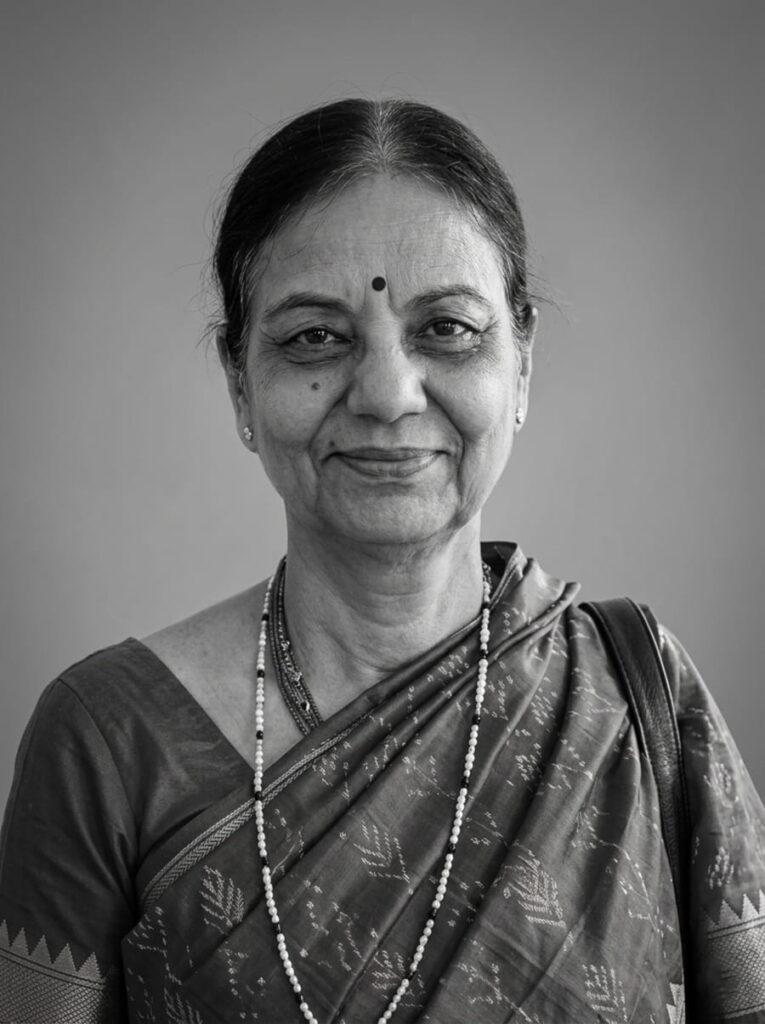
Microbiology lectures at MGIMS were scheduled after lunch. Post-lunch drowsiness was a known hazard. Dr. Pratibha Narang’s sharp eyes and, as Dr. Prabha Desikan recalled, her impeccable aim were the corrective: a piece of chalk flying through the air with precision, waking the unfortunate student before she had registered what had happened. The chalk landed. The student woke. The lecture continued.
This detail is offered not as an anecdote about discipline but as an introduction to a woman whose entire career was organised around the refusal to accept less than full engagement — from her students, from her institution, from herself. She taught Microbiology for over fifty years at MGIMS, founded its department from nothing, built it into a laboratory of national repute, led the institute as Dean, served as Secretary of the Kasturba Health Society, published 145 scientific papers including 105 original articles on tuberculosis, supervised 34 MD theses and two PhD students, won the Senior Commonwealth Fellowship and the first Dr. P.R. Gangadharam International Travel Award given by the American Lung Association, and — when her institution did not yet offer postgraduate courses — packed up her two daughters, aged two and four, and moved to Delhi to complete her MD herself.
She retired in March 2025. She had been at MGIMS for fifty-one years.
The Doon School, Lady Hardinge, and the Turn to Microbiology
Pratibha Narang was born on September 9, 1947, in Srinagar. Her father was a mathematics teacher of considerable distinction — a gold medallist from Punjab University who taught at DAV College, Hoshiarpur, and then at the Doon School in Dehradun, where he eventually retired as Vice Headmaster. He wrote twenty-five mathematics textbooks, contributed articles on Einstein’s theory of relativity to the Times of India and Hindustan Times, was published in the Illustrated London News, and was invited by the BBC to speak on public schools. The household she grew up in was one in which intellectual seriousness was the ambient condition.
At ten, she joined the Doon School as a day student. Her classmates included Sanjay Gandhi, Kamal Nath, Naveen Patnaik, Mani Shankar Iyer, and Karan Thapar. She completed her intermediate at the Allahabad Board and entered Lady Hardinge Medical College in Delhi in 1965. She earned her MBBS, served as the college’s cultural president, and won the Annie McKenzie Prize for being the best all-rounder.
After graduating, she completed two house jobs in Obstetrics and Gynaecology at AIIMS from 1971 to 1972. On January 16, 1971, she married Dr. Ravinder Narang, a surgeon completing his MS in General Surgery from PGI Chandigarh. Gynaecology had been her intended speciality. The pivot to Microbiology was practical and deliberate. Her husband was seeking a faculty position at a teaching hospital; a clinical speciality and the demands of a young family were not, she judged, compatible with the life they were building. Microbiology offered a different rhythm.
Her mentor at Lady Hardinge, Dr. K.B. Sharma, gave her the counsel she would remember for the rest of her career: “Virgin soil yields the best harvest, provided one tills it.”
On August 10, 1973, she joined MGIMS as Lecturer in Microbiology — the first Microbiology teacher the institution had appointed. Microbiology was then still part of the Pathology department. MGIMS had no postgraduate programme. In 1976, she took study leave, moved to Delhi with her two daughters aged two and four, completed her MD in Microbiology at Lady Hardinge, and returned to Sevagram in May 1978 as Reader. The soil was virgin. She began to till.
Building the Department
Microbiology became a separate department on August 15, 1980. It had two technicians, no postgraduate students, and Dr. Narang. She became Professor and Head in 1982 and led the department for twenty years.
The intellectual centre of her work was tuberculosis. This was not an abstract speciality choice. Dr. Sushila Nayar had founded the Badshah Khan Hospital in Faridabad as a TB sanatorium in the early 1950s, had watched children and young adults die there, and had never released that specific grief. Her commitment to TB control was personal. When Dr. M.D. Gupte, a professor of Community Medicine at MGIMS, secured ICMR funding for a field trial on TB but left before completing the project, Dr. Nayar turned to Dr. Narang — the co-investigator, without prior field experience — and asked her to lead. She led. The result was the first ICMR field trial on intermittent Short Term Chemotherapy for pulmonary tuberculosis patients in the Wardha district, examining TB prevalence in both tribal and non-tribal populations through smear and culture-positive cases.
This was the work that shaped the rest of her research career. TB became her subject in its full complexity — latent and active infection, drug-sensitive and drug-resistant strains, pulmonary and extrapulmonary disease, typical and atypical presentations. Her Microbiology lectures built Robert Koch’s world for students who had never imagined microorganisms could be made vivid and consequential. In the seminar hall, in the laboratory, at the blackboard, she crafted a narrative around Mycobacterium tuberculosis that made the discipline feel like the most important subject in medicine — which, in terms of global burden of disease, it arguably was.
She established the postgraduate programme in Microbiology in the 1980s, and TB research became its central axis. The students she produced — Rajni Gaind, Manjusha Dudhe, Prabha Desikan, Rahul Narang, Ujwala Raut — became leading microbiologists across India. She supervised thirty-four MD theses and two PhD students. She collaborated with TB researcher Madhukar Pai in a study of latent tuberculosis among healthcare workers — research that placed MGIMS on the international TB research map. She published 145 papers between 1974 and 2022, 105 of them original articles on tuberculosis, and received seventeen extramural research grants from national and international agencies.
In 1992, she received the Senior Commonwealth Fellowship to the United Kingdom. In 2000, she became the first recipient of the Dr. P.R. Gangadharam International Travel Award, given by the American Lung Association under the IUATLD. In 2006, the Tuberculosis Association of India gave her the Lupin-TAI Award. In 2012, she became President of the Indian Association of Medical Microbiologists. In 2018, the Vidarbha Association of Medical Microbiologists created the “Dr. Pratibha Narang VAMM Professional Achievement Oration Award” in her honour — given annually to a senior microbiologist from the region for outstanding contributions.
The Administrator and the Teacher
She became Dean of MGIMS in 2002 — the first woman to hold the position — and served until 2007. In October 2007, she became Secretary of the Kasturba Health Society, a role she held until 2014. Those who worked with her in administrative roles described the same qualities that characterised her teaching: calm, attentive, thorough, firm where necessary, never indifferent to the person in front of her.
Dr. Prabha Desikan — who chose Microbiology for her postgraduate training despite being third on the merit list, specifically because of Dr. Narang’s example, and who went on to become Director of ICMR-BMHRC, Bhopal — described her as a diagnostician whose approach to clinical samples was exemplary, a researcher whose clarity about hypotheses was remarkable, and a mentor who was deeply invested in each of her students. The firmness, the practical advice, the wealth of knowledge and experience — and behind all of it, a kindness and warmth that Desikan called rare and invaluable.
About her own mentor, Dr. Narang said: “Dr. Sushila Nayar’s perfection and attention to detail were evident everywhere — in fieldwork, conference presentations, publications, and grant applications. She seemed to read every word before it went to print.” The quality she most admired in her teacher was the quality she spent fifty years embodying in her own practice.
Her family became a small medical school in itself: Dr. Ravinder Narang in surgery, daughter Ritambhara in gynaecology, daughter Dipti in paediatrics, son Udit in internal medicine, sons-in-law and daughter-in-law all in medicine. A household in which medicine was not a profession but an inheritance.
She continued as Emeritus Director-Professor after stepping down from departmental leadership, remaining available to faculty and students with the consistency of someone who does not know how to be otherwise. The chalk, presumably, still had its uses.
“Virgin soil yields the best harvest, provided one tills it.”
She tilled it for fifty-one years.
Mentored Students (MD/MS)
Diagnostic importance of stick ELISA in smear negative cases of pulmonary tuberculosis
Prevalence and characterization of non tuberculosis mycobacteria (NTM) among symptomatics screened for pulmonary tuberculosis in community.
Study of Klebsiella pneumoniae in hospital patients and hospital environment.
A study of Trichomonas vaginalis infection with evaluation of different diagnostic techniques
A comparative study of Campylobacter jejuni in childhood diarrheas among the hospital and community subjects.
Evaluation of growth of Mycobacterium tuberculosis on different culture media
Detection of circulating tubercular antigens with Ayoama – B using stick ELISA technique
Microbiological and epidemiological study of fungal isolates in sputum of symptomatics for pulmonary tuberculosis
Microbial flora in cases of cervicitis vaginitis in reproductive group with reference to some epidemiological parameters
Role of anti neural antibodies in nerve damage in leprosy patients.
Epidemiological characterization of salmonella typhi strains using serotyping, phage typing, biotyping antibiogram and plasmid transfer as marker
A study of staphylococcal bacteraemias in hospitalized patients.
Epidemiological typing of clinical isolates of proteus species.
Study of mycobacterial isolates from clinical samples with sub division of Mycobacterium tuberculosis into its variants.
Evaluation of investigative techniques and clinical parameters in the diagnosis of childhood tubercular lymphadenitis- a field study.
Evaluation of diagnostic potential of Mycobacterium tuberculosis excretory-secretory antigen (ESAS-DEI) by stick ELISA in tuberculosis
Standardization and evaluation of direct sensitivity test for M. tuberculosis in pulmonary tuberculosis.
Detection of extended spectrum beta lactamases producing strains of Klebsiella pneumoniae and oxytoca in rural hospital
A study of vancomycin resistance amongst the methicillin resistant strains of staphylococcus aureus isolated in a rural hospital.
Evaluation of different screening procedures for the detection of extended spectrum beta lactamases (ESBLs).
Paraffin slide culture technique for isolation of nontuberculous mycobacteria from stool and sputum samples
Evaluation of BACTEC 460 TB system and serodiagnostic kits in pulmonary and extrapulmonary tuberculosis.
Blood culture positivity rate for mycobacteria of HIV seropositive and seronegative cases suspected of tuberculosis.
Evaluation of rapid multi-tube method for detection of susceptibility of Mycobacterium tuberculosis to rifampicin and isoniazid
Comparison of a whole blood interferon gamma release assay with tuberculin skin testing to detect latent tuberculosis infection in children.
Isolation and characterization of mycobacterial species from AIDS patients attending a rural hospital in central India
Comparison of MTT Tube method with conventional method and real time PCR for detection of Rifampicin resistance in Mycobacterium tuberculosis
Characterization of Non tuberculous Mycobacterial isolates from HIV seropositive patients attending a rural hospital and their correlation with environmental isolates
Detection of Amp-C Beta lactamases producing bacteria from various clinical specimens in a rural hospital
Detection of Extensively Drug Resistant (Xdr) Strains Amongst the Multidrug Resistant (Mdr) Mycobacterium Tuberculosis Isolates Processed in Tertiary Care Hospital in Central india.
Evaluation of Direct MTT Colorimetric Method For AFB Positive Sputum in order to Detect Rifampin Resistant Mycobacterium Tuberculosis.
Speciation and Drug Susceptibility of Non-Tuberculous Mycobacteria Isolated From Symptomatics For Pulmonary Tuberculosis.
Epidemiology of Nontuberculous Mycobacteria (NTM) from the environmental samples in Wardha district in Central India
Isolation,identification and characterization of Candida isolates from oral lesions
Study of high risk human papillomavirus genotypes and epidemiological factors in cervical cancer patients and normal women
Evaluation of newer in situ cold staining methods against conventional Ziehl-Neelsen for the detection of acid fast bacilli in sputum.
Key Milestones
| 1947 | Born, 9 September, Srinagar |
| 1957 | Joined Doon School, Dehradun, as day student — classmates included Sanjay Gandhi, Naveen Patnaik, Kamal Nath, Mani Shankar Iyer, Karan Thapar |
| 1965 | Entered Lady Hardinge Medical College, Delhi |
| 1971 | Married Dr. Ravinder Narang, 16 January |
| 1971 | House jobs in Obstetrics & Gynaecology, AIIMS |
| 1972 | Daughter Ritambhara born, 4 March — began Demonstratorship in Microbiology, Lady Hardinge |
| 1973 | Joined MGIMS, 10 August — first Microbiology teacher appointed |
| 1976 | Took study leave — moved to Delhi with daughters aged two and four |
| 1978 | Completed MD Microbiology, Lady Hardinge — returned to MGIMS as Reader, May |
| 1980 | Microbiology became separate department, 15 August |
| 1982 | Appointed Professor and Head of Microbiology |
| 1992 | Senior Commonwealth Fellowship — visited public health and reference laboratories, United Kingdom |
| 2000 | First recipient, Dr. P.R. Gangadharam International Travel Award — American Lung Association, IUATLD |
| 2002 | Became Dean of MGIMS — first woman to hold the position |
| 2006 | Lupin-TAI Award — Tuberculosis Association of India |
| 2007 | Became Secretary, Kasturba Health Society — until 2014 |
| 2012 | President, Indian Association of Medical Microbiologists |
| 2018 | Vidarbha Association of Medical Microbiologists created “Dr. Pratibha Narang VAMM Professional Achievement Oration Award” in her honour |
| 2025 | Retired, 31 March — after fifty-one years at MGIMS |