Om: the long illness
For nearly a decade, my elder brother Om lived with myasthenia gravis, an illness that did not announce itself loudly but stayed, patient and persistent, in the background of his life.
In those early years, it seemed manageable. His eyelids would droop, giving him a tired look, but tablets held the disease in check, and he carried on with his routines. He ran his shop, met people, argued about small things, and spoke as freely as he always had. If the illness was present, it remained in the margins.
That changed in 2024.
Tired of taking medicines every day, Om stopped them. What followed was not sudden, but it was relentless. His voice began to fade, first becoming slurred, then hesitant, and eventually falling silent. Swallowing grew difficult, and meals turned into careful, prolonged efforts. Even a sip of water demanded attention. Conversations, once easy and frequent, became brief and then rare. Almost without our noticing when it began, silence settled around him.
The medical battle
In October 2024, I took him to the Central India Institute of Medical Sciences in Nagpur, an institution founded by Dr. G. M. Taori. Dr. Neeraj Baheti confirmed what we had begun to suspect: the disease had advanced, and the antibody levels were high.
We began treatment with intravenous immunoglobulin, followed by steroids, and later rituximab. A nasogastric tube was inserted when swallowing became unsafe, and it soon became his main source of nutrition.
There were small improvements that we held on to. His eyelids lifted, and the troubling accumulation of saliva in his throat reduced. But his neck muscles remained weak, and his head would fall forward, as if even holding it upright had become too demanding.
For weeks, he travelled between Yavatmal and Sevagram, always accompanied by his wife or his son Raju. We began to live within the rhythm that serious illness imposes—a new treatment, a brief stabilization, a fragile hope, and then a gradual decline that no intervention could fully arrest.
Looking back, those weeks feel both long and brief, as if time had stretched and contracted at the same moment.
What the illness took
The illness did not take only his strength; it altered how he saw himself.
Om had run his shop for decades. It was not just a livelihood but a structure around which his days were organized. Over time, however, the world around him had changed. Online businesses had altered buying habits, and the small shop that had once sustained him no longer fit into that new order. He closed it.
I remember the day the shutters came down. There was no ceremony, no conversation, just a plain acceptance. Yet something shifted in him after that.
In the months that followed, dependence replaced independence. Where he had once moved through his day with ease, he now required help for the smallest tasks. Tubes and medicines entered his daily life, and the space around him grew quieter. He never spoke of it directly, but one could sense the weight of it—the slow realization that the life he had known was slipping away.
The last night
On 26 November 2024, Om died in Sevagram Hospital.
The night before, I sat beside him. He was fully conscious and aware. At one point, he joined his palms in a gentle pranam and looked at me for a long moment. Then, with a slight movement of his hand, he pointed towards the monitors and the intravenous lines.
He did not need to say anything. I understood what he meant.
A little later, he asked for water. He drank it slowly, taking small, deliberate sips, as if aware that this simple act had acquired a finality. After that, he closed his eyes and rested.
By morning, he was gone.
We had already made the decision that there would be no ventilator, no chest compressions, and no attempts to force life back into a body that was no longer able to sustain it. It was a difficult decision, but it allowed him to leave without struggle.
In those last hours, I was not only a physician. I was his younger brother, sitting beside him, aware of what medicine could do—and what it could not.
Ashok: without warning
A year later, on 24 December 2025, my elder brother Ashok died in Pune at the age of eighty-two.
Two days earlier, he had travelled there to spend some time with his younger son Sumit and his daughter Surekha. It was an ordinary decision, the kind that families make without thinking much about it.
On the morning of the 24th, he developed chest pain. His daughter-in-law, Chanchal, called me, and as she described his symptoms, the diagnosis became clear almost immediately. This was a heart attack.
I asked her to give him aspirin and another antiplatelet drug, along with a statin, and to take him at once to Dr. Kalidas Bharati’s hospital in Pimple Saudagar, which was close by. I also called Dr. Bharati myself. In such moments, familiar professional connections become deeply personal.
Ashok reached the hospital in time and received emergency treatment, including a clot-buster. For a short while, he improved, and we allowed ourselves to believe that the worst might have passed.
Within two hours, a second heart attack took him away.
We reached Pune late that night. The next day, as we performed his final rites, the speed of what had happened still felt unreal.
There was grief, but also an understanding that he had not suffered for long. He had not been confined to a bed or lived through a prolonged illness. His departure was sudden, but it spared him the slow decline we had witnessed the year before.
Pushpa: Jiji
On the morning of 22 March 2026, my sister Pushpa died at home in Indore. She was eighty.
The news came through a phone call from my nephew Aalok.
Her illness had begun in 2018, when she developed ovarian cancer. She went through what such a diagnosis demands—major surgery, cycles of chemotherapy, blood transfusions, and repeated hospital visits. I remember her first call to me when I was at PGI Chandigarh, where I had gone to examine MD students. She spoke of abdominal distension, and even before the tests were done, I felt a sense of unease. The ultrasound confirmed that the disease had spread beyond the ovaries.
All my life, I had called her Jiji.
She faced her illness with a steadiness that did not draw attention to itself. She went through each cycle of chemotherapy without complaint, accepting the discomfort as part of what had to be done. A year before her death, she asked me to draft her living will. She was clear in what she wanted—no ICU, no life-sustaining machines, and a wish to remain at home.
When I visited her in Indore a fortnight before she died, I was struck by how frail she had become. Yet her awareness was intact. That evening, we sat together and completed her will. Aalok was present. She signed each page carefully, and when it was done, she seemed lighter, as if something that had weighed on her for months had finally been set aside.
I spoke to Dr. Pankaj Singhai, a palliative care physician in Indore, who, along with his team, ensured that her care could continue at home.
In her final days, she gradually withdrew. She slept more, spoke less, and stopped eating. The day before she died, I saw her on a video call. She opened her eyes briefly and looked at the screen, but she did not have the strength to speak.
I ended the call and sat for a long time without moving. The care she had taken over her own final arrangements—down to the last detail—is a story already told in full in “Jiji.”
What remains
In the span of a year, I lost two brothers and a sister, each in a different way.
Om’s illness unfolded slowly, allowing us to witness both his suffering and his endurance. Ashok’s death came suddenly, leaving no time to prepare. Pushpa’s journey moved between these two—prolonged, yet marked by a steady acceptance.
Their departures were different, but what followed was similar.
The house feels emptier now. Conversations that once seemed ordinary return in fragments. Names, places, and moments surface without warning.
When I think of them, I do not think only of their illness or their final days. I remember Om in his shop, Ashok making plans without fuss, and Jiji speaking of her life across Nagpur, Sirpur-Kagaznagar, Baroda, Gwalior, and Indore.
We were, for many years, three brothers and a sister.
That is how I choose to remember us.
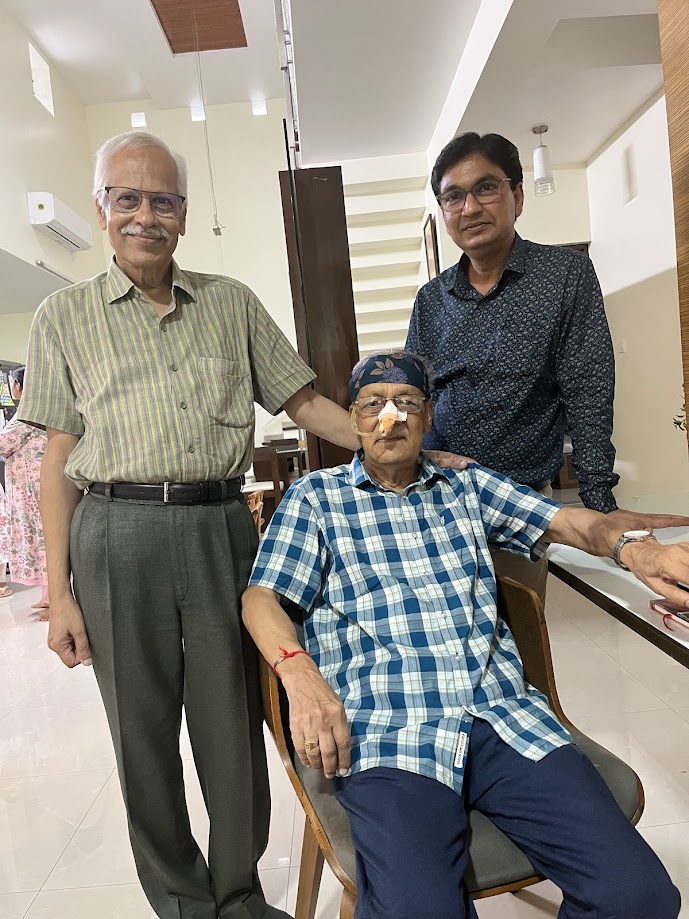
Om, Rajesh, and I — October 2024. Six weeks later, he was gone.