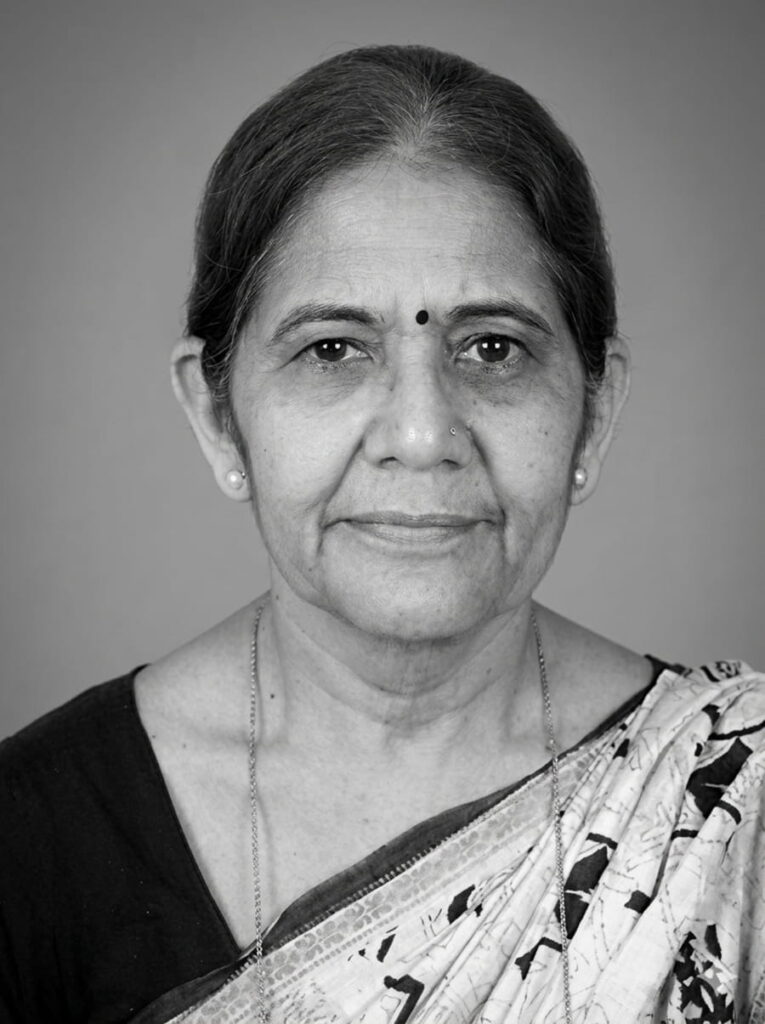
Dr. Shakuntala Chhabra
Professor and Head of Obstetrics and Gynaecology · Medical Superintendent · Dean · MGIMS Tenure 1975 – 2024 Born 22 November 1949, Gondia Education MBBS, Government Medical College Nagpur (1970) DGO (1972) ·MD Obstetrics and Gynaecology, Government Medical College Nagpur (1972)
Gondia, the Eye Camps, and the Generous Doctor
Shakuntala Chhabra was born on November 22, 1949, in Gondia, the youngest of six children of Amir Chand Chhabra, a forest contractor who had migrated from Rawalpindi. Two childhood experiences crystallised her understanding of what medicine was actually for. At rural eye camps, she watched doctors restore sight to blind patients — skill and kindness functioning as an inseparable unit. At home, she watched their family doctor treat her ailing brother every single time without ever taking a rupee. Both images carried the same essential truth: medicine was the combination of elite competence and raw generosity. She decided she wanted to be exactly that kind of doctor.
She entered Government Medical College, Nagpur, in 1966, graduated MBBS in 1970, and completed both her DGO and MD in Obstetrics and Gynaecology in a blistering two and a half years — an early signal of the intensity she would bring to everything she undertook. When she chose Obstetrics over a more comfortable research or administrative path, her mentors were surprised. But for her, the emotional connection with patients was not supplementary to the clinical work; it was the entire foundation.
The Crucible
In July 1975, during the Emergency, she joined MGIMS as Lecturer. The night of the massive haemorrhage came shortly after her arrival. The mother lay pale, her pulse racing, her skin cold and clammy. The bleeding refused to stop. She was twenty-six years old, newly arrived in Sevagram, fresh from her MD, and entirely alone with the catastrophic emergency unfolding in front of her. That night, she saved two lives. The choice she had made — to be in the wards with desperate women rather than in a comfortable research post — became, in that delivery room, a lifelong mission.
By 1980, like many of her peers, she considered leaving. Prestigious institutions presented themselves as possibilities. Dr. Nayar tried to create a new administrative path in Social Obstetrics to retain her, but Dr. Chhabra declined — she knew her strengths lay in hands-on patient care, not in administration. She chose to stay in the wards. The forty-nine years began to accumulate.
She chose not to marry. Brief breaks at her nearby home offered nothing more than a simple meal and a half-cup of tea before she rushed back. Hunger and fatigue were treated as minor inconveniences. The department was not just her job; it was her entire life.
The Villages and the World
As director of the Family Planning Unit for seventeen years, she expanded its scope far beyond contraception — introducing cluster immunisations, launching cervical cancer screenings, and educating rural women on reproductive health. The dusty villages of Vidarbha became her field just as much as the hospital ward.
In 1989, a British Council diploma programme in Liverpool deepened her grasp of global maternal healthcare. The WHO invited her to Jakarta as consultant; she went, contributed brilliantly, and when offered a highly lucrative permanent role, she chose to return to Sevagram because her rural department needed her more than Geneva did. Further training took her to Sweden and Maastricht. Over five decades, she produced more than six hundred publications — accumulated through relentless application of research discipline to the clinical problems she encountered every day. The manuscripts she returned to her residents were famously covered in red ink.
Aakanksha
In 1987, the sight of a discarded foetal skull near her home in Sevagram shook Dr. Chhabra to her core. She immediately proposed a safe motherhood programme for unwed mothers and abandoned children. Institutional resistance was fierce. Fourteen exhausting years of advocacy and bureaucratic navigation followed. Finally, in 2001, with funding from a Danish agency and the vital support of Dhirubhai Mehta, she secured the licence for an orphanage. She named it Aakanksha — aspiration.
Since its founding, Aakanksha has cared for 492 infants, facilitated 443 formal adoptions, and supported 613 women in acute distress. The foetal skull in 1987 had been the harrowing beginning of a fourteen-year journey toward a building, a system, and a name that meant hope.
The Ward and What It Required
She was petite and frail, eating sparingly, dressing simply, spending almost nothing on herself, living steps from the department, and moving briskly through its corridors keeping watch over every detail. Backgrounds, wealth, and political connections held zero weight in her ward. Elite competence was the only accepted currency. Casual attitudes received sharp, public rebukes. The apron was mandatory. The corridor fell silent.
Dr. Kishore Shah, one of her students, described her with precision: “Dr. Chhabra was, without question, the department’s fiercest taskmaster. Her passion for obstetrics and gynaecology was a fire that never dimmed, but it burned those who stood too close. She demanded perfection — anything less was unacceptable. And yet, she was a brilliant surgeon, a visionary in her field, and utterly devoted to her patients. Medicine, for her, was not a profession; it was a sacred duty.”
Beneath this terrifying exterior lay a truth her students only came to understand over time: the impossibly high standards were never about her ego; they were entirely about the patients who needed those standards held. A woman bleeding to death in a rural hospital at midnight needed the resident standing beside her to have been trained by someone who accepted no excuse for incompetence. Dr. Chhabra had been that terrified twenty-six-year-old resident once. She trained her students exclusively for that moment.
The Measure of a Life
After forty-nine unbroken years, she left MGIMS on March 31, 2024. At seventy-five, she began an entirely new chapter at a medical college in Shirpur, working to build a 750-bed super-specialty hospital for tribal communities.
Somewhere in a remote village she once served, a mother holds her child close — safe, alive, and thriving — simply because Dr. Chhabra was there. This is the ultimate measure of her life. It is enough. It is, in fact, everything.
Mentored Students (MD/MS)
Community based screening for gynecological disorders specially for cervical cancer by Papanicolaou and fluorescent microscopy
The impact of maternal anemia on the obstetrical outcome
The obstetrical neonatal factors influencing neonatal jaundice
Ante partum perception of fetal kick count to monitor fetal wellbeing
Sperm antibodies in infertility
Intracervical injection of hyalase in acceleration of labor
Respiratory function tests during pregnancy their relation to pregnancy outcome
Prediction of severity of toxemia of pregnancy and intrauterine growth retardation by glomerular filtration rate and platelet count
Hysterography in menstrual disorders
Screening for impaired glucose tolerance during pregnancy and its impact on pregnancy outcome
Cervical scoring for prediction of onset of labor and its outcome
Genitourinary tract infection in patients of primary infertility with special reference to chlamydia trachoma is
Prediction of preterm labor premature rupture of membranes with special reference to cervico-vaginal infections
Study of cervical erosion by Papanicolaou staining and its relation to chlamydia infection detected by ELISA
Study of cases of recurrent abortions with special reference to antisperm antibodies detected by an ELISA
Prospective study of the predictive value of antenatal biophysical monitoring in high risk pregnancy
Iodine deficiency in women with pregnancy wastage
Clinico Investigative profile of menstrual disorders in perimenopausal woman with special reference to hysterosalpingography, hysteroscopy and ultrasonography
Correlation between maternal medico socio-demographic factors and platelet counts in intrauterine growth retardation with a reference to low dose aspirin in the management
Evaluation of feto-pelvic relationship and labor outcome in nulliparous woman
Clinical study of cases of induced labor with special reference to use of prostaglandin E2 and hyalase
Evaluation of women with chronic pelvic pain without any abdominally palpable Pathology with special reference to transvaginal sonography hysteroscopy and laparoscopy
Study of factors causing and effecting arrest of preterm labor with special reference to double blind study of efficacy of isoxsuprine and ritodrine
Role of Microalbuminuria for prediction of hypertensive disorders of pregnancy PIH/preeclampsia
An institutional based retrospective prospective study of epidemiology of gynecological malignancies in this rural part of eastern Maharashtra
Reproductive morbidity in adolescents- A case control study
Correlation between status of hemolytic, liver enzymes and platelet counts and feto-maternal outcome in cases of pregnancy induced hypertension, pre-eclampsia and eclampsia, a prospective study
Visible reproductive morbidity of community, an institutional based study
Epidemiological Clinico investigative profile of primary dysmenorrhoea
Prediction of hypertensive disorders by measuring early second trimester maternal serum beta human chorionic gonadotropin
Cesarean Section for non progress of labor in a rural institute (retrospective analysis and prospective study)
Trends in hysterectomy: rural experiences
Study of oligohydramnios with special reference to attempts at optimum outcome through prophylactic ante partum amino infusion as an interventional strategy
Analysis of retrospective case records and prospective cases of ovarian malignancy to study the factors affecting progress and prognosis
Study of feto-neonatal outcome in pregnancies complicated by third trimester vaginal bleeding with special reference to feto-maternal hemorrhage and fetal blood in vaginal blood
Trends, progress and prognosis in carcinoma cervix
Prevalence and Clinico – sonographic biochemical profile of polycystic ovary syndrome in rural women of reproductive age with menstrual irregularities
Carbohydrate and lipid derangements in pregnancies with hypertensive disorder with special reference to perinatal outcome
Incidence, Clinico – biochemical -sonographic profile of premenopausal women with polycystic ovarian syndrome
Clinico – sonographic evaluation of pregnancy in first trimester with special reference to placental site and dimensions for predicting pregnancy disorders and feto-maternal outcome
Causes and effect study of bleeding in first half of pregnancy
Analysis of retrospective cases and prospective study of admission pattern, reason and outcome of critically ill Obstetrics patients at a rural medical institute
Study of clinical investigation, surgical histopathological diagnosis and staging of carcinoma cervix by prospective and retrospective analysis
Analysis of Retrospective Cases and Prospective Study of Admission Pattern, Reasons and Outcome of Critically Ill Obstetric Patients At A Rural Medical institute
Perinatal Outcome in cases of Term and Preterm Prelabour Rupture of Membranes with Special Reference to Body Mass index, Haemoglobin Status, Amniotic Fluid index, Cervical Score and Cervical and Vaginal Colonization.
Retrospective Analysis of Records of Cases of Fetal Growth Restriction (FGR) to Know the Relationship between Anaemia and FGR and Prospective Study of Pregnant Women with FGR to Find Out Correlation Between Anaemia, Cardiac Output and FGR/Maternofetal Outcome.
Cause and Effect Study of intrapartum Foetal Distress in Women with No Risk Factors.
A Cause and Effect Study of Women with Early onset and Late onset Hypertensive Disorders in Pregnancy, Labour and Postpartum with Special Reference to Serum and Urinary Calcium As A Predictive Marker.
A Clinicopathological study of women with complex and/or atypical endometrial hyperplasia and endometrial carcinoma with special reference to risk factors including lifestyle diseases and polycystic ovarian syndrome
Key Milestones
| 1949 | Born, 22 November, Gondia — youngest of six children; father forest contractor from Rawalpindi |
| 1966 | Entered Government Medical College, Nagpur |
| 1970 | Completed MBBS, GMC Nagpur |
| 1972 | Completed DGO and MD Obstetrics and Gynaecology — two and a half years |
| 1975 | Joined MGIMS, 7 July — Lecturer in OBG; saved two lives on her first emergency night call |
| 1984 | Head of Department |
| 1985 | Promoted Professor |
| 1987 | Discarded foetal skull near home — fourteen-year journey toward Aakanksha begins |
| 1989 | British Council diploma programme, Liverpool — global maternal healthcare |
| 1990 | WHO consultancy, Jakarta — offered permanent role; chose to return to Sevagram |
| 2001 | Founded Aakanksha orphanage — 492 infants cared for, 443 adoptions, 613 women supported |
| 2004 | Promoted Director Professor |
| 2005 | Medical Superintendent |
| 2007 | Dean, MGIMS |
| 2024 | Left MGIMS, 31 March — joined medical college in Shirpur to build 750-bed super-specialty hospital for tribal communities |