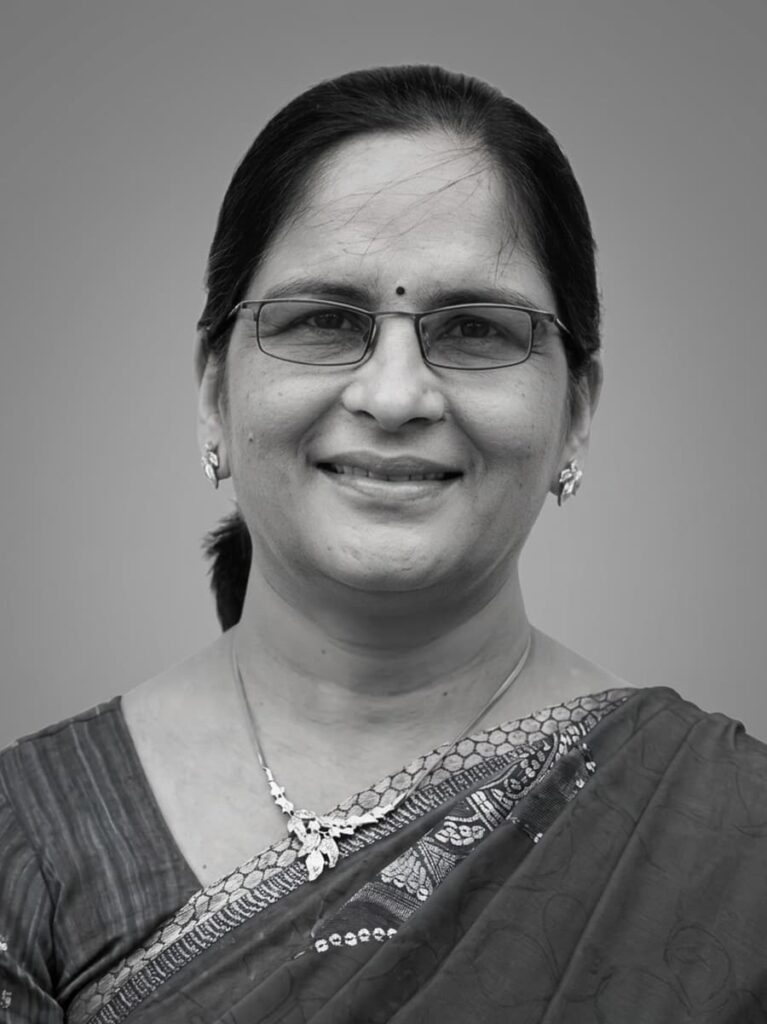
Dr. Shubhada Jajoo
Reader in Obstetrics and Gynaecology · MGIMS Tenure 1985 – 1989 Born 13 June 1957, Tadavale, near Barshi, Maharashtra Education MBBS, Dr. Vaishampayan Memorial Government Medical College Solapur (1980)MD Obstetrics and Gynaecology, Solapur (1983)
PhD JNMC Savangi Wardha (2019)
Tadavale, the Dream, and the Dry Rotis
Shobha Tapade — she became Shubhada Jajoo after her marriage — was born on June 13, 1957, in Tadavale, a small village near Barshi in Maharashtra. Her parents, Ratanlal and Godavari, had eleven children and severely limited means. She was the youngest. The family could not always sustain school fees. There were literally no chairs to offer when the prominent Jajoo family came to visit.
The dream crystallised on a specific day during a visit to Beed. Her mother fell ill, and Shubhada watched the doctor at work — calm, composed, commanding absolute respect without effort. A door opened in her mind. If medicine was out of reach, she told herself, life itself was simply not worth living. This was not childhood melodrama; it was the cold determination of a child who had identified the one thing capable of changing her entire trajectory.
Her elder brother Lakshminarayan took her to Barshi; her brother-in-law provided a roof and bore the cost of her education. She ranked first in her school and sixth in the entire Barshi division — an achievement that required a daily six-kilometre walk to a boys’ mathematics class, because no mathematics class existed for girls. During her pre-degree years at Dayanand College in Solapur, the hostel served dry rotis and cold, watery dal, and no one called to check whether she was managing. She managed. In 1976, she entered Dr. Vaishampayan Memorial Government Medical College, Solapur, and earned her MBBS in 1980 with medals for academic excellence.
The One-Month Departure
The MD seat at GMC Nagpur seemed ideal — her husband was pursuing super-specialisation there, her in-laws were in nearby Wardha, and her friends were in Nagpur. The department’s reality pointed elsewhere. It was steeped in vicious politics and power struggles that had nothing to do with medicine. Just one month in, she made the staggering decision to leave. Leaving meant risking the entire specialisation she had been working toward since childhood. But some decisions come from a bedrock of self-respect that cannot be argued with. She returned to Solapur on faith alone.
In 1983, she secured an MD seat in Solapur. The civil hospital provided a relentless stream of gynaecological and obstetric emergencies that honed her clinical instincts rather than breaking her. By 1985, armed with her MD, she moved to Wardha, stepped briefly into the Civil Hospital post vacated by Dr. Rani Bang, and applied to MGIMS. Why MGIMS? She had a ready answer: “Because that’s where the academics were.”
The Interview and the Arrival
She joined MGIMS on October 1, 1985, exactly seven months pregnant. She had applied for the post in March and appeared before the interview board in September — a formidable panel that included Dr. Sushila Nayar, Dr. B.S. Chaubey, Dr. M.P. Dwivedi, and four others. Selected from three highly qualified candidates, she arrived carrying her daughter Rucha just two months ahead of the birth. Her maternity leave lasted exactly six weeks. Then she was back, the newborn in the background and the gruelling hospital work in the foreground, the two massive demands running simultaneously.
She joined Dr. Swarnalata Samal’s unit and found in her superior a model of professional character that was the exact opposite of everything the toxic GMC Nagpur department had represented — humble, self-effacing, allowing residents and faculty to take full credit for their work. For Shubhada, who had grown up in a household where the generosity of others had made her education possible, this quality resonated deeply.
What She Built in the Department
She introduced magnesium sulphate for treating eclampsia — a direct, vital departure from the lytic cocktail that had been standard — and patient outcomes immediately improved. She taught Dr. Samal how to perform laparoscopic tubectomies, a skill her mentor would carry forward for the rest of her career. She brought tight organisational structure to the department’s examination processes. The clinical pace was relentless: with only two units in the department, every other day was OPD or surgery, interspersed with deliveries, emergency C-sections, medical student lectures, and postgraduate training.
She was promoted to Reader in August 1989. She would finally lead her own unit, mentor postgraduates, and conduct independent research. The autonomy she had been working toward for years was finally within reach. Four days after Christmas in 1989, she abruptly resigned. Pressure from her in-laws to leave Sevagram and establish a private practice in Wardha had mounted, and the family decision was made.
The Double Gold and the Long Return
She turned the family home into an eight-bed hospital, acquired an ultrasound machine and a laparoscope, and began building again from scratch. Her husband Suhas eventually joined her. In 2001, academia called her back — she began teaching part-time at JNMC Sawangi. By 2011, she was a full Professor, a postgraduate guide, and a PhD holder.
The university ceremony at which she received her PhD provided a moment of profound poetic justice. At the exact same ceremony, her younger daughter Shruti received a gold medal for standing first in Anaesthesiology. Union Minister Nitin Gadkari presided over both awards. The woman who had walked six kilometres for a mathematics class was now being formally recognised alongside the daughter who had followed her into medicine, standing entirely equal beside her.
Her elder daughter Rucha — born just two months after her mother joined MGIMS in 1985 — became a laparoscopic surgeon, following her father. Shruti became an anaesthesiologist, following her mother into academia. In October 2024, Dr. Shubhada Jajoo retired from her academic post at JNMC Sawangi. She has finally stepped away from Obstetrics, focusing entirely on Gynaecology — trading the relentless midnight emergencies of the labour room for the measured precision of scheduled surgery. After a lifetime anchored to hospital wards, she is finally travelling, discovering the vast geography of India at her own pace. The village girl from Tadavale who had no chairs to offer when guests visited is still making the dream true today.
Key Milestones
| 1957 | Born, 13 June, Tadavale, near Barshi — youngest of eleven siblings; father Ratanlal, mother Godavari |
| 1970s | Walked six kilometres daily to a boys’ mathematics class — no class existed for girls |
| 1976 | Entered Dr. Vaishampayan Memorial Government Medical College, Solapur |
| 1980 | Completed MBBS, Solapur — medals for academic excellence |
| 1981 | MD seat, GMC Nagpur — left after one month; toxic departmental politics; returned to Solapur on faith |
| 1982 | Married Dr. Suhas Jajoo, 26 February — Wardha’s Gandhian family; no chairs to offer when they had come to visit |
| 1983 | MD Obstetrics and Gynaecology, Solapur — relentless civil hospital emergencies |
| 1985 | Joined MGIMS, 1 October — seven months pregnant; daughter Rucha born two months later |
| 1985 | Introduced magnesium sulphate for eclampsia — replacing lytic cocktail; patient outcomes immediately improved |
| 1989 | Promoted Reader, August |
| 1989 | Left MGIMS, 29 December — family decision; built eight-bed hospital in Wardha with husband |
| 2001 | Began part-time teaching, JNMC Sawangi — academia calling her back |
| 2011 | Full Professor and postgraduate guide, JNMC Sawangi · PhD awarded — at same ceremony as daughter Shruti’s gold medal |
| 2024 | Retired from JNMC Sawangi, October — continues practice with husband and daughter Rucha in Wardha |