If Christine, Maureen, and Joseph were my bridge to American life, my Indian circle became my anchor to home. Before leaving Sevagram, I had pictured Berkeley as a year of quiet weekends and lonely meals — Saturdays in the library, speaking more to books than to people.
I could not have been more wrong.
Once I settled in, I discovered what every Indian abroad eventually discovers: we are never truly alone. The Bay Area was full of familiar names, familiar accents, and familiar warmth. California stopped being a place of campuses and freeways. It became a map of living rooms, dining tables, and cups of tea that appeared before you could even ask. I called it our Desi GPS — an invisible navigation system that always knew where the next home-cooked meal was.
Madhu and Niki: the first safe house
It began, naturally, with Madhu and Nikita Pai. They were not just the reason I was in Berkeley. They were my translators — helping me understand everything from bus routes to the American grading system, from what to buy at the supermarket to what to ignore entirely.
One Sunday morning, soon after I moved into Manville Apartment, Madhu called.
“Come for tea and breakfast,” he said.
“I can’t,” I replied, sounding important. “I’m going to San Jose to meet Bhavana’s cousin.”
I pronounced it exactly as it looks: San-Joes.
Madhu paused. Then, very gently, he rescued me. “SP,” he said, “here it’s San Ho-say. The J becomes H. Spanish.”
I felt foolish for a moment — a full professor who could not pronounce the name of the next city. But I was grateful. That small correction saved me from a great many future embarrassments.
Madhu and I also bonded over cricket, which in America is as rare as a decent cup of cutting chai. He knew where to find it. We would drive to an Indian cinema in Fremont and watch India play on a large screen, surrounded by hundreds of shouting expatriates, returning late, sleepy and satisfied, like boys who had stolen an extra hour of childhood.
On quieter Sundays, we played cricket in Madhu’s backyard. After the match, Niki would feed us a breakfast that felt like a reward for simply showing up. For a few hours, Albany became Sevagram.
Raju and Uma: the weekend reset
My most frequent refuge was the home of Raju and Uma Zamvar in Sunnyvale, about fifty miles from Berkeley. Their house was my weekend reset button — the place I went when the week had been long and the studio apartment had begun to feel small.
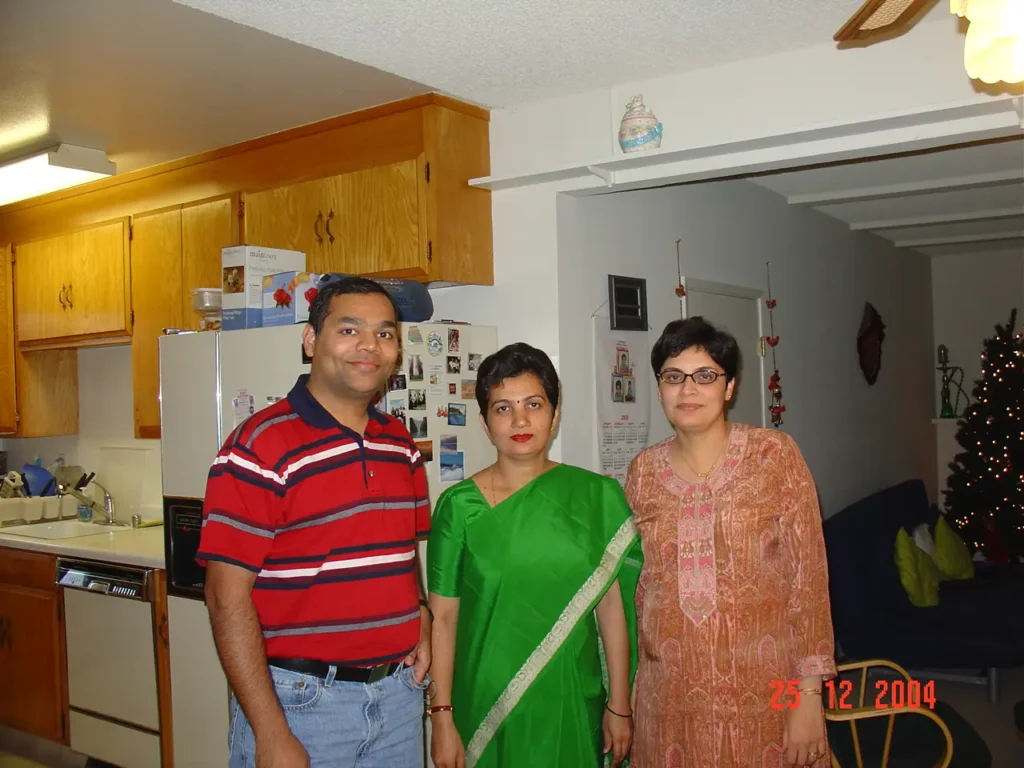
They had a black Honda Civic that became our little chariot across the Bay Area. Raju had just joined Visa. Uma was working as an internist at Kaiser Permanente Santa Clara. They were young, busy, building their lives in a new country — and yet they made space for us with the ease of people who understand, instinctively, what it means to be far from home.
We celebrated Diwali 2004 with them. Their son Rohan was a toddler then, wobbling around the house with that proud seriousness that toddlers carry. Uma was pregnant with their second child, Rishi, who would arrive in February 2005. Even with a demanding job and a growing belly, she hosted us as if it cost her nothing.
Our weekends found their rhythm. Raju would take us to Fry’s Electronics — a vast store that felt like a museum of the future, aisle after aisle of gadgets and cables and things that had no name yet. We wandered through it, amazed that Silicon Valley seemed to run on small shiny objects.
And then came the real medicine: Indian food.
We would go to Chaat House on El Camino Real. After a week of sandwiches and salads, a plate of pani puri and pav bhaji tasted like homecoming — not metaphorically, but physically, in the chest. In January 2005, when Bhavana visited, we celebrated Rohan’s birthday at Mayuri Restaurant in Santa Clara. There was a bird show for the children. It was loud, cheerful, and slightly chaotic — exactly the way birthdays should be.
Today, Raju is a senior professional at Visa and Uma is Chief of Medicine at Kaiser, leading a large team. But in my mind, they remain the young couple in the black Civic who made sure a lonely student did not stay lonely for long.
More homes, more hands
The circle kept expanding in the way that Indian networks do — each connection leading to another, each home opening a door to the next.
Bhavana’s aunt, Nilu Masiji, lived in Palo Alto. Visiting her gave us a glimpse of an older Indian community, settled and steady, that had made California genuinely its own. We went trekking in the Palo Alto hills and were surprised, as one always is, by how green California could be.
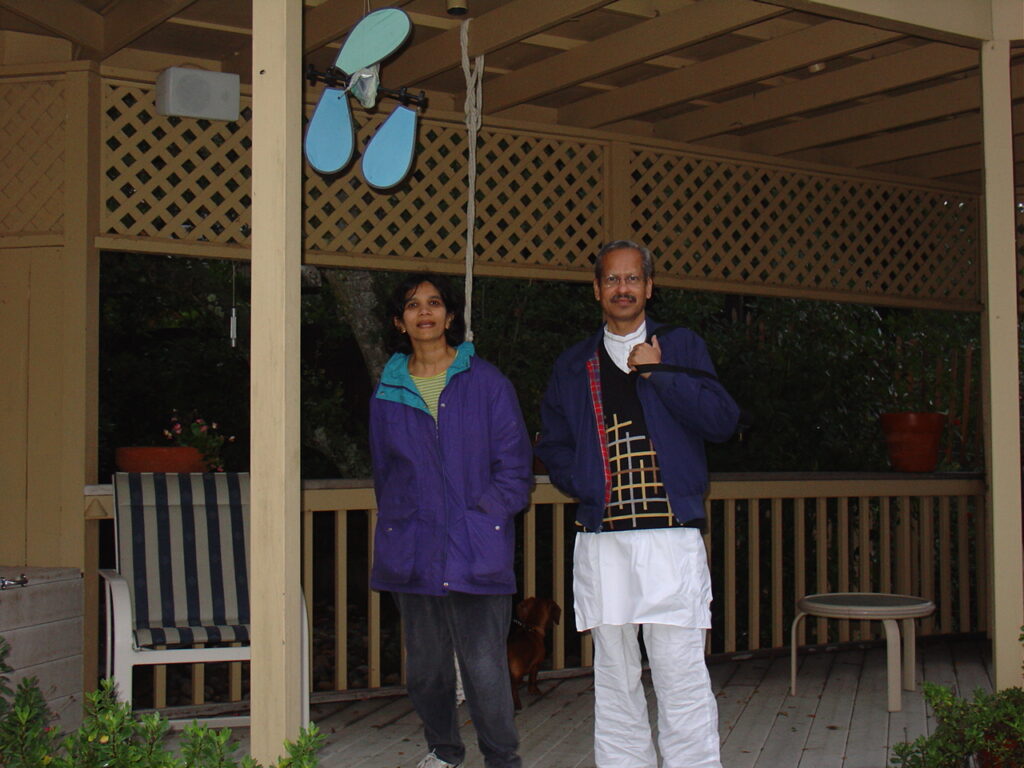
In Fremont, Rahul Asawe and his wife Heena fed us as if we had been away for years rather than weeks. And then there was Sanket Khemuka — a Wardha connection, vivid and unexpected in the middle of Silicon Valley. Seeing a Wardha boy working in Sunnyvale, confident and settled, filled me with a quiet pride. Wardha, it turned out, had travelled farther than any of us had imagined.
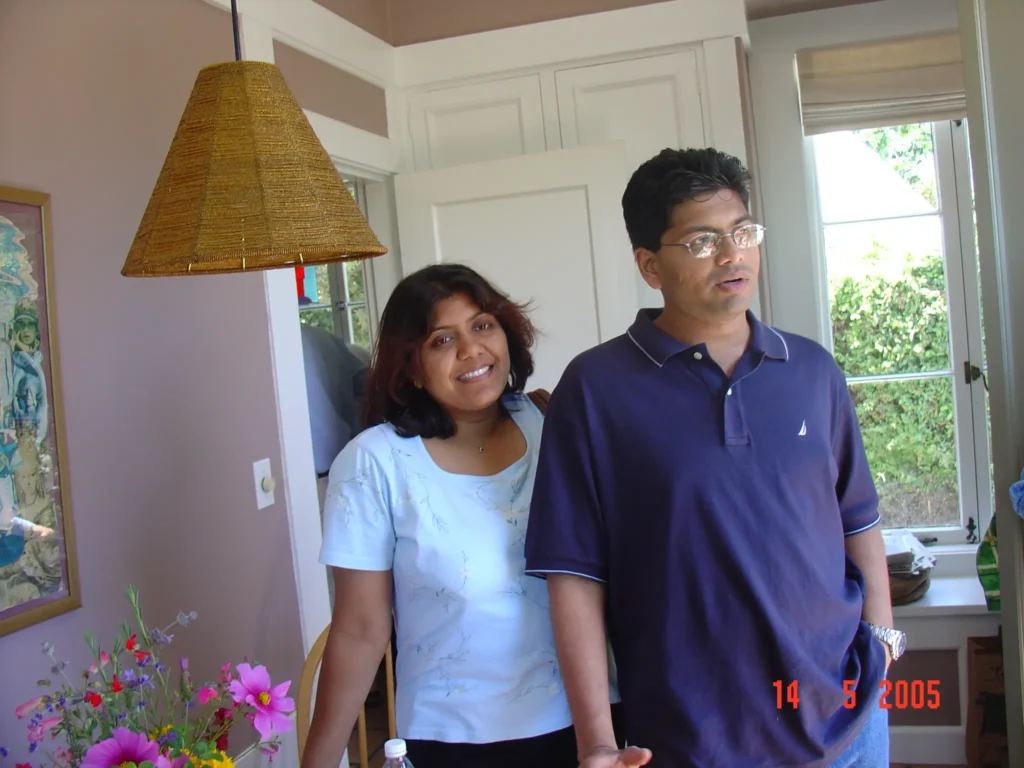
When graduation day arrived in May 2005, Raju and Uma drove all the way from Sunnyvale to Berkeley to be there. Later, they came to the apartment for lunch with my friends. It was a simple meal. It felt like a celebration with family.
Los Angeles: a tour of people
During Bhavana’s December visit, we took a trip to Los Angeles. It was not sightseeing — or not primarily. It was a tour of people.
We met Subhash Mantri, Deodas Rathi, and Chandrakala Rathi. We stayed with Shilpa Fattepuria, the daughter of our family friend from Wardha, Ramesh Fattepuria. Sitting in her living room in California, talking about Wardha names and Wardha stories, the distance between the Bay Area and Vidarbha shrank to nothing. That is the peculiar alchemy of the Indian diaspora — you travel ten thousand kilometres and find yourself talking about the same street corner you left behind.
Denver: cricket at 2 AM
Before flying home in May 2005, I made one final stop — a flight from Oakland to Denver, to visit Ravi Kachaliya and his wife Shyamala.
Ravi came from a Wardha family that everyone knew. His father Bhupatbhai had run Panchsheel Store, a cloth shop that had dressed half the town for decades. Ravi had built a life in America, earned two Master’s degrees, and established himself in finance. He lived in a large home in Denver, but he carried Wardha inside him the way we all do — in his references, his humour, and the particular ease he had with people from home.
For four days, Shyamala fed me Gujarati food that tasted as if it had made the journey directly from our kitchens: dhokla, thepla, undhiyu. Ravi and I were both night owls. We sat up late, watching India versus Pakistan on his large television, cheering and complaining like seasoned selectors. We talked about books — swapping authors, arguing gently over sentences. Those nights were the perfect winding down. After months of deadlines and lectures, Denver felt like a long, unhurried exhale.
And then I found, recently, a letter I had written to Bhavana from Denver — dated 20 March 2005. Gmail had been born barely a year before, and I was still discovering that letters could travel instantly. Reading it now, twenty years later, I find it captures those days more precisely than memory alone can manage.
In fact, I had written to her the day before as well — on 19 March, the evening I arrived in Denver. That letter, too, survived in my inbox.
Denver, 20 March 2005
Hi Bhavana,
I am writing this mail from Denver, where I landed last night. Berkeley was a bit cold and wet all Friday. I took BART from Berkeley to Oakland airport and got into a bus that took 15 minutes to take me to the airport. I already had a boarding pass, so all I had to do was check my luggage and wait for an hour at the gate. Later I found that my bag had been opened officially by the airport authorities as part of a routine random check. It is always better not to lock the bags — if the authorities have to break the locks, they can damage the zip. Two and a half hours later, I found myself at Denver airport.
Ravi had already hinted — and I am glad that he did — that Denver is a really huge airport. Much bigger than San Francisco. And certainly more beautiful. I came five floors down, took a train, collected my luggage, went one floor down, and then waited about 15 minutes for Ravi and his wife to arrive. A 25-minute drive took us to their home at about 9:30 pm — Denver is one hour ahead of Berkeley time. Their home is really beautiful. I am taking a few snaps of their artfully decorated rooms. What caught my eye was the open-plan concept — drawing room, living area, kitchen, and dining room all flowing into one, with the master bedroom overlooking the drawing room. Like California homes, all homes in Denver are made of wood, which makes them easy to remodel every few years. You do not have to live in the same old house year after year.
I had a lovely Indian-style lunch, which I ate to my heart’s content. And then a surprise was waiting for me. Ravi has a large, wall-mounted television, which was showing the India-Pakistan match live. And like me, this couple is also cricket-mad. We ended up enjoying Rahul Dravid’s century and watching Dinesh Karthik narrowly miss his, until almost 2:00 am. The post-tea session of the match was recorded on video so that we could watch it the next day. Then I retired for a well-deserved sleep.
I am sure the next three days are going to be exciting. Both Ravi and Shyamala work from home and seem to be doing very well. They told me stories of how their parents visited last year and, much against their original plan, ended up staying for a couple of months. And now Bhupatbhai has liked the US so much — particularly its work ethic and professional honesty — that he is planning to visit again.
I will keep you posted on the day’s developments in the evening. I do hope everything is fine in Sevagram. Have a nice time.
With all my love, SP
Dear Bhavana, my love,
March 20th — my second day in Denver. We stayed up late the day before — till 1:45 am. The India-Pakistan cricket match, shown live on cable, was too tempting to go to sleep for. I woke up early the next morning, though. I did write you a mail, but because I could not access the net, the mail is still sitting in the draft section of my Outlook. The Sevagram map that you sent me looks indeed very nice. I also received a mail from Rahul Narang and replied to him yesterday.
In the afternoon, Ravi drove us for about two hours to a small town called Georgetown. These small towns around Denver have their own innate 18th-century charm, with most of them built in the old French style, and even today they have carefully retained that same old touch. I saw snow there, capping the mountain tips, dressing the green trees, and clothing the houses.
Next we drove for about 45 minutes to reach another small town called Vail. This town showcases the spectacularly beautiful Rocky Mountains that stretch from coast to coast. Eyes refuse to believe that nature could be so picturesquely pure and spectacularly serene. No wonder that this town houses some of the most expensive homes in the USA: celebrities have invested close to 100 crore rupees to acquire small one- or two-bedroom apartments, to get away from the maddening, crowded cities and their hustle and bustle. These homes take you straight to the Rocky Mountains — clothed in pristine white snow — and bring a much-needed solace and stillness to the average ambition-driven American. Even Europeans come here in winter to spend their vacations.
We then strolled through the town. Ravi took me to several shops that sell antique showpieces and watches to connoisseurs. Some watches, exquisitely beautiful, cost 20 lakh rupees. And the shop owner was generous enough — as most Americans are — to allow us to try these watches on our wrists. For a few seconds, our wrists were the proud owners of the most expensive Swiss watches in the world! Collectors interested in unique cut-glass pieces also frequent an adjoining shop that showcases sculptures and pieces whose prices range from 10 to 50 lakhs.
The stomachs were hungry by now and badly needed food. A Chinese restaurant looked a bit shady, and we chose to eat pizza at an Italian restaurant instead. After a wait of about 50 minutes in a queue, a waitress ushered us into a busy — and noisy — dining hall whose walls were painted black and red. The pizza tasted really good, more so because our palates were quite hungry. It was 11:30 at night when we came back. And then curiosity got the better of us again. Ravi and I watched the final session of the India-Pakistan match until our eyes literally dropped and we found it extremely difficult to stay awake.
Today an Indian couple has invited us for lunch. We will go there and then probably to a famous Hindu temple here.
I spoke to Bhupat bhai yesterday night. He was very happy to know that I was with Ravi. He had already called him, asking that he make my stay as comfortable as possible. He also said that it was my home and I should stay as long as I wanted. He again instructed Ravi to take special care of me. He regretted that he had visited the US too late in his life, and that had he come here about ten years earlier, he would have settled down in the US. He was deeply impressed with their work ethic and professionalism, and also with the dignity of human labour and the equality of people.
That is it. I will write to you again.
With all my love, SP
What home really means
On the flight back to India, I understood something simple that I had not known how to articulate before.
I had gone to America to study public health. I learned epidemiology and statistics, of course — and I am grateful for both. But the deeper education was quieter. Home, I learned, is not a building. Home is people.
It was Madhu saving me from saying San-Joes for the rest of my year. It was Uma making tea even when she was tired. It was Raju driving us around the Bay Area as if we had always belonged there. It was Ravi watching cricket with me at midnight in Denver, talking about Wardha as if we had never left.
They took a foreign country and wrapped it in familiarity.
And because of them, even when I was far from India, I never once felt far from home.