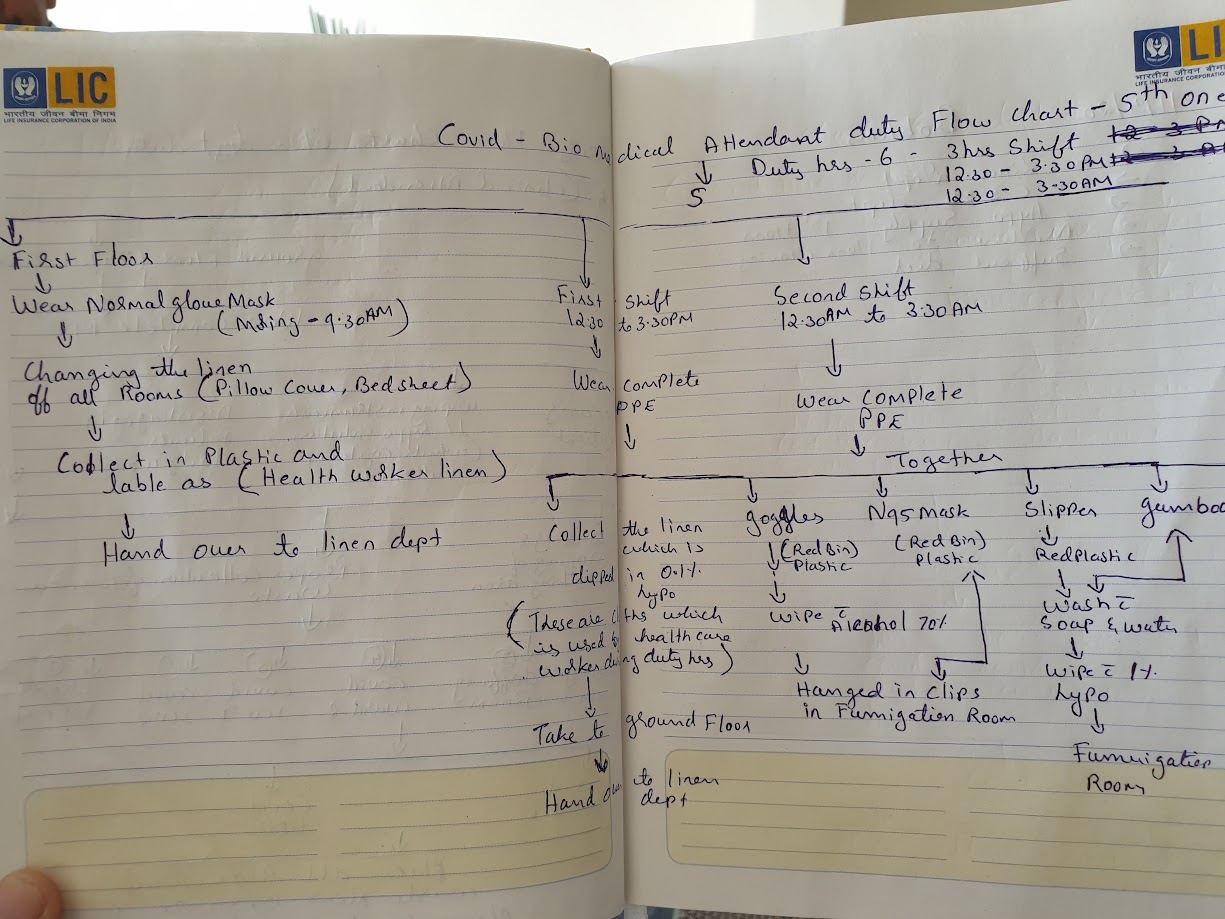
Meticulous protocols: A handwritten COVID-19 duty flow chart for hospital attendants, 2020.
In early April 2020, I stood in the central corridor of MGIMS and felt as though I were walking through a ghost town. For over a decade as Medical Superintendent, my walk through the hospital had meant a sensory overload: woodsmoke from the tea stalls, families gathered under the neem trees, the constant hum of outpatients seeking healing. Now that life had been surgically removed. The OPDs were silent. The wards were empty. The lockdown had frozen the world outside, but for those of us inside the walls, the silence was not peaceful — it was the breath drawn before a long, sustained scream.
Covid-19 arrived in Sevagram like a phantom. It didn’t just threaten our health; it threatened our institutional identity. We are a teaching hospital rooted in the Gandhian tradition, where the “touch” of the physician and the presence of the community are the pillars of the mission. Suddenly, that which made us human made us vulnerable. Clasping a patient’s hand, sitting close to hear a whispered symptom, operating through the night — these acts of service had become acts of biological hazard.
***
The Anatomy Hall Summit
To lead through this, I needed to anchor our fear in structure. I convened an emergency meeting of department heads in the Anatomy Lecture Hall — a choice of venue that was accidental but became symbolic. We sat surrounded by the silent teachers of human structure, the skeletons and preserved specimens that represent the absolute certainty of medical science, while trying to decipher a microscopic invader dismantling that certainty in real time.
I looked at the faces of Subodh Gupta, Sumedh Jajoo, Dhiraj Bhandari, and our senior nursing supervisors — veterans who had managed chikungunya in 2007 and cholera outbreaks without flinching. In their eyes I saw my own uncertainty reflected back. The fear was primal: would there be enough masks, would the ventilators hold, and the question every staff member carried home — if I go into that ward today, am I carrying death to my children tonight?
“Our fight will be driven by science,” I told the room, trying to keep the knots out of my voice. “We will not be governed by anecdotes, by social media rumours, or by fear. We will build a fortress here, but it will be a fortress of evidence.”
***
Repurposing the Old Hospital
Our first move was logistical surgery. We emptied the entire old hospital building — the historic home of Surgery and Orthopaedics — and turned it into a dedicated Covid Block, dividing it into a Red Zone for patients and a Green Zone for staff. We also moved screening outdoors, into the long corridor between Medicine and registration, once we realised that open air was our ally and air-conditioning would simply circulate the virus.
***
The Hunt for “Gold Dust”
My desk stopped being covered in files and started being covered in lists of masks and PPE kits. I watched senior surgeons who had done thousands of operations hold a simple face mask with the reverence usually reserved for a delicate instrument. We had constant debates about using PPE wisely — everyone wanted to wear full “astronaut” suits for every task, and we had to teach staff that science, not layers of plastic, was their real protection.
***
The Heartbreak of “No-Touch” Medicine
I remember the young residents and nurses preparing for their first Covid shifts, many barely out of their teens — the red marks of tight masks on their faces, the quiet weeping in the locker rooms before a shift. Wardha’s April heat, a dry furnace touching 45°C, turned non-breathable PPE into a sauna; dehydration was immediate, exhaustion absolute. But the physical discomfort was nothing beside what we were being asked to practise: medicine without touch. We listened to lungs through layers of plastic, spoke to gasping patients from behind glass, and eventually stopped using our stethoscopes altogether.
I was sixty-four, and my heart condition kept me out of the wards to save my own skin. The guilt was real and took time to make peace with — was it right to ask young doctors to work afraid while I sat safe in an office? Eventually I understood that my fight was not at the bedside but at the desk: managing the chaos, enforcing science, keeping drug use rational.
We made a pact in that Anatomy Hall: we would fight the virus, but we would also fight to keep our humanity. We would adapt, improvise, and struggle — but never abandon the discipline of care.