Our world was a triangle of the library, the ward, and the hostel. The “scholars” in our batch walked the corridors with thick, heavy copies of Goodman & Gilman’s Pharmacology cradled in their arms like holy relics. They seemed to believe that if they carried the weight long enough, the knowledge would enter through their skin by osmosis. The rest of us, seeking clarity over bulk, found our savior in Dr. R.S. Satoskar. He wrote the way a good teacher speaks—simple, direct, and determined to keep you sane while you memorized the half-life of diuretics.
But it was Pathology that truly stole our hearts, and we had one man to thank for it: William Boyd. To us, Boyd wasn’t a dry academic; he was a storyteller who happened to hold a scalpel. He didn’t just list symptoms; he painted them. He could describe a diseased gallbladder as if he were writing a Gothic novel: “graceful, fragile gossamer folds of the mucosa… loaded down by dense yellow opaque masses, much as a delicate birch tree might be weighed down by a load of snow.” He wrote that influenza could cross a continent as fast as an express train, and he famously compared the lesions of syphilis to “the list of the ships in the Iliad.” We didn’t just read Boyd to pass; we read him to see the poetry in the tragedy of disease.
The Anatomy of a Prank
Life in the hostel was a delicate balance of intense study and high-velocity nonsense. Among us was Abhimanyu Kapgate, a boy from a small village in Bhandara whose English was hesitant but whose memory was a biological miracle. Kapgate knew Gray’s Anatomy with the devotion of a priest. You could point to any obscure nerve or a minor muscle in the palm, and he would recite its origin, insertion, and nerve supply with rhythmic precision.
However, Kapgate’s expertise ended at the human body. Cricket was, to him, a baffling foreign ritual. One humid evening in Room 99, Narayan Dongre decided to test the limits of Kapgate’s literal mind. We were all obsessed with eponymous syndromes—Guillain-Barré, Cushing’s, Conn’s. With a perfectly straight face, Dongre asked Kapgate about the “Greg Chappell and Andy Roberts Syndrome.” He followed it up with the “Tony Greig Syndrome,” discussing them as if they were rare tropical conditions found only in the most advanced textbooks.
Kapgate’s pride was his undoing. He didn’t admit ignorance. That night, while we stifled our laughter, he went to the library and searched the medical indexes like a man possessed. He spent hours turning pages, hunting for a pathology that only existed on a cricket pitch. He returned late, looking defeated and weary. When we finally broke the news—that these were cricketers, not diseases—he was furious. He vowed a revenge that, like most hostel threats made before the lights went out, was forgotten by breakfast.
The Sudden Silence
But the mid-seventies in a medical hostel weren’t just about Boyd’s prose or locker-room pranks. There was a shadow that lived in the corners, born of a system that was rigid, hierarchical, and often indifferent to the human cost of failure.
The afternoon of April 21, 1975, is a memory that remains frozen in time. Chandrabhan Chattani—Chandar to all of us—was a quiet, reliable boy from a business family in Yavatmal. He was the person you played table tennis with to unwind, or the one you shared a quick, oily breakfast with in the canteen. But the Second MBBS University exams had turned into a monster he couldn’t outrun.
Just before the Forensic Medicine paper, while we were all frantically reciting toxicological formulas in the corridors, Chandar retreated to his room in Hostel 4. He had been reading Agatha Christie’s Death Comes as the End—a grim, desert-toned mystery. Perhaps its themes of inevitable endings offered a dark comfort to his own despair. Fearing he could never meet the expectations of his family, he took an overdose and chose a permanent exit.
The hostel let out a collective, ragged gasp as the news spread. The crushing irony arrived a month later when the results were posted: Chandar had passed the paper he feared with a 58. He was qualified to move forward, but he wasn’t there to see the notice board.
A year later, the silence returned when we lost Pramila Khapre in the girls’ hostel. She was a girl of impeccable grace and beautiful handwriting, but she, too, found the weight of the white coat too heavy to bear. We moved on because the system demanded it. Classes continued, and the wards beckoned. But the corridors of the GMC hostel never felt quite the same again. Some absences don’t leave quietly; they remain as a soft, persistent echo in the back of your mind, reminding you that in medicine, the most fragile thing we ever handle isn’t the patient—it’s often ourselves.
The Verdict
The university is indifferent to grief; the machinery grinds on. When the results were finally pinned to the notice board, we crowded around, searching for our names. For some, the marks were a source of relief; for others, they were a heartbreaking reminder of what might have been.
My own marksheet is a yellowing relic now. It isn’t the transcript of a genius, but of a student who had finally found his footing in the world of clinical logic.
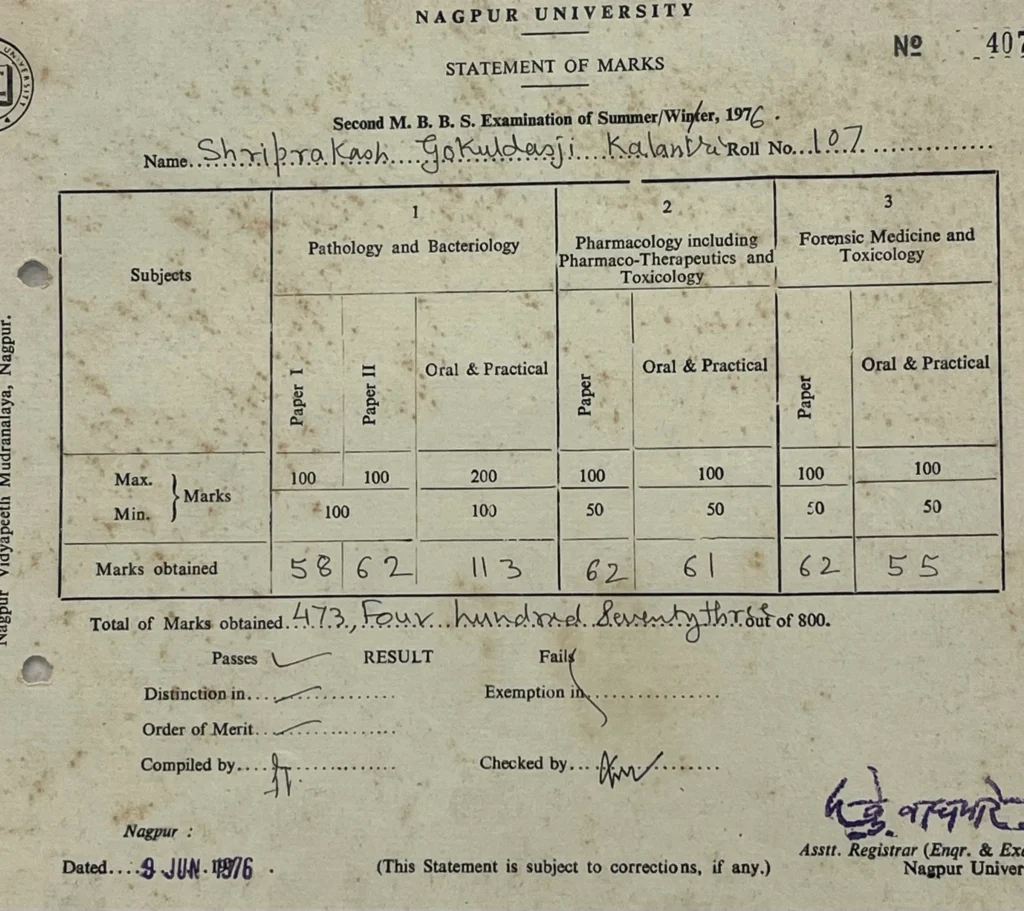
Looking at these numbers decades later, I don’t see the marks so much as I see the hours spent under a dim hostel lamp. These figures were our ticket out of the “middle overs” and into the real game. We had survived the grind and the silence. Ahead of us lay the hospital wards and the patients who would eventually teach us more than Boyd ever could.