Kamala Desikan
Secretary, Kasturba Health Society · Nurse · Institution Builder Tenure 1988 – 2003 Lifespan 1926, Nalluru, Guntur district, Andhra Pradesh — 15 October 2004, Sevagram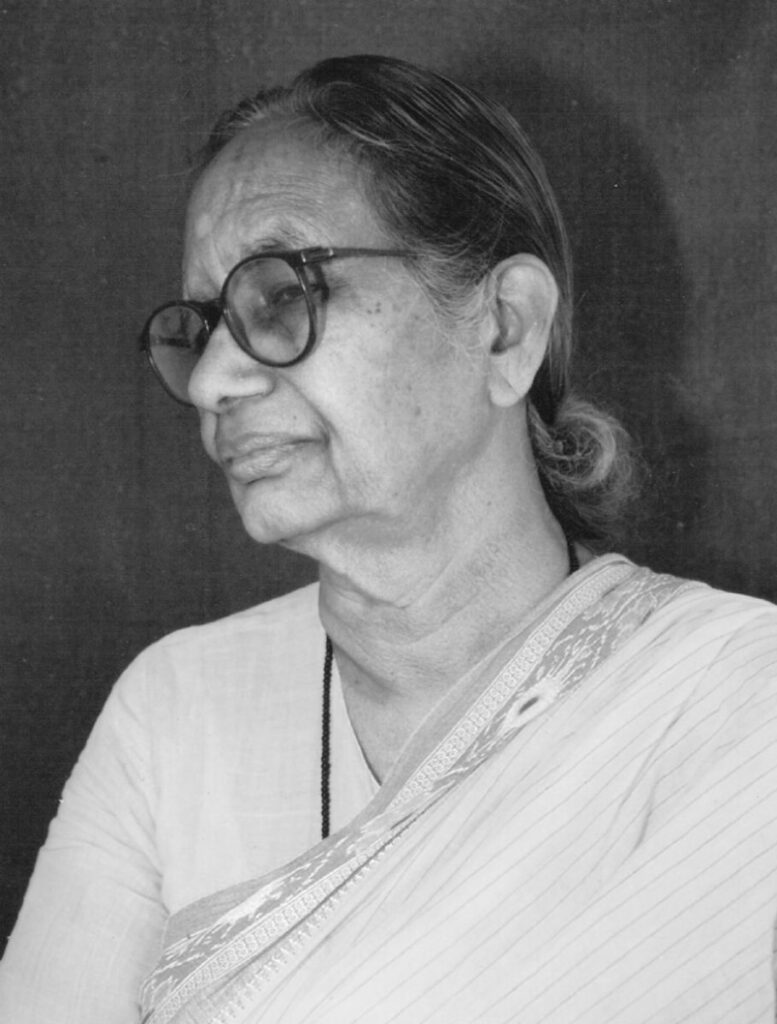
Kamala Desikan’s story begins in 1927, in the quiet village of Nalluru in Andhra Pradesh. She was the only child of her parents, but her mother’s death from tuberculosis within months of her birth left her in the care of her grandmother. Her father remarried, but his influence on Kamala was profound. An intelligent landlord with a sharp interest in politics, he wore khadi with pride and spoke passionately about Sarvodaya and Gandhi. As a little girl, Kamala sat beside him during these discussions, absorbing the ideals of justice, simplicity, and service. Gandhi’s vision became her own, and the dream of living in his ashram took root early.
When she was nearing twenty, she chose to follow that dream. Moving to Sewagram Ashram, she entered a world of discipline and service. Under the guidance of Prabhakarji, a veteran Gandhian, and Dr. Sushila Nayar, she trained as a nurse at Kasturba Hospital. She cared for patients with quiet dedication, and in a twist of fate, became the hospital’s first surgical patient when Dr. Nayar operated on her tonsils. Gandhi himself visited her afterwards, a moment that eclipsed her pain and etched itself into her memory. Her bond with fellow Gandhian Smt. Manimala Choudhary began here, a friendship that lasted a lifetime.
Her years at Sewagram shaped her spirit. She worked with refugees after Partition along with Dr. Sushila Nayar. Later, when Vinoba Bhave began his Bhoodan Yatra, she was inspired by his vision of Gramdaan—villages gifted for the poor. She volunteered to serve in Garanda, a remote tribal settlement in the Koraput district of Orissa. The journey to Garanda itself was arduous: trains, buses, and finally a sixteen-kilometre walk through dense forests. Life in Garanda was spartan—rice, dal, and brinjal were the only staples, malaria was rampant, and huts were their shelter. Kamala, the only trained health care provider, administered quinine injections to everyone, including herself. Yet she found fulfilment in this hardship, serving the tribals with courage and compassion.
In 1957, her life took a new turn. She married Dr. K.V. Desikan, a leprologist she had met at Sewagram, in a simple Gandhian wedding that cost only thirteen rupees. Together, they moved to Chilakalapalle village, where leprosy was widespread. While Desikan treated patients, Kamala immersed herself in the harijan colony. She brought spinning machines to train women, taught embroidery and painting, and encouraged girls to study beyond primary school. She co-founded Gramodaya Samiti to support education, healthcare, and women’s emancipation. At night, she tutored mischievous boys at home, giving them guidance and shelter. Years later, when those boys returned as successful professionals, the reunion was joyous proof of her quiet influence.
Her work soon extended beyond India. In the early sixties, Shri Jayaprakash Narayan, a Gandhian socialist and political leader, had visited Israel. He had been very impressed by the community working groups – the “Kibbutz”, in that country. He felt that the concept of the Kibbutz could be applied to Vinoba’s “Gramdaan” villages, and decided to send a team of Sarvodaya workers to Israel. In view of her work in the “Gramdaan” village, Goranda, in Orissa, Kamala was selected to the team. She spent six months in Israel, studying the way of life in a Kibbutz, participating in community work, visiting villages, and learning about the travails faced during the holocaust. Once, the then Prime Minister of Israel, Ben Gurion, addressed the group. Kamala sketched a picture of him as he was addressing them. Ben Gurion saw the sketch and, with a broad smile, autographed it. Later, Golda Meir, then a member of the Israeli Knesset, interacted with the group. A photograph of Kamala talking to her captured the warmth between them. Kamala returned to India with a broader vision and renewed energy, convinced that grassroots cooperation could transform villages back home.
Soon after Kamala’s return, Desikan and Kamala moved to Vellore. Desikan joined the MD Pathology course in the Christian Medical College (CMC), at Vellore. Kamala joined an ICMR project on Streptococci under Dr. Grace Koshy, Professor of Microbiology at CMC, involving community work. While working in an urban slum in Vellore, Kamala encountered a woman burdened with caring for her late sister’s four children in addition to her own, while her husband, disabled by leprosy, could not contribute. The woman struggled as the sole breadwinner, working as a domestic help in many households. Kamala stepped in with characteristic compassion and pragmatism: she arranged for two of the children to be cared for by relatives, placed another in a children’s home linked to an ICMR nutrition project, and personally supported one herself. The faculty at CMC responded generously whenever Kamala sought help, and through these efforts, she not only eased the family’s hardship but also forged enduring friendships with colleagues—bonds that lasted throughout her life.
After completing his MD in Pathology, Desikan joined the Central Leprosy Teaching and Research Institute at Chengalapattu, Tamil Nadu, in 1967. Around this time, Kamala was expecting their first child, and for the delivery she returned to the familiar surroundings of CMC Vellore. In July that year, their daughter was born—a little girl they named Prabha, in honour of Prabhakarji, Kamala’s mentor from Sewagram, who had guided her so deeply in her early years.
The family settled in Chengalapattu, where they lived for the next ten years. Kamala devoted herself wholeheartedly to raising Prabha, pouring her energy into motherhood with the same compassion and commitment she had always shown in her social work. Yet even in those years, she continued to nurture her own passions. For a brief period, she enrolled in an art school in Madras, honing her skills in painting and exploring her creative side. It was a time of balance—between family and personal growth, between nurturing her child and cultivating her own talents, a reflection of the rich, multifaceted life she would continue to lead.
In 1976, Desikan was appointed Director of the ICMR’s Central JALMA Institute for Leprosy in Agra, and the family—Desikan, Kamala, and their daughter Prabha—moved there. For Kamala, Agra became a new chapter of service. She quickly noticed that many children of class IV employees were not attending school. Concerned, she began teaching them the alphabet in the verandah of her home. Word spread, and soon more children arrived daily. When her home could no longer accommodate them, she turned an empty garage at the institute into a makeshift classroom. As the numbers grew, she enlisted the wives and daughters of JALMA staff and scientists to help teach. Before long, children from neighbouring villages were flocking to the little garage school, which soon ran out of space.
Recognising the need for a proper institution, ICMR permitted the use of land on the JALMA premises, but Kamala had to raise funds for construction. She met the challenge head-on, bargaining tirelessly for building materials and drawing support from unexpected quarters, including Rev. Tokiwa, the high priest of the Tsubosaka Dera temple in Nara, Japan. With such generosity and her persistence, the school was built. Named Lopamudra Vidya Mandir, it began as a primary school, grew into a secondary school, and eventually a high school. Recognised by the Government of Uttar Pradesh, it quickly became a respected local institution. Rev. Tokiwa later invited Kamala to Japan to share her experiences, and with his help, she arranged for teachers from the school to visit Japan and learn from the practices there. To this day, the school continues to provide education to children who might otherwise have had none.
Her compassion extended beyond education. Kamala noticed that leprosy patients arriving from distant towns had nowhere to stay if they reached Agra on weekends. Lodges refused them rooms, forcing them to sleep under trees or in makeshift shelters. She discovered an old leprosy home near JALMA, a fortress-like eighteenth-century building with rooms around a central courtyard, then housing only a handful of patients. Meeting with the municipal commissioner, she secured permission to revive the place. She formed the Kushth Sewa Samiti, gathered prominent locals, and renamed the building Kushth Sewa Sadan. The municipal corporation provided food for existing inmates, while JALMA supported referred patients, but Kamala knew more was needed. With help from LEPRA and Rev. Shoken Tokiwa, she arranged funds for food and clothing. She even procured a cow, cared for by one of the patients, whose milk provided both nourishment and a small income. She encouraged carpet weaving among patients, giving them dignity and purpose. Her regular visits built bonds of trust so deep that some patients, abandoned by their families, asked her to perform their funeral rites. She honoured their wishes, accompanying their bodies to the cremation ground and carrying out the rites herself.
In Agra, Kamala became affectionately known as “Mataji”—mother to all whose lives she touched. When she was diagnosed with an acoustic neuroma and underwent surgery at AIIMS, New Delhi, many of those she had helped volunteered to donate blood. The operation was successful, though it left her with facial palsy. Where others might have retreated, Kamala trained a domestic helper to perform daily physiotherapy massages and simply carried on with her work, undeterred.
Her interests were as varied as her service. She played the sitar and violin, loved both Carnatic and Hindustani music, and encouraged Prabha to train in Bharatanatyam. Painting was a passion—she created watercolours and oils of portraits, still life, landscapes, and scenes that moved her: the Taj Mahal, Gandhi from photographs, her lodgings in London and Japan, Niagara Falls, and the Himalayas in every shade of daylight. Gardening was another love. With guidance from the superintendent of the Taj Mahal gardens, she developed JALMA’s grounds into prize-winning displays. Her ikebana flower arrangements filled entire pavilions at Agra’s annual flower show, becoming star attractions. Even Agra’s famed carpet industry inspired her—she installed a loom at home and wove two hand-knotted Persian carpets, or “galeechas,” with her own hands.
Another defining chapter of her life came when she returned to Sewagram as Secretary of the Kasturba Health Society after Dr. Desikan retired. It was a role that demanded courage, conviction, and vision. She managed both the hospital and the Mahatma Gandhi Institute of Medical Sciences, ensuring that Gandhian simplicity guided modern medical education. Dealing with the administrative issues of a larger institution brought its own challenges, from managing the hospital and medical college staff to confronting politically motivated agitators who sought to disrupt the work of the Kasturba Health Society. Kamala faced disputes over land, unrest among employees, and the constant need to balance Gandhian simplicity with the demands of modern medical education. Yet she met each challenge with courage and clarity, resolving conflicts before they escalated, and ensuring that the institution remained a sanctuary of service. Her leadership was marked by both strength and compassion—she could be unyielding when defending principles, but equally nurturing when creating opportunities for women, students, and the disadvantaged.
When politically motivated groups tried to seize land belonging to the Society, Kamala confronted them directly, unflinching even when her male colleagues feared violence. Her presence alone was enough to make the agitators retreat. She dealt with staff disputes and quelled unrest before it could disrupt the institution. At the same time, she created opportunities for disadvantaged women by founding Udyami Mahila Mandal, a cooperative that provided hot meals and employment. She set up a crèche for working mothers, ensuring that women could balance family and career. She also encouraged the development of a bakery and food stalls, run by destitute women, which became a lifeline for students and staff. Her initiatives combined practicality with compassion, strengthening the institution while uplifting those who needed support most.
Her vision extended beyond administration. She believed the campus should be a living example of Gandhian ideals, where self-reliance and community flourished. She promoted horticulture, organized flower shows that brought families together, and encouraged staff to participate in cultural activities. She was fearless in defending the institution’s integrity, but equally nurturing in creating spaces where women, children, and the disadvantaged could thrive.
Kamala stepped down from the post of Secretary, KHS, in 2002. On the 15th of October, 2004, she started the Soundari Smriti Shikshan Kendra, in memory of a much loved sister-in-law, to provide free tuition classes to village school children who could not afford such classes. By evening, that day, she was no more. She had passed on just the way she wanted, graciously, in the service of society. Her daughter, Prabha Desikan, and son-in-law, Skand Trivedi, both alumni of MGIMS, survive her.
Key Milestones
| 1926 | Born, Nalluru, Andhra Pradesh |
| 1946 | Arrives at Sevagram Ashram, age twenty |
| 1946 | Gandhi visits her bedside after tonsillectomy |
| 1948 | Refugee rehabilitation work with Dr. Nayar |
| ~1950 | Goranda, Koraput — five years in the forest |
| 1957 | Marries Dr. K.V. Desikan — total cost: ₹13 |
| 1957 | Chilakalapalle — Ambar Charkha programme for harijan women |
| 1960 | Six months in Israel studying kibbutz model |
| 1976 | JALMA Institute, Agra — garage school begins |
| 1976 | Lopamudra Vidya Mandir — school built from nothing |
| 1976 | Kushth Sewa Sadan — hostel for leprosy patients |
| 1988 | Returns to Sevagram — Secretary, Kasturba Health Society |
| 1988 | Founds Udyami Mahila Mandal canteen, MGIMS |
| 2003 | Resigns as Secretary, KHS |
| 2004 | Dies 15 October, Sevagram — founding a school that morning |