Dr. Meena Ramdas Belsare
Professor of Anatomy · Reader · MGIMS Tenure 1975 – 1983 Lifespan 24 September 1941, Murud Janjira, Maharashtra — — Education MBBS (Topiwala National Medical College, Mumbai) [1967]MS Anatomy (MGIMS, Sevagram) [1979]
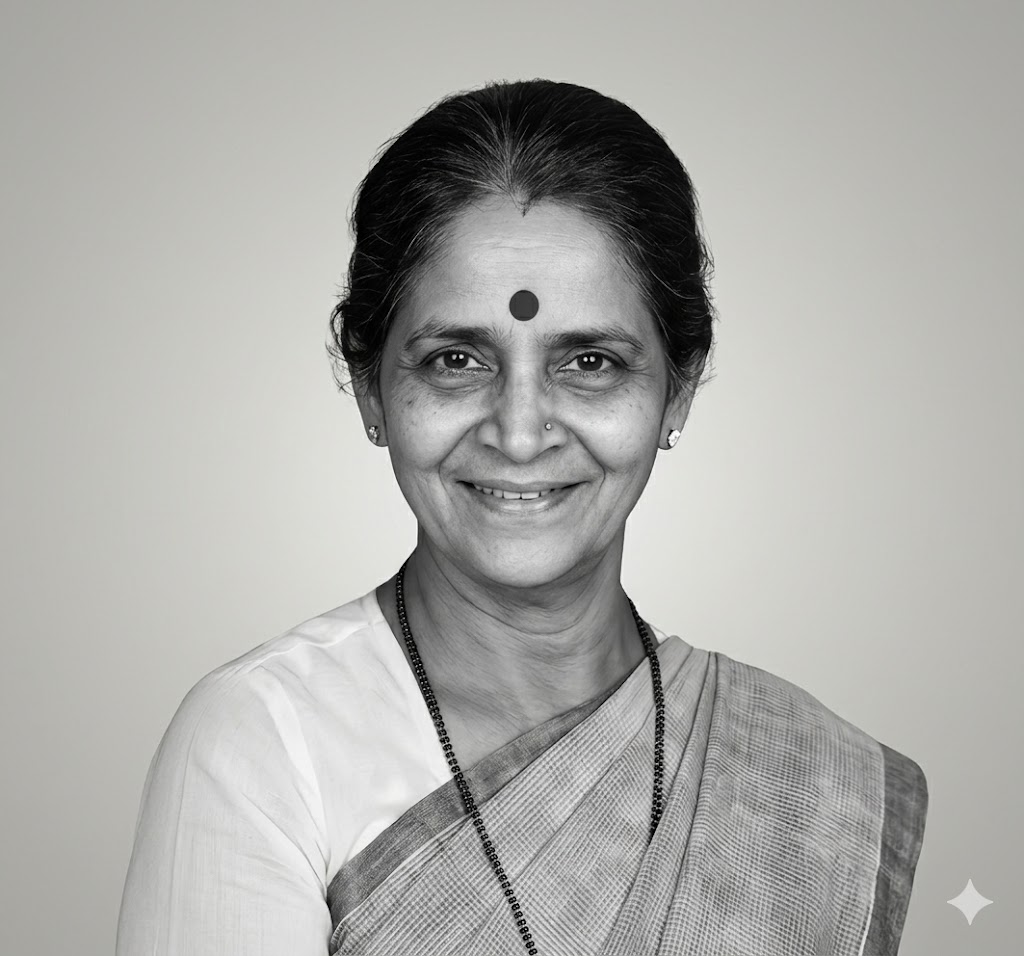
Reader in of Anatomy · MGIMS · The Teacher Who Made the Subject Navigable
Twice in her life, a man decided what she would do with it.
The first time, her father — an architect who believed engineering was unsuitable for women — pointed her toward medicine. She complied without protest. The second time, her husband — a surgeon who felt clinical work would be too demanding for a woman — steered her away from anaesthesia toward anatomy. She complied again.
What is remarkable is not the compliance. That was the world she lived in, the one most women of her generation navigated without the vocabulary to name what was happening. What is remarkable is what she built inside the boundaries others drew. She arrived at MGIMS in 1975 with only an MBBS, no postgraduate qualification, no prior experience in anatomy. She left in 1983 as a Reader, with an MS earned mid-career while still teaching, having shaped seven batches of medical students — nearly 450 young doctors — in a discipline she had not chosen but had made entirely her own.
Murud Janjira to Sevagram
Meena Mhatre was born on September 24, 1941, in Murud Janjira, a coastal town in Maharashtra known for its formidable island fort rising from the sea. Her early years were spent in Palghar, then Mumbai, where she attended Parle Tilak Vidyalaya — known for its strict discipline — and studied Inter Science at Parle College under Bombay University.
She was a bright student who prepared simultaneously for the Group A mathematics path and the Group B biology path, keeping her options open. Her father closed one of them. She took the other and in 1962 secured admission to Topiwala National Medical College in Bombay, graduating in April 1967. A six-month house job at National Hospital followed, then rotations at G.T. Hospital, then three years as a Medical Officer with the Bombay Municipal Corporation’s Health Department — the steady, unglamorous work of urban public health in a city that never slowed down.
In 1971, she married Dr. Ramdas Belsare. When he joined the Surgery Department at MGIMS, she followed him to Sevagram — a world away from Bombay in every respect that mattered. She took up a house job in anaesthesia, found her footing in the operation theatre, and seemed to be settling into clinical work when her husband suggested otherwise. She transitioned to Anatomy.
The Dissection Hall
She joined the Anatomy department on July 5, 1975, appointed Lecturer on the strength of an MBBS alone — an appointment that required both Dr. Sushila Nayar’s willingness to see potential where credentials were thin, and Meena Belsare’s willingness to prove it warranted.
The department she entered was a formidable place. Dr. G.R.K. Hari Rao, Dr. Kolte, Dr. Kane, Dr. Parthasarathy — these were academics of strong personalities and strong opinions, who ran the dissection hall with an exacting discipline. No student entered without a proper dissection kit and a copy of Cunningham’s anatomy text. Hair neatly trimmed, faces clean-shaven, white khadi aprons spotless, shoes polished. The atmosphere was one of rigorous, almost military, academic precision.
Among these more flamboyant figures — teachers who commanded attention through oratory, theatrics, and sheer force of presence — Meena Belsare found a different register entirely. She was quiet, unobtrusive, methodical. She did not perform anatomy. She taught it. Where her colleagues swept students along on the current of a powerful personality, she made the subject itself navigable — a map that could be read without fear, bone by bone, pathway by pathway, in the steady company of someone who would not make them feel foolish for not yet knowing their way.
“The students back then were a different breed,” she recalled years later. “Disciplined, diligent, utterly focused. We lived and breathed anatomy — Gray’s, Sahana, Kadasne, Cunningham. Page by page, we etched its intricacies into young minds.”
She pursued her MS in Anatomy while teaching, completing it in 1979 under the guidance of Dr. Hari Rao. Her thesis examined the morphology of motor plates in fast and slow muscle fibres across several species — a quietly meticulous piece of research entirely characteristic of the woman. On November 5, 1981, she was promoted to Reader. She had arrived without a postgraduate degree and climbed the academic ladder through teaching, research, and persistent competence.
The Woman in the Khadi Sari
Those who were her students remember not just what she taught but how she looked teaching it. A prominent bindi on her forehead. A simple khadi sari. A mangalsutra. A single bangle. Modest chappals. She was the embodiment of the Sevagram aesthetic — simplicity worn without ideology, as a natural expression of who she was.
She lived in MLK Colony, a short walk from the department. She was so thoroughly embedded in the rhythms of the campus that to encounter her anywhere felt like encountering the institution itself — unhurried, purposeful, entirely without pretension.
Her husband Dr. Ramdas Belsare presented a striking contrast: broad-shouldered, confident, carrying the unmistakable authority of a senior surgeon. She was petite, soft-spoken, effortlessly self-effacing. They were not opposites so much as different expressions of the same dedicated impulse — one outward and declarative, the other inward and steady.
Arrogance never found a home in her. She sought no recognition, held no interest in institutional power, did not aspire to be larger than what the work required. Her world was the dissection hall, the first-year student standing before a cadaver for the first time, the particular combination of anxiety and curiosity that anatomy produces in young doctors who have not yet made peace with the fact of mortality. She met them there, in that combination, and helped them through it.
The Departure
When Dr. Ramdas Belsare decided to leave MGIMS and open a private practice in Amravati, she followed him. On February 20, 1983, she submitted her resignation. Three months later, she left Sevagram.
It was the third time the shape of her professional life was determined by someone else’s decision. She accepted it with the same grace she had brought to the previous two. She had, by then, learned that the geography of a career matters less than the quality of work done within it. She had taught nearly 450 students in eight years. She had earned her postgraduate degree mid-career. She had risen from Lecturer to Reader. Whatever Amravati held, she had established what she was capable of.
The transition was not smooth. At Panjabrao Deshmukh Medical College in Amravati, she began again as a Lecturer — a step backward in title, a wound that any academic would feel. The recognition came eventually. She was reinstated as Reader, then became Professor, then Head of Department, then Dean — retiring in 1999 having reached, through a longer and more circuitous route, the seniority she had earned.
What Remained
Dr. Ramdas Belsare developed Parkinson’s disease and dementia in his later years. She cared for him through the long decline until his death on May 26, 2019. Their three children took different paths: their elder daughter Sharmishtha became an ENT specialist in Amravati; their son Chaitanya earned a PhD in fruit science; and their younger daughter Sukanya, born in Sevagram, trained as a computer engineer before finding her calling as a spiritual teacher in San Francisco. Something of the quiet inward quality her mother embodied seemed to pass, in a different form, to the youngest.
In the memory of the students she taught — the batches of 1975 through 1982, now middle-aged doctors spread across the country — Dr. Meena Belsare occupies a particular kind of space. Not the legendary teacher whose lectures electrify a lecture hall. The other kind: the one whose patient, unhurried presence in the dissection hall made the subject feel manageable, whose quiet confidence in the student’s ability was itself a form of teaching, and whose lessons — spoken in gentle tones, over cadavers and textbooks, in a dusty department in a village in Vidarbha — linger long after the words have faded.
Key Milestones
| 1941 | Born, 24 September, Murud Janjira, Maharashtra |
| 1962 | Admitted, Topiwala National Medical College, Bombay |
| 1967 | MBBS — house job, National Hospital; rotations, G.T. Hospital |
| 1968 | Medical Officer, Bombay Municipal Corporation Health Department |
| 1971 | Marries Dr. Ramdas Belsare — moves to Sevagram |
| 1971 | House job in anaesthesia — steered by husband toward Anatomy |
| 1975 | Joins Anatomy department, MGIMS, 5 July — Lecturer on MBBS alone |
| 1979 | MS in Anatomy — thesis on motor plate morphology in fast and slow muscle fibres |
| 1981 | Promoted to Reader, 5 November |
| 1983 | Resigns 20 February — follows husband to Amravati private practice |
| 1983 | Joins Panjabrao Deshmukh Medical College — begins again as Lecturer |
| — | Reader → Professor → Head of Department → Dean, PDMC Amravati |
| 1999 | Retires as Dean, Panjabrao Deshmukh Medical College |
| 2019 | Dr. Ramdas Belsare dies, 26 May — she had cared for him through Parkinson’s and dementia |