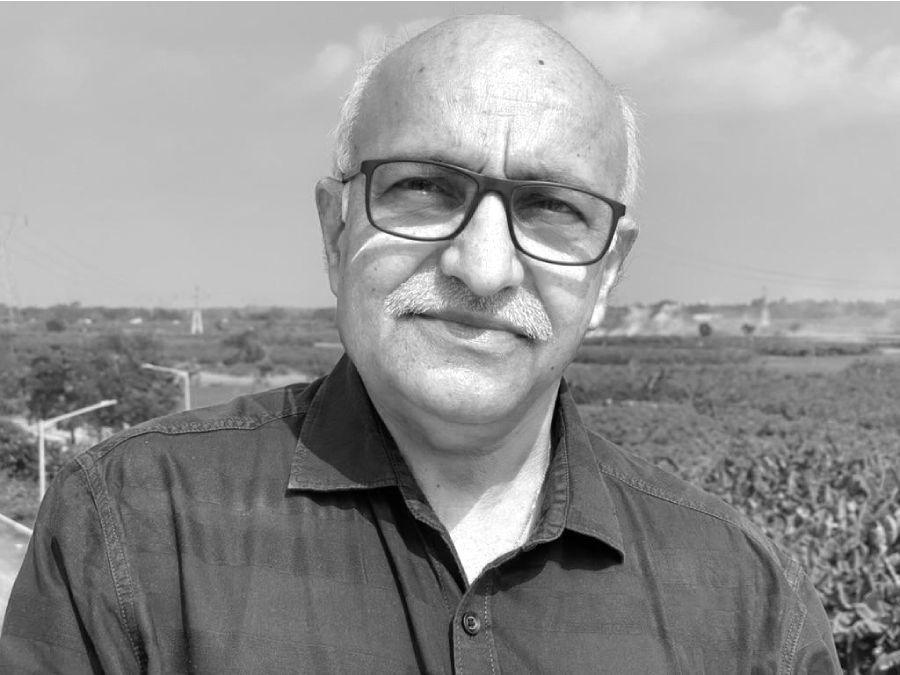
Dr. Ramji Singh
Professor & Head of Physiology · MGIMS Tenure 1986 – 2012 Lifespan 1957, Bansgaon, Gorakhpur district, Uttar Pradesh — — Education MBBS: Shri Krishna Medical College, Muzaffarpur (1970)MD: King George's Medical College, Lucknow (1975)
He meant it literally. During his postgraduate years at King George’s Medical College in Lucknow, his research on the central action of Angiotensin II in dogs had begun with disaster — animal after animal dying under anaesthesia, an expensive imported reagent wasted, a supervising professor waiting for results that were not coming. The failure had driven him across the corridor to the Pharmacology department, where he spent long hours learning drug administration techniques, unearthed a buried head holder and mechanical drill from the department’s dusty stores, designed specialised cannulas, and rebuilt his entire experimental technique from scratch. When he resumed the experiments, his hands were steady, the animals survived, and the research moved forward. The faculty who had quietly doubted the outsider — he was not a KGMC alumnus — saw what he was made of.
That capacity to fail, analyse the failure, and return with improved hands would become the defining characteristic of a career that took him from a village 100 kilometres west of Gorakhpur to the Executive Directorship of AIIMS Kalyani.
Bansgaon to Muzaffarpur: An Ordinary Beginning
Ramji Singh was born in 1957 in Bansgaon, Gorakhpur district, Uttar Pradesh. His father Keshav Prasad Singh began as an assistant development officer and rose to block development officer, and with each posting the family moved — Maharajganj, Saunghat, Menhdawal, Bhatpar Rani — Ramji adapting to new teachers, unfamiliar accents, and different syllabi with every transfer. The disruption that would have defeated some students sharpened him instead. He learned to find his footing quickly.
His father’s plan for him was modest and clear: become a doctor, return to Ballia, run a small private practice. There was nothing wrong with this plan. Ramji followed it without particular resistance, entering Sri Krishna Medical College in Muzaffarpur with the 1974 batch. Bihar’s academic calendar was chaotic in those years — class suspensions, exam postponements, the institutional disorder that had worsened in the Emergency’s aftermath — and what should have taken five years stretched considerably. He completed his MBBS in 1980.
He remembered one examiner from those years with particular warmth: Dr. S.P. Nigam, a distinguished Professor of Medicine from Sevagram, who tested him on a case of mitral stenosis during the First MBBS examinations. Years later, when Ramji joined MGIMS, he met Dr. Nigam again. The circle had closed quietly, as circles in the MGIMS story tend to do.
In June 1979, a few months before his Second MBBS examinations, he married Lalitaji. Their first son arrived in 1981. He was twenty-two, still in medical school, already a husband and father — the kind of domestic responsibility that concentrates a young man’s ambitions.
The Accidental Physiologist
He had intended private practice. A friend filling out postgraduate applications at King George’s Medical College included Ramji’s name on the form, ticking boxes for every subject including physiology and community medicine, unaware of the cutoff marks. Ramji was accepted into the Physiology programme. He reasoned that an MD would improve his prospects. He went.
What happened next surprised him. Under Professor S.D. Nishith, head of the Physiology department at KGMC, he found himself genuinely engaged by research for the first time. The Angiotensin II project had high stakes — ₹5,000 of the department’s research grant spent on Swiss-imported reagent, a significant sum. When the initial experiments failed and the animals died, Nishith did not rescue him from the consequences. Ramji rescued himself: the corridor visits to Pharmacology, the excavated equipment, the redesigned cannulas, the rebuilt technique. The research recovered. He had learned something about himself that private practice in Ballia could not have taught him.
He did not receive a stipend during his postgraduate years — an unusual hardship for a married man with a child. His second son Ashok was born in October 1984. He worked as a demonstrator from September 1983 onward, the modest salary providing basic stability. He completed his MD in 1985, defended his thesis, and began scanning for lecturer posts.
His department head saw the advertisement for a post at MGIMS before Ramji did. He summoned Ramji, dictated the biodata to his secretary, wrote a recommendation letter in his own hand, and told them to airmail it the same day. It was the kind of mentorship that changes careers by acting before the student has organised himself to act.
Arriving in Sevagram
The interview was scheduled for August 4, 1986. It was Ramji’s first journey outside Uttar Pradesh — a 1,000-kilometre trip over twenty-eight hours. He stepped off at Wardha East station to find every cycle rickshaw taken. A man with two Lucknow students saw his predicament and gestured to a space in his rickshaw: “Come along, young man.” Ramji arrived at his hotel opposite the station carried by a stranger’s generosity.
The next morning, he walked onto the MGIMS campus — gravel underfoot, neem-scented air, the distant sound of ashram prayers. In the Physiology department, Dr. K.N. Ingley greeted him. Dr. M.D. Khapre nodded. Dr. Sutikshna Pande and Dr. K.S. Bhat welcomed him with warm smiles. The easy camaraderie of a small department that knew itself well settled his nerves before the interview began.
Dr. Sushila Nayar opened the proceedings: “Dr. Singh, if selected, how soon can you join MGIMS?”
“Immediately, ma’am,” he said without hesitation.
She outlined the code of conduct: khadi, vegetarian diet, the Gandhian ethos that was not merely institutional decoration but daily practice. He listened and agreed. He had not known, arriving at Wardha station the previous evening, that this was the place he would spend the next twenty-six years. He knew it by the time he walked out of the interview room.
When he joined in September 1986, his life fit into a room at Kabir Niwas. Over the next decade, his footprint in Sevagram grew—first to the Type-2 quarters, then to a larger house in MLK Colony. Finally, in 2003, he moved a mile from the hospital to a home he had built himself. It was no longer just institutional housing; it was a house with his own gate and his own garden. By the time he turned the key in that front door, the village of Sevagram had officially ceased to be a workplace and had become his hometown.
Twenty-Six Years in Physiology
He rose through the department steadily — Lecturer in 1986, Reader in 1991, Associate Professor in 1995, Professor and Head in 1998 — leading it for thirteen years. His teaching earned him the Professor K.P. Puthuraya Best Teacher Award in Physiology in 2008. He did not seek the award; his students and colleagues had made the case for it.
He registered for a PhD under Dr. K.N. Ingley in 1988, intending to continue the department’s reproductive physiology research. The subject did not ignite him. He did not complete it. He was honest about this — a man who understood the difference between obligatory academic credential and genuine intellectual engagement, and who chose not to pretend the two were the same. What he did instead was become a PhD guide himself, mentoring Jyoti Jain, Sachin Pawar, Vinod Shende, Amit Kant, and Bharati Mahindrakar through their doctorates. He supervised postgraduate students from 2002 to 2012 — eight in total, from Alka Rawekar to Vikash Udan — and oversaw MD theses in the Surgery department as well, including work by Tapti Saha on post-meal urinary alkaline changes in duodenal ulcer management and by B.S. Bakane on TENS and surgical wound flap survival.
In December 1999, Ramji and Dr. S. John Premendran brought the 45th Annual National Conference of Physiologists and Pharmacologists to Sevagram. The theme was hypertension in the new millennium, but the true test was the terrain. To host 200 delegates in a village, Ramji had to revert to the scrappiness of his Lucknow lab days. He spent months navigating the bureaucracies of the ICMR and the Medical Council of India for grants, eventually bridging the gaps by leaning on family resources to ensure no guest went without a comfortable bed or a hot meal.
The logistics were an exercise in improvisation—transforming rural spaces into academic halls that rivaled urban centers. By the final day, the skepticism of the city delegates had been replaced by the quiet hum of a successful gathering. Dr. Sushila Nayar, then eighty-five, rose to deliver the presidential address. She moved slowly, her frame diminished by age, but as she stood at the podium and looked out at the assembly Ramji had built from nothing, she didn’t need a formal commendation. She simply caught his eye, and in that steady, sharp gaze was the silent recognition of a mission fulfilled.
From 1998 to 2003, Ramji lived the double life of a professor and the Warden of the Jawaharlal Nehru Boys’ Hostel. While the role was often viewed by faculty as a burdensome detour from academic work, Ramji turned the warden’s office into a space where the door stayed unlatched. He wasn’t just checking room assignments; he was a constant presence in the corridors, listening to the anxieties of students far from home.
The “hostel boy” who sat in his office or shared a meal with him during that period eventually became the cardiologist in London, the oncologist in Mumbai, or the neurosurgeon in New York. These men didn’t just remember him as an administrator; they continued to call him “Sir” with a tone that suggested family rather than faculty. Decades later, when these specialists reached back to Sevagram, it wasn’t out of institutional duty, but because the warden of the Nehru Hostel had once treated their personal struggles with as much gravity as their physiology lessons.
After Sevagram
When Dr. Ramji Singh left MGIMS in 2012, he wasn’t looking for a quiet exit; he was seeking a larger canvas. He moved into the AIIMS system, first as Professor and Head of Physiology at AIIMS Patna, and eventually as the Executive Director of AIIMS Kalyani—perhaps the furthest point imaginable from the quiet clinic in Gorakhpur his father had once envisioned. Along the way, he held additional charges at AIIMS Deoghar and Guwahati, becoming a pillar of the burgeoning AIIMS network.
Yet, his influence wasn’t merely administrative. His move opened doors for nearly two dozen MGIMS faculty members, a quiet testament to an institutional loyalty that followed him across state lines. Over four decades in the classroom and two decades in high-level administration, he balanced the rigors of national-level governance—serving as General Secretary of the APPI and as a Fellow of GSMC-FAIMER—with the patient work of a mentor, guiding Ph.D. students and chairing university boards.
His career has been defined by a refusal to stay static. After years in the Gandhian ecosystem of Sevagram and the structured world of the AIIMS institutions, he took on a new challenge as the Dean of a private medical college in Durg, Chhattisgarh. It was a move driven by a characteristic curiosity: a desire to understand the mechanics of private medical education in India.
He remains quiet about these transitions, carrying the steady confidence of a man whose self-worth doesn’t rely on the titles on his door. He had arrived in Sevagram a stranger, shaped by a series of fortunate accidents—a friend’s application form, a timely recommendation, a chance rickshaw ride. He spent twenty-six years turning that stranger into a fixture of the community, proving through consistent work that most obstacles are not matters of destiny, but simply problems of technique.
Read Dr. Sushila Nayar’s full profile in Architects of MGIMS
Mentored Students (MD/MS)
The involvement of monoaminergic mechanism to pain responsiveness in conscious rats
A comparative study of free radical antioxidant status of anesthetic agent semen in fertile infertile men
The study of morphological and functional sperm indices in subjects of impaired fertility potential
Cardiac efficiency tests in medical students
Soleus H-Reflex in Chronic Low Back Pain
Nerve Conduction Velocity – A Normative Study
Electrophysiological Evaluation of Carpal Tunnel Syndrome in a Population of Subjects with Diabetes
Study of sperm deformity index (SDI), level of reactive oxygen species (ROS) and sperm function tests in normozoospermic and oligo-asthanoterato-zoospermic males
Effect of Noise Pollution on Hearing in Auto-Rickshaw Drivers – A Baep Study
A Study of Blink Reflex Alteration in Patients of Hypothyroidism and Type-2 Diabetes Mellitus – A Case Control Study.
Autonomic neuropathy, peripheral neuropathy and minimal hepatic encephalopathy in cirrhosis of liver: A clinical and electrophysiological study.
Key Milestones
| 1957 | Born, Bansgaon, Gorakhpur district, Uttar Pradesh |
| 1974 | Entered Sri Krishna Medical College, Muzaffarpur |
| 1979 | Married Lalitaji, June |
| 1980 | Completed MBBS |
| 1983 | Joined KGMC Lucknow as Demonstrator — MD Physiology |
| 1985 | Completed MD Physiology, King George’s Medical College, Lucknow |
| 1986 | Joined MGIMS as Lecturer, September |
| 1991 | Promoted Reader |
| 1995 | Promoted Associate Professor |
| 1998 | Appointed Professor & Head of Physiology |
| 1998 | Appointed Warden, Jawaharlal Nehru Boys’ Hostel |
| 1999 | Organised 45th National Conference of Physiologists, MGIMS |
| 2008 | Awarded Professor K.P. Puthuraya Best Teacher Award in Physiology |
| 2012 | Left MGIMS after twenty-six years |
| 2012 | Joined AIIMS Patna as Professor & Head of Physiology |
| 2016 | Appointed Executive Director, AIIMS Kalyani |