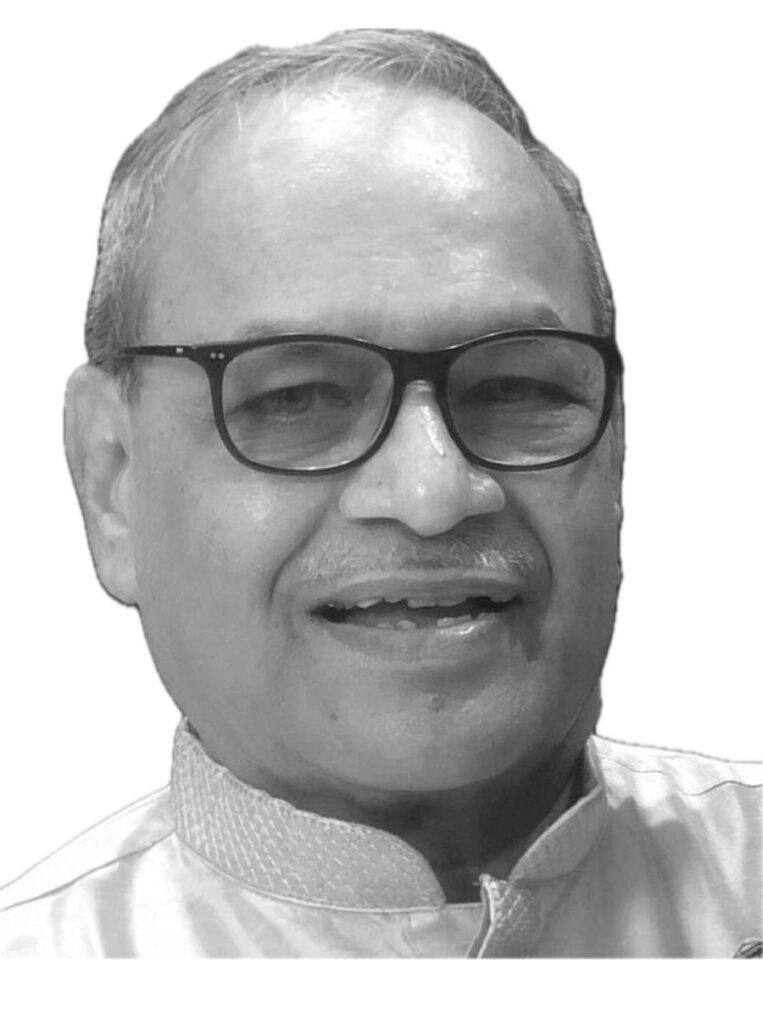
Dr. Deepak Kumar Mendiratta
Director-Professor & Head of Microbiology · MGIMS Tenure 1986 – 2014 Born 30 October 1952, Agra Education MBBS (Government Medical College, Patiala) 1977MD Microbiology (Government Medical College, Patiala) 1984
He had spent four years as a medical officer at a primary health centre in Sauja — a village of under a thousand people, seventy-eight kilometres from Chandigarh, poor road connectivity, unreliable electricity, the nearest bus stop reachable only by scooter. Five kilometres of bicycle riding at the far end. This was his daily commute to work. By the time he arrived in Sevagram in November 1986, rural life held no surprises for him. He adapted to village life, as one account put it, as naturally as a duck takes to water.
This is worth establishing early, because it explains something about why he stayed. Many faculty members came to Sevagram from cities and experienced the simplicity as a sacrifice to be endured. Mendiratta arrived already formed by the rural Punjab experience — the 1984 riots following Indira Gandhi’s assassination had eventually driven him to seek something new, but what he was looking for was not urban comfort. He wanted to do better microbiology. Sevagram, under Dr. Pratibha Narang, offered exactly that.
Agra, Air Force Schools, and Rural Punjab
Deepak Kumar Mendiratta was born on October 30, 1952, in Agra, the son of Shri Prem Nath Mendiratta, an aeronautical engineer in the Indian Air Force, and Rita Rani Mendiratta. The family moved with his father’s postings — Agra, Tambaram, Bangalore, where he attended St. Joseph’s High School — and he completed his matriculation in 1969 at Baroda High School after five years there. He earned his BSc at Government Mohindra College, Patiala, in 1973, and his MBBS at Government Medical College, Patiala, in 1977.
Between 1977 and 1982, he served in the Punjab Civil Medical Services, which included four years at the Sauja primary health centre — the bicycle and the scooter and the quiet difficulty of medicine practiced far from backup. In December 1982, he moved to a Demonstrator post in the Microbiology department at his alma mater in Patiala, completing his MD in December 1984.
After his MD, he returned to village practice for two years. Punjab in 1984 was convulsed by the riots following the assassination. Fear and uncertainty accumulated. A trip to Delhi brought him to Dr. Shrinivas, Head of Microbiology at AIIMS, who listened to his career ambitions and suggested Sevagram immediately — the Microbiology department under Dr. Pratibha Narang was exactly the environment he was describing. Mendiratta wrote to Dr. Narang. Her reply was warm and elegant. He packed his belongings and took the next train south.
He arrived on November 17, 1986.
The Department and the Partnership
He began in two-room accommodation in Kabir Colony. His parents, who had retired to Lucknow in 1979, moved to Sevagram in 1999 and remained there until their deaths. In 2002, he built his own house in Sushila Nagar Colony, a kilometre from the college, with Dr. Ramji Singh and Dr. B.S. Garg as neighbours.
The department he joined had Dr. Narang, postgraduate students Dr. Tripathi and Dr. Ramani, and two technicians. He had come from general practice and a demonstrator post — not from a research-intensive academic background. The initial hesitation was honest: he was uncertain whether he was equipped for faculty life. Dr. Narang’s manner dissolved the uncertainty quickly. They worked side by side, sharing slides, discussing cases, refining diagnoses. The department had the atmosphere of a family rather than a hierarchy. Outside working hours, the young faculty community gathered for badminton, carrom, birthday celebrations, and staff club events — the social texture of a campus where people genuinely liked each other.
Two years after joining, drawn by the prospect of higher earnings, he applied for a faculty position in Saudi Arabia. Dr. Narang gave him a two-year leave of absence. He worked at Naib Hospital, Gazi, from February 1989 to February 1991. Dr. Sushila Nayar was keen for his return. When his Saudi term ended, he came back to Sevagram.
He was promoted to Associate Professor in August 1995, Professor in August 2002, and Director-Professor shortly before his departure. When Dr. Narang became Dean in 2002, she handed the Microbiology department to him. He led it for twelve years.
Research, Teaching, and the TB Field Trial
The research direction he inherited from Dr. Narang was tuberculosis, and he continued it with full commitment. Among his most significant contributions was a field trial on short-course chemotherapy for tuberculosis — work that helped establish the evidence base for the DOTS regimen adopted nationally. He conducted important research on tuberculous lymphadenitis and leptospirosis. In 2003, the department collaborated with the University of California, Berkeley, on a diagnostic study using gamma interferon to detect latent TB — the partnership with Madhukar Pai that Dr. Narang had initiated, continued and developed under his leadership.
Across his tenure, he undertook twenty-three national, international, and regional research projects, published nearly eighty papers, and guided eleven postgraduate students from Ravneeth Kaur in 2002 to Somnath Bhunia in 2013. Their theses ranged across the infectious disease spectrum of rural Central India — leptospirosis in acute febrile illness, Candida in preterm neonates, enterococcal resistance patterns, non-viral microbial keratitis, metallo-beta-lactamase production in Pseudomonas and Acinetobacter, PCR for neonatal sepsis diagnosis. The breadth reflected a department whose interests extended well beyond any single pathogen.
Teaching was a significant part of what he was — a fact that became sharply visible after he left Sevagram. At Chirayu Medical College in Bhopal, where he became Dean in May 2019, microbiology attendance among students stood at ten percent when he arrived. Within a few months, it reached ninety percent. This required no particular magic: it required the consistent application of the clarity, approachability, and high expectation that his postgraduate students at MGIMS had valued and that he brought unchanged to a new institution.
He described Dr. Narang with the precise warmth of someone who has chosen their words carefully: “It’s rare to find and work with such a wonderful head of department. She was not only a philosopher and guide but also showered affection like an elder sister.”
Mala, and the Life Built in Sevagram
He married Mala, originally from Bareilly, on October 8, 1981. She had been teaching school in Patiala. In 1991, she joined MGIMS as a computer operator and rose through the institution’s administrative structure to become Administrative Officer — a position she held until 2014, when she resigned coinciding with her husband’s departure. Their careers at MGIMS ran in parallel for twenty-three years. Both left together when the chapter closed.
Their son Sidharth — MGIMS 2004, MS Surgery, MCh Plastic Surgery from CMC Vellore — practises privately in Nagpur. Their daughter Surabhi, an engineer, lives in the United States.
He left MGIMS on August 7, 2014, for Chirayu Medical College in Bhopal. The private, for-profit college environment was not congenial — the structured restrictions, the intellectual atmosphere thinner than what he had known, the loss of the autonomy Sevagram had given him. On October 31, 2022, he retired from academic medicine. He spends his time now in Nagpur with his grandchildren.
The years in Sauja on a bicycle, the years in Sevagram working through slides with Dr. Narang, the twelve years leading the department, the field trial that contributed to DOTS, the eighty papers, the eleven postgraduates — these are the constituents of a career built in village settings, by a man who was formed by rural life early enough that it never felt like sacrifice.
Mentored Students (MD/MS)
A study of seropositivity for leptospirosis in cases of acute fever attending out patient department of a rural hospital in Wardha district
Study of colonization by yeast in the preterm neonates admitted in the NICU of a rural hospital with special reference to Candida species
Speciation and characterization of enterococci isolated from patients in a rural hospital with special reference to high level aminoglycoside resistance (HLAR)
Study of non viral microbial keratitis in patients attending Kasturba hospital, Sevagram in central India.
Clinical and bacteriological correlates of whole blood interferon gamma (IFN- ?) in newly detected cases of pulmonary TB.
Study of SXT element in Vibrio cholerae in a rural hospital of Central India
Comparison of Microscopy, Culture on LJ and Bactec 460 TB System and Detection of insertion Sequence 6110 in Sputum For the Diagnosis of Tuberculosis Pulmonary Symptomatics
Detection of Metallo-Beta-Lactamase Producing P.Aeruginosa Isolated From Patients Attending A Rural Hospital in Central india Using Phenotypic and Genotypic Methods
Prevalence of Metallo-B-Lactamases in Clinical Isolates of Acinetobacter Baumannii From a Tertiary Care Rural Hospital in Central india.
Prevalence of ?-Lactamases and their Co-Expression in Gram Negative Bacilli Isolated From invasive Sites of Patients Admitted in Tertiary Care Hospital of Central india.
Utility of Clinical Parameters, Septic Screen and Pcr For Rapid Diagnosis of Bacterial Neonatal Sepsis in Culture Positive Cases.
Detection and characterization of Ampc β lactamase in Escherichia coli and Klebsiella pneumoniae isolated from sterile fluids of patients attending a tertiary care rural hospital by phenotypic and genotypic method.
Key Milestones
| 1952 | Born, 30 October, Agra |
| 1973 | Completed BSc, Government Mohindra College, Patiala |
| 1977 | Completed MBBS, Government Medical College, Patiala |
| 1977 | Joined Punjab Civil Medical Services — four years at Sauja PHC |
| 1981 | Married Mala, 8 October, Bareilly |
| 1982 | Demonstrator, Microbiology, GMC Patiala |
| 1984 | Completed MD Microbiology, December |
| 1986 | Arrived MGIMS, 17 November |
| 1989 | Two-year leave — Naib Hospital, Gazi, Saudi Arabia |
| 1991 | Returned to MGIMS, February — Mala joined as computer operator |
| 1995 | Promoted Associate Professor, August |
| 1999 | Parents moved from Lucknow to Sevagram — lived with him until their deaths |
| 2002 | Promoted Professor, August — took charge of Microbiology department when Dr. Narang became Dean |
| 2003 | Collaborated with University of California, Berkeley — gamma interferon study for latent TB detection |
| 2014 | Left MGIMS, 7 August — Mala resigned same day after 23 years |
| 2019 | Dean, Chirayu Medical College, Bhopal — May to November 2020 |
| 2022 | Retired from academic medicine, 31 October |