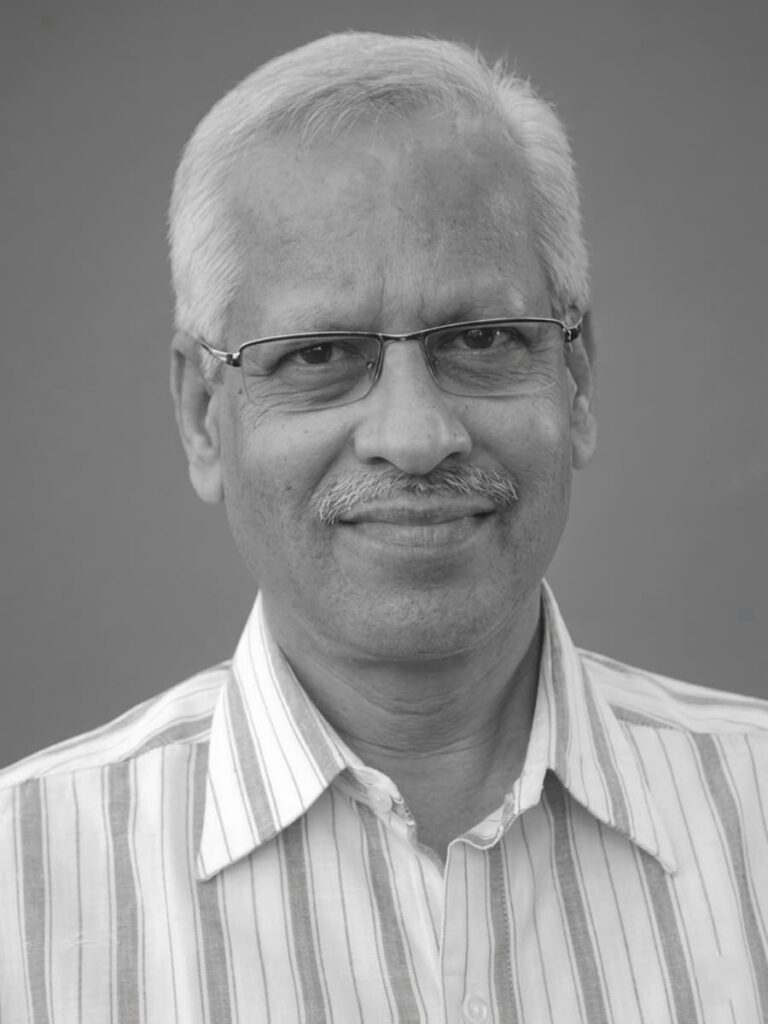
Dr. S.P. Kalantri
Director Professor of Medicine, Medical Superintendent Tenure 1982–Present Born 15 August 1957, Wardha Education MBBS. (Government Medical College, Nagpur, 1978)MD Internal Medicine. (Government Medical College, Nagpur, 1982)
MPH (Epidemiology) (University of California, Berkeley, USA, 2005)
The Fear of Mathematics
He was born on Independence Day—August 15, 1957—the youngest of six siblings in a Marwadi family that had produced, across generations, not a single doctor. His father, Gokuldas Kalantri, managed cotton factories owned by the Bajaj group. His mother, Parvati Devi, had been educated only to the fourth grade. There was no medical tradition in the family, and no particular reason to expect that the youngest child would spend his entire life in a Gandhian hospital five miles from home. There was, in fact, no reason to expect much of anything, except that the youngest child always had to find his own way.
He found it, as he would find most things, through a combination of accident, instinct, and the quiet stubbornness of someone who knows what he does not want, even when he cannot yet name what he does.
His schooling moved through Wardha’s institutions, shaped by circumstance rather than a grand plan. He attended Balmandir, then Craddock High School—where a classmate named Suhas Jajoo sat nearby, sparking a friendship that would later determine his entire professional trajectory. At Swavalambi Vidyalaya, English arrived with the Biology curriculum, and Mathematics was quietly dropped. He opted out of Mathematics entirely out of fear. In retrospect, that fear was the most consequential academic decision he ever made: it permanently closed the door to engineering, leaving medicine as the only viable path forward.
When he enrolled at Jankidevi Bajaj Science College, he scored 73% in his BSc Part 1 examination—precisely the margin required for admission to medical college. Medicine had entered his life not through a burning vocation, but through the back door of habit and proximity. He was not marching toward a white coat with purpose; he was simply moving forward.
Room No. 99
He entered Government Medical College (GMC), Nagpur, in 1973. Out of a batch of two hundred students, he would eventually emerge ranked fourth in his final MBBS examination. For much of his time at GMC, from undergraduate through postgraduate, he lived in Room No. 99—a number that became a private landmark. During his second year, his childhood friend Suhas Jajoo moved in with him. The Wardha connection had followed him to Nagpur.
During his 1978 internship, the rural posting in Bhadrawati planted something durable in his mind: an unvarnished understanding of what healthcare in rural India actually required, a lesson no lecture hall had ever conveyed with equivalent force. When he began his house jobs, he gravitated immediately toward Internal Medicine. It was not an accidental choice; all of his role models—the sharpest clinical minds at GMC—were in Medicine. He wanted to emulate them, without a single second thought.
His MD program began in 1980 under the formidable Dr. B.S. Chaubey. In a highly unusual move, Chaubey transferred the young doctor into his own unit and took him personally under his wing—a first in GMC Nagpur’s history. Kalantri completed his MD in 1982. He was twenty-four years old, sitting in Room No. 99, with absolutely no map for what came next.
He knew only one thing with uncomfortable certainty: he did not want to sit alone in a private clinic. He craved the noise and rigorous discipline of a teaching hospital—the ward rounds, the fierce arguments over a diagnosis, the quiet pride of watching a terrified student grow into a doctor.
The Afternoon at Jajoo Wadi
In early May 1982, he went to visit Suhas at his home in Jajoo Wadi, Wardha. By sheer luck, he ran into Suhas’s elder brother, Dr. Ulhas Jajoo, who was already a Reader in Medicine at MGIMS Sevagram. Ulhas looked at him for a moment—long enough to sense exactly what the young man wasn’t saying—and asked casually: “Why don’t you join us at Sevagram?”
There was no grand speech. No persuasion. Ulhas simply acted. A brief word to the Medical Superintendent, Dr. Karunakar Trivedi. A quick meeting. A nod. The post of Senior Registrar was his, for ₹650 a month.
His father had already drawn a very different map. He had built a modest structure in Wardha with windows facing Indira Market. It was meant to be his son’s clinic, the steady income practically within reach. When told of the change in plans, disappointment slipped visibly through his father’s eyes. But with a grace his son would only fully understand later in life, he said nothing, and quietly stepped aside.
On a scorching afternoon—May 4, 1982—Shriprakash Kalantri rode his Bajaj Priya scooter through the gates of MGIMS. After the imposing stone architecture of GMC Nagpur, Sevagram felt like another country. The hospital still partly occupied the old Birla guest house; the wooden floors creaked, and the walls peeled in tired layers. There were no ventilators, no monitors, no infusion pumps. Medicine here was practiced the old way: with a stethoscope, a remarkably steady hand, and whatever clinical judgment could be gathered at the bedside.
He joined Dr. A.P. Jain’s unit. The morning ECG correction sessions, led by Dr. O.P. Gupta, Dr. Jain, and Dr. Ulhas Jajoo, possessed the disciplined, terrifying quality of a court hearing. Residents lined up with the night’s ECGs clutched like confession letters, where every missed P-wave was a matter of grave consequence.
He was exactly where he needed to be.
The Permanent Belonging
His ascent was steady, each step earned through the slow accumulation of correct decisions at the bedside. He became a Lecturer in 1983, a Reader in 1987, a Professor in 1997, and a Director Professor in 2012.
In February 1984, he married Bhavana Laddha, a science graduate from Indore. Their son, Ashwini, and daughter, Amrita, were both born in Sevagram, delivered by Dr. Shakuntala Chhabra. Ashwini would go on to become a Professor of Community Medicine at MGIMS, marrying Shaily Jain, an administrative officer at Kasturba Hospital. Amrita completed her DNB in Radiology and married Dr. Sahaj Rathi, a hepatologist. The family that the institution had helped begin in 1982 had, by the next generation, grown into the institution itself.
When a lucrative offer to become Professor and Head at a privately owned medical college arrived in 1993, he swiftly declined. Sevagram had given him his professional ethics, his work culture, and an unbreakable connection to his students and patients. He never wanted to leave.
Acquiring an independent unit in 1992, he eventually guided thirty MD students. Many of their theses were published in international journals with the student listed as the first author and SP Kalantri as the last—a deliberate inversion of the academic hierarchy that distinguishes a teacher building careers from one simply harvesting credit.
Berkeley and the Argument for Evidence
A week-long workshop on Evidence-Based Medicine (EBM) in Toronto in 2001 permanently altered the register of his clinical thinking. The analytical tools he had been blindly reaching for finally had a name and a rigorous method. He returned with absolute clarity: the pharmaceutical industry’s deep, pervasive presence in the hospital was scientifically and ethically indefensible.
In 2001, he successfully persuaded the President of the Kasturba Health Society, Dhirubhai Mehta, to ban pharmaceutical and device companies from sponsoring medical conferences at MGIMS. It was the beginning of a massive structural earthquake.
In 2004, a Fogarty Scholarship took him to the University of California, Berkeley, where he completed an MPH in Epidemiology. When he returned, equipped with formal epidemiological weaponry, his stance was unambiguous: the industry had to go entirely. When he became Medical Superintendent in 2009, he banned medical representatives from the campus and launched a low-cost generic drug initiative. The cost of a hospital admission at Kasturba plummeted, fundamentally redefining what affordable healthcare meant in Vidarbha.
The Hospital That Learned to Think in Data
For decades, Kasturba Hospital’s information lived on fragile paper—registers, slips, and carbon copies covered in handwriting that oscillated between elegant and illegible. It worked, but with immense friction.
When the Hospital Information System (HIS) finally arrived in Sevagram in 2004, it required a decade and a half of agonizing, unglamorous labor. There were 3:00 a.m. trains to Nagpur, blue screens of FoxPro, and servers that crawled. Bhavana stepped in as the system’s database administrator. It was not a supporting role; she became the absolute spine of the project, holding the data architecture together whenever the institution’s enthusiasm for change collided with its appetite for familiar routine.
Today, the HIS that runs Kasturba Hospital is one of the few fully functional systems in India. It carries, invisibly, the legacy of two people with the same surname who spent fifteen years simply refusing to let it fail.
The Pandemic War Room
Nothing in Sevagram’s collective memory prepared it for March 2020. For MGIMS—an institution built on the Gandhian promise of open doors—the COVID-19 pandemic posed a cruel paradox: How do you serve the highly contagious without becoming victims yourselves?
As Medical Superintendent, Kalantri found himself in a war room without a map. The old administrative tools of negotiation and consensus-building were instantly obsolete, replaced by oxygen flow rates, tanker GPS coordinates, and the cold, terrifying arithmetic of mortality.
The hospital admitted nearly 6,000 COVID-19 patients. He secured massive donations to install permanent oxygen systems. Crucially, he demanded that only strictly evidence-based therapies govern clinical management, fiercely eliminating the irrational, politically promoted drug regimens sweeping the rest of the country. On Twitter, and across national media, he publicly argued for science. While much of Indian medicine temporarily capitulated to panic and pressure, in Sevagram, rational medicine held the line.
On February 15, 2023, he voluntarily stepped down as Medical Superintendent. His reasoning was characteristically sharp: “It is time to step down when people ask why, not why not.”
Beyond the Ward
Over the years, he gathered lives outside the hospital. Obsessed with books since the age of five, he also allowed cricket to shape his imagination. In 2015, he discovered cycling, completing grueling 300-kilometer non-stop brevets alongside his daughter Ashwini, sparking a cycling culture across the campus.
He writes relentlessly in Hindi, Marathi, and English. He documented all 204 classmates of his 1973 batch. He blogs on Matter-of-Fact. And eventually, he compiled ninety-three definitive portraits of the medical teachers who built MGIMS across four decades.
This book is the completion of that massive project. He arrived on a Bajaj Priya, trading his father’s carefully imagined clinic for ₹650 a month and a hospital with creaking floors. He found what he did not even know to ask for: a place where medicine became not merely a job, but the very structure around which his entire life would beautifully organize itself.
He is still here.
Mentored Students (MD/MS)
Prognostic significance of pre discharge six week symptom limited treadmill test after acute myocardial infarction
Efficacy of fiberoptic bronchoscopy in smear negative pulmonary tuberculosis
Diagnostic utility of palpation and percussion in clinic assessment of cardiomegaly
Efficacy of clinical signs in the diagnosis of splenomegaly and ascites
Clinical profile of Snakebite in Sevagram : An observational study
A clinical profile of pesticide poisoning in Sevagram : an observational study
Blood pressure measurement by sphygmomanometer : knowledge, practice and instrument audit
The validity of physical examination in diagnosis of pneumonia
Validity of perception and palpation to screen fever
Validity of Siriraj and Guy’s hospital stroke scores for differentiating hemorrhage from ischemic strokes
Predicting outcome after stroke: Prospective evaluation of three stroke scores
Validity of history and physical examination in the diagnosis of hypothyroidism
Risk factors for acute myocardial infarction : A hospital based case-control study from a rural tertiary hospital in central India
Simple clinical predictors of brain lesions in patients with impaired consciousness: a cross sectional study from a rural, tertiary hospital in central India.
Predictors of in Hospital Mortality in Snake Bite : A hospital based Retrospective Chart Review
Accuracy of History and Physical Signs in Pleural Effusion
Is alcohol consumption associated with increased risk of intracranial hemorrhage? – a hospital based case control study in rural population in central India
Acute undifferentiated fever: A clinico-epidemiological correlation in a rural hospital
Accuracy of physical signs in the diagnosis of meningitis and the diagnostic accuracy of low CSF glucose in the diagnosis of bacterial meningitis
Diagnostic Accuracy of Rapid Diagnostic Test for Leptospirosis
Pattern and Problem of Pesticide Poisoning in a Teaching Rural Hospital – Retrospective Analysis of Hospital based Data
Accuracy of History and Physical Examination for Diagnosis of Acute Myocardial infarction: A Hospital Based Diagnostic Accuracy Study.
Predicting Mortality in Acute Intracerebral Haemorrhage by ICH Score.
Predictors of mortality in patient hospitalized with pesticide poisoning
Predictors of 30-day mortality and disability in patients hospitalized with acute incident stroke
Hyponatremia: Causes, Characteristics and Outcome in Critically ill Medical inpatients
Comparison of Acute Physiology and Chronic Health evaluation (APACHE 2) Score with organ failure score (SOFA) to predict hospital mortality in Medicine Intensive Care inpatients.
Incidence and Risk factors for Ventilator associated Pneumonia
Intermediate syndrome and respiratory failure in acute organophosphorus pesticide self-poisoning
Acute undifferentiated febrile illness in patients presenting to a tertiary care teaching Hospital in central India : Etiology, clinical spectrum and outcome
Clinical Predictors of In House Mortality in pateints with snakebite
Diagnostic accuracy of 20-minute whole blood clotting test (WBCT20) to detect coagulopathy in snake envenomation
Anion Gap and Serum Lactate Levels in Acutre Insecticide Poisoning
Perceptions of Palliative Care Among Patients with Head and Neck Cancer: A Hospital Based Mixed Methods Study
Burden Among Caregivers of Head and Neck Cancer Patients A Hospital-Based Mixed Method Study
Key Milestones
Joined GMC Nagpur for MBBS, having “inadvertently shut the engineering door” by choosing biology in Class 9.
Obtained MD in General Medicine from Government Medical College, Nagpur.
Arrived in Sevagram as a Senior Resident in the Department of Medicine, beginning a “brief posting” that has lasted over four decades.
Appointed Lecturer in Medicine after an interview with the “titan” Dr. B.S. Chaubey.
Awarded the Fogarty AIDS International Research Scholarship; obtained an MPH in Epidemiology from UC Berkeley, returning with a new focus on evidence and asking better questions.
Appointed Medical Superintendent of Kasturba Hospital, focusing on low-cost drug initiatives and the “grammar” of hospital systems.
Led the hospital’s COVID-19 response, showcasing that desperate times do not require desperate measures—and that in medicine, restraint is often the best intervention.
Returned to the wards and the classroom, while undertaking the “quiet urgency” of documenting the institutional history of MGIMS.