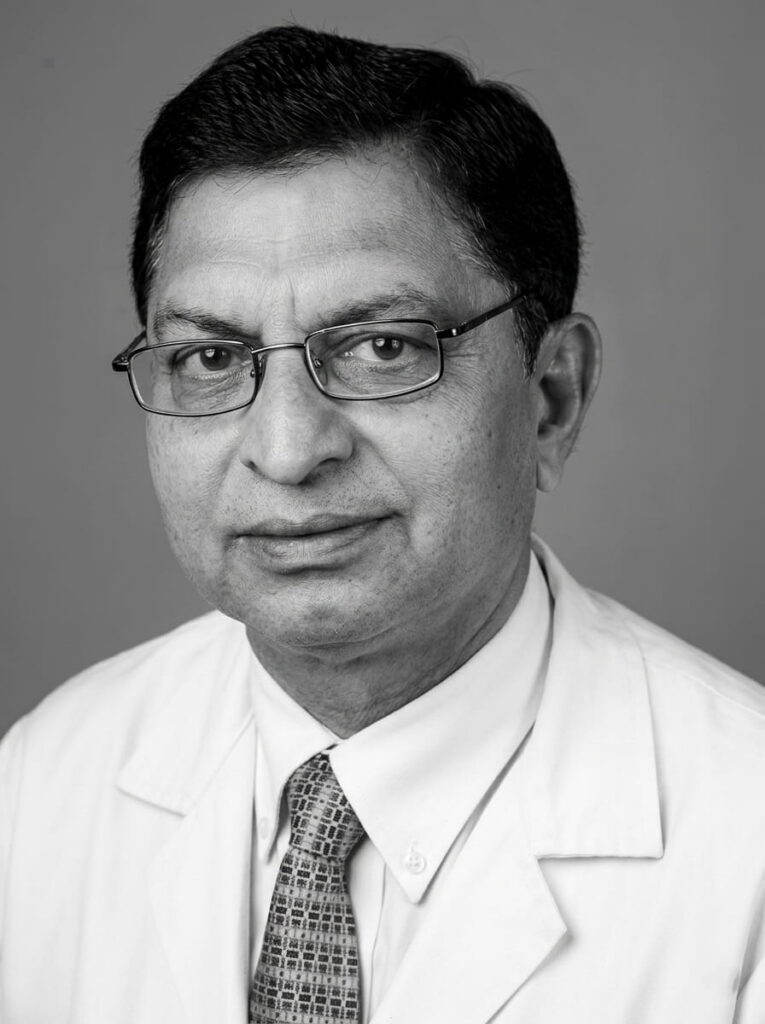
Dr. Kiran Kher
Reader in Surgery · MGIMS Tenure 1979 – 1985 Born 24 February 1951, Raipur Education BSc, Ravishankar University Raipur (1968)MBBS, Pandit Jawaharlal Nehru Memorial Medical College Raipur (1973)
MS General Surgery, PJNMMC Raipur (1977)
The Knock on the Door
The clerk at the Dean’s office told him flatly that there was no vacancy, and none foreseeable.
Kiran Kher thanked him politely, walked away, and began wandering through the hospital. He noticed the nameboard outside Dr. K.K. Trivedi’s office. Summoning his courage, he simply knocked, walked in, and explained that he wanted to join the Surgery department.
Dr. Trivedi listened quietly, nodded once, and told him to get his luggage ready. “Join us in two days.”
This is exactly how his MGIMS career began—not through the formal, bureaucratic channel that had just turned him away, but through a direct appeal to the right person, made possible only by his willingness to knock on an unfamiliar door. It was entirely characteristic of the man.
He had deliberately chosen Sevagram over a comfortable government service posting because colleagues spoke highly of its integrity. He had already seen more than enough in Madhya Pradesh’s medical colleges—professors bluntly refusing to see poor patients unless they were paid for private consultations, the rich receiving fawning attention while the destitute died unattended in public wards. He understood early that the way medicine was practiced mattered just as much as the medicine itself. He wanted to be in a place where it was practiced properly. So, he got his luggage ready.
Raipur, the Biology Decision, and the Surgeon’s Fascination
Kiran Kumar Kher was born on February 24, 1951. His father, Shri Shrikant Vinayak Kher, was a regional bank manager who was frequently transferred across Madhya Pradesh. Despite the constant relocations, Kiran’s family ensured he spent his entire schooling in Raipur, providing him with vital stability. He attended Hindi-medium schools, sitting cross-legged on tat pattis (coir mats) with his classmates, learning under the strict, elemental teaching methods of the era.
In the ninth grade, he made a deliberate, consequential choice: Biology over Mathematics. He understood exactly what he was doing. The Mathematics door was closing; the Medicine door was opening. He completed his pre-medical studies at Ravishankar University in 1968 and earned his MBBS from Pandit Jawaharlal Nehru Memorial Medical College in 1973.
Surgery had begun to deeply fascinate him during his final MBBS year. He carefully studied the way surgeons moved through the hospital—a quiet, unshakeable confidence in the corridors, crisp white coats, and steady hands that held a scalpel without any visible effort. As an intern, whenever he found a spare moment, he would slip into operating theatres uninvited, just to watch. He was not performing enthusiasm for his superiors; he was genuinely, entirely absorbed.
He completed his MS in General Surgery at his alma mater in 1977. His thesis—a clinicopathological study of cervical lymphadenopathy—reflected the highly methodical approach that would come to characterize his entire surgical career.
His house officer salary had been ₹350 per month. As a postgraduate student, ₹533. As a registrar, ₹675. The money was never the point. The hands-on experience was the point, accumulated patiently, year by year, until he was ready for whatever came next.
The Kitchen and the Camaraderie
He arrived at MGIMS on July 2, 1979, as a Lecturer in Surgery. He was a bachelor.
The first floor of the Surgery department housed a small group of young, unmarried doctors who had improvised a secret kitchen in direct defiance of institutional convention. Someone rolled the chapatis. Someone else managed the dal and rice in a steam cooker. Dinner was shared every night with a deep camaraderie that softened the brutal edges of their exhausting days. The kitchen was carefully, desperately concealed from the administration.
One day, Dr. Sushila Nayar found it.
She was absolutely furious. The young lecturers stood their ground and made their case: the local hotel food was unhygienic, there was no community mess available to them, and they simply could not afford to eat out every single day on their modest salaries. The logic held. Dr. Nayar, recognizing reason when she heard it, relented. The kitchen stayed.
His closest friends in those years were Dr. Ulhas Jajoo, Dr. Ramakant Tiwari, and Dr. Panchauli. They were young, unmarried, and still finding their feet in Sevagram, bound together by shared surgical emergencies and late-night conversations. Their communal meals cost less than ₹100 a month. Forty years later, he still recalled that illicit kitchen with the particular fondness of someone who understands that simplicity and sufficiency are not the same thing as deprivation.
He married Praveena Moharikar in 1980—a brilliant postgraduate student in Ophthalmology. They became another of Sevagram’s famous “paired appointments,” two specialists building their careers in the exact same institution, anchored to each other and therefore deeply anchored to the place.
The Department Under Trivedi
He worked primarily in Dr. Trivedi’s unit, managing a demanding surgical workload: 140 lectures per year, forty-two weeks of bedside postings, and a grueling OR schedule that included mitral valvotomies, hydatid cyst removals, laparotomies, and thyroidectomies.
In 1982, an unusual administrative incident marked a turning point in the department. On a single day, several junior faculty members—including Dr. Ulhas Jajoo, Dr. V.K. Mehta, and Dr. Kiran Kher—were unexpectedly granted postgraduate “guide” status without having applied for it. Once the circumstances became clear, the reason proved to be administrative rather than meritocratic: an influential staff member’s daughter urgently needed a postgraduate seat, and to legally secure it for her, all eligible faculty were designated as guides simultaneously.
While the grant of guide status had arrived in a highly irregular manner, Dr. Kher used it straightforwardly and honorably. He supervised two postgraduate students, one of whom—Santosh Prabhu—went on to become a distinguished neurosurgeon.
In the theatre and at the bedside, Dr. Kher was a stark contrast to the loud, boastful stereotype of the surgeon. He was of slight build, wore glasses, and remained perpetually calm and thoughtful. He chose his words carefully. His soft voice was never raised in disagreement. His gentle manner made terrified patients feel instantly at ease—a quality of presence that functions very differently from commanding authority, but is no less effective in a ward environment. He was promoted to Reader in February 1984.
The Decision to Leave
By 1985, harsh financial reality had settled in. Faculty salaries at MGIMS were exceedingly modest—considerably below what urban counterparts were earning. He had observed that professional prestige in the world outside Sevagram was deeply entangled with financial success in ways that he could no longer entirely dismiss. He decided it was time to leave and build a private practice in Wardha.
He prepared for his departure with the exact same practical thoroughness he brought to the operating table. In private practice, a surgeon often had to serve as his own anaesthesiologist—”keeping wickets while bowling,” as he wryly described it. So, he turned to the formidable Dr. R.N. Shetti and asked to be taught exactly what he needed to know: intubation, spinal taps, and patient monitoring. The quiet lessons from the master anaesthesiologist were invaluable.
He established Sainath Nursing Home in a small, rented space in Ramnagar. He started with a bank loan and the bare essentials: a table, chairs, a blood pressure apparatus, an operating table, and a suction machine. As Praveena’s ophthalmology practice grew rapidly alongside his, they continuously upgraded the clinic, building a thriving hospital through incremental, deliberate investment.
The Inviolable Ethics
But the ethics he had carried away from Sevagram remained absolutely inviolable.
There was no overcharging. There were no unnecessary surgeries. Crucially, there was zero participation in the deeply entrenched, corrupt system of “cuts and commissions” between surgeons and referring doctors. This exact corruption had been his primary reason for fleeing Raipur’s medical establishment in the first place. In private practice in Wardha, surrounded by a fiercely competitive environment where such practices were standard operating procedure, he rigidly maintained the moral code he had absorbed in Sevagram.
He had come to MGIMS seeking a place where medicine was practiced properly. When he eventually left, he simply took that place with him.
Dr. Trivedi had told him to get his luggage ready. He had. And those two days had become six years, and those six years had become the unshakeable moral foundation of absolutely everything that followed.
Mentored Students (MD/MS)
An evaluation diagnostic abdominal paracentesis in acute surgical conditions of the abdomen.
Key Milestones
| 1951 | Born, 24 February, Raipur — schooling entirely in Raipur despite father’s frequent transfers |
| 1968 | BSc Part 1, Ravishankar University, Raipur — had chosen Biology over Mathematics in ninth grade |
| 1973 | Completed MBBS, Pandit Jawaharlal Nehru Memorial Medical College, Raipur |
| 1977 | Completed MS General Surgery, PJNMMC Raipur — thesis on cervical lymphadenopathy under Dr. H.S.D. Sharma |
| 1979 | Clerk turned him away; knocked on Dr. Trivedi’s door instead; told to get his luggage ready |
| 1979 | Arrived MGIMS, 2 July — Lecturer in Surgery; improvised kitchen with bachelor colleagues on the first floor |
| 1980 | Married Praveena Moharikar — ophthalmologist; joined MGIMS 1981 as Senior Registrar, then Lecturer |
| 1982 | Granted postgraduate guide status — supervised two students; Santosh Prabhu became a distinguished neurosurgeon in Kolhapur |
| 1984 | Promoted Reader, 9 February |
| 1985 | Left MGIMS, 2 December — learned anaesthesiology from Dr. R.N. Shetti in preparation for private practice |
| 1985 | Established Sainath Nursing Home, Ramnagar, Wardha — bank loan; table, operating table, suction machine |