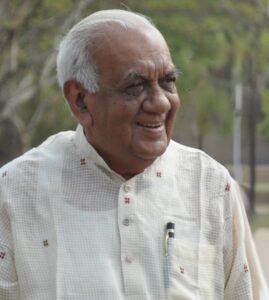
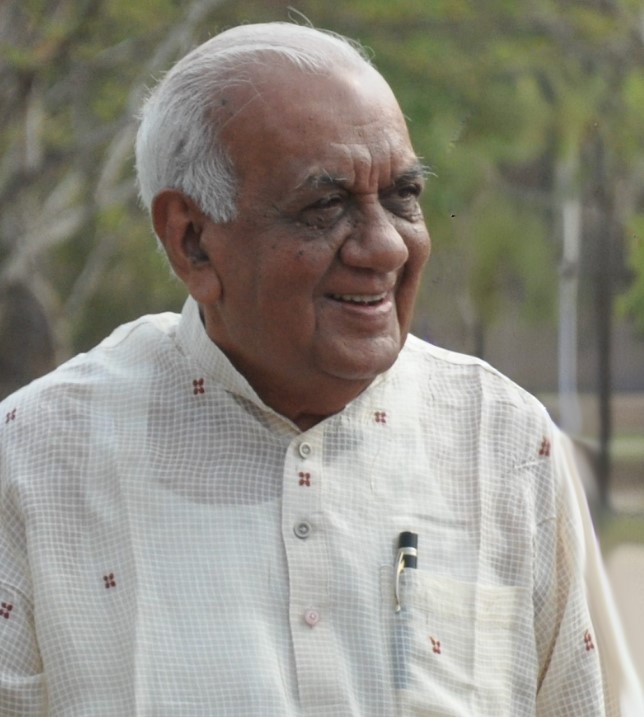
President, Kasturba Health Society · Chartered Accountant · Gandhian · The Last of the Founding Generation
“When Dr. Sushila Nayar met me in the summer of 1982 and asked me to oversee MGIMS, I was taken aback. I didn’t even know how to pronounce the names of half the departments, let alone understand what they did.”
He said this often, and with his characteristic candor — half laughing at the improbability of it, half genuinely awed by the chain of events that had led a seasoned corporate chartered accountant from Bombay to a rural medical college in Wardha. It was, by any reckoning, an unlikely appointment. And yet Dhirubhai Mehta spent the next four decades proving it was exactly the right one.
He died on April 22, 2024, in Bombay Hospital, forty-eight hours after being admitted for what they thought was viral pneumonia. He was eighty-seven. His son Nirad and daughter Maitri were beside him. Five days short of his eighty-eighth birthday, he was gone — and with him closed the last chapter of the founding generation of MGIMS.
Songath, Borivali, and the Making of a Chartered Accountant
Dhirubhai was born on April 27, 1936, in Songath, a small village in Gujarat’s Bhavnagar district. His father Shantilal was a schoolteacher at Gurukul High School — an Arya Samaj institution — the first in his village to have passed matriculation, struggling to support nine children on a teacher’s salary. Eventually, Bombay beckoned. Shantilal left the family behind, found work at the stock exchange, switched to accounting at a trading firm, saved every rupee, and gradually built enough security to move the family to a small apartment in Borivali.
His mother Savitaben had studied only to fourth standard, was engaged at five and married at thirteen. But she was, as Dhirubhai always maintained, no ordinary rural woman. When her daughter’s marriage began to fail within a year, Savitaben — in a time and place where divorce was taboo and family honour paramount — told her daughter to walk away. Choose dignity over tradition. It was a kind of courage that Dhirubhai never forgot and tried, in his own fashion, to replicate.
He schooled in Gujarati medium, moved to Borivali for high school, and chose Sydenham College of Commerce and Economics in Churchgate for his degree — drawn partly by its prestige and partly, he admitted, by the fact that it spared him Zoology. He could not bear dissections. The irony of spending four decades at a medical college was not lost on him.
He graduated in 1957, began his three-year articleship at a firm in Fort, tutored students and took part-time work to fund his studies, and in 1961 cleared the Chartered Accountancy examination on his first attempt before turning twenty-five. He was India’s 5,635th Chartered Accountant. He wore it lightly but earned it without shortcuts.
Khadi, Bajaj, and the Corporate Years
As a teenager, while peers chased fashion, Dhirubhai chose khadi. Not as an ideology performance — as a settled conviction. He opened khadi shops in Borivali. He caught the attention of Vaikunthbhai Mehta, walked into rooms where Dada Dharmadhikari and Narayan Desai spoke, and found his Gandhian formation alongside his commercial one.
After qualifying, he navigated three companies before joining the Bajaj Group in 1966 — the year he also married Nandini Bajaj, daughter of Radhakrishnaji Bajaj and granddaughter of Shrikrishnadas Jajoo, the revered freedom fighter and Gandhian leader. She was fluent in Hindi, Marathi, Marwari, and English, educated across Wardha, Banaras, and Lucknow. The marriage connected him to Wardha in ways that would prove consequential.
At Bajaj Auto, he rose steadily. Sharp in finance, investment, and taxation, he earned the trust of Kamalnayan, Ramakrishna, and Rahul Bajaj over two decades. In the early 1970s, he played a pivotal role in the Bajaj-Piaggio legal battle over the Vespa scooter. He held directorships beyond Bajaj, advised regulatory bodies, and served on committees shaping transparency and corporate governance at SEBI, CII, and FICCI.
During the Emergency of 1975, he stood with Jayaprakash Narayan at personal and financial risk — funding and sustaining the movement while thousands were jailed. He admired Vinoba Bhave but wrote him blunt letters questioning his support for the Emergency, which Vinoba had called a Festival of Discipline. Dhirubhai called it India’s darkest hour. He was not a man who moderated his views for the sake of comfort, even when the person on the other end was someone he revered.
At fifty, with a successful corporate career available to him for however long he wanted it, he walked away.
“It wasn’t easy,” he later said. “Nirad and Maitri were still studying. Nirad had his sights set on top American universities — an expensive dream. But my family stood by me.” His children both became chartered accountants. “Must be in the genes,” he would say, “but they did it on their own — without ever asking for help.”
How He Came to Sevagram
Until 1982, Dhirubhai Mehta and Dr. Sushila Nayar had never met.
The connection was made by Sarla Parekh, who had managed MGIMS’s finances for years and watched the institution’s funding position worsen through the late 1970s. She had known Dhirubhai for decades, admired his financial acumen and his Gandhian instincts, and heard that he was leaving Bajaj Auto. She went to Dr. Nayar. Why not bring Dhirubhai to Sevagram?
Nalinibhai Mehta and Tapdiya arranged a lunch. Dr. Nayar and Dhirubhai met. Conversations turned into shared visions. What began as an introduction became a calling.
He was already familiar with Wardha — his wife’s family was from there, the Bajaj Group had deep roots in the district. But familiarity with a place and choosing to give your working life to it are different things. He chose. He joined the Kasturba Health Society’s governing board, began visiting Sevagram regularly, and started the long process of understanding an institution whose departments he still couldn’t pronounce.
He never sought to overshadow Dr. Nayar. Where others with his corporate background might have arrived with a mandate for transformation, he arrived with humility. He worked quietly, offered his expertise where it was useful, and deferred to her vision without resentment. She, in turn, recognised what he offered — not just financial acumen but integrity, and the particular authority of a man who had no personal stake in the institution’s money.
“She shaped the institution’s ideals,” those who watched them work together said. “He secured its foundation.”
By the late 1990s, as Dr. Nayar’s health declined after her heart attack, she had ceded almost all operational authority to Dhirubhai. When she died on January 3, 2001, the governing body of the Kasturba Health Society looked to no one else.
Twenty-Three Years as President
He inherited an institution built on Gandhian ideals in a landscape that was changing fast around it. Private medical colleges were multiplying. For-profit hospitals were appearing near Sevagram. The commercial logic of Indian healthcare was encroaching from every direction. Dhirubhai’s task — the task he set himself — was to hold the line.
He held it.
MGIMS under his presidency cut ties with the pharmaceutical industry — a decision that alarmed many who feared the resulting loss of revenue. The money did not dry up. The institution’s ethical standing strengthened. He was not a man who governed by committee consensus; he made decisions and stood behind them.
The infrastructure he built across those twenty-three years was substantial: trauma centres, ICUs, a Cath Lab, dialysis units, a de-addiction centre, a mother and child centre, a palliative care unit, proper hostels for students and residents. A low-cost drug initiative that made treatment affordable for patients who had previously struggled to buy medicines. A unit for abandoned newborns. Healthcare outreach into Melghat — the tribal Korku Adivasi communities in the Satpura hills, where malnutrition and neglect had long gone unaddressed. He secured five crore rupees for the Melghat centre, went there himself on visits that were not for show, and stood behind the doctors and nurses on the ground when the work became difficult.
He brought distinguished academics onto the KHS board, wanting MGIMS to develop not just clinical excellence but scientific temper. He strengthened community medicine. He ensured every incoming batch of students underwent the Gandhi Ashram orientation — waking before dawn for prayers, cleaning, spinning yarn, learning service before they learned surgery. This mattered to him not as ritual but as formation.
Every month, he visited Sevagram. He walked the campus. He kept his door open. He drank tea with anyone who came. His wit was quick, his stories effortless, his ability to put people at ease genuine. He saw no hierarchy worth maintaining in casual human encounter.
The Man, Honestly Rendered
He was not without flaws, and a portrait that ignored them would do him a disservice.
He was susceptible to sycophancy — could be quick to form attachments to those who flattered him, sometimes misjudging people whose charm exceeded their reliability. He enjoyed dropping names — Vinoba Bhave, Jayaprakash Narayan, ministers, bureaucrats — and in his later years these stories became a refrain, repeated with a frequency that those close to him recognised but could not always redirect. As president, he had a mandate to guide and preach, and he used it with an enthusiasm that occasionally crossed into self-righteousness.
He relished the role. The access it provided, the visitors it brought, the influence it carried — he was not indifferent to any of it. And he struggled, as his final years arrived and memory began to soften his grip on administration, to do what every leader must eventually do: identify a successor and let go. He could not, or would not. He held the chair into his late eighties, when the institution needed something different from what he could still offer.
These are not small failings in a man who led an institution for twenty-three years. They should be recorded alongside his achievements, because an honest portrait serves memory better than a hagiography, and because Dhirubhai himself — who never softened the truth to spare someone’s comfort — would have expected no less.
What he was not, and never became, was corrupt. In a landscape where institutional leadership and personal enrichment so often moved together, Dhirubhai remained untouched. He donated crores to MGIMS quietly, without fanfare. The house he built on campus — his home in Sevagram for decades — he willed to the institution. He left no wealth extracted from the place. He left the place better than he found it.
“All I want,” he once said, “is for MGIMS to offer quality education and healthcare that everyone can afford.”
One sentence. His life’s work in it.
The End
His wife Nandini died in August 2022. He grieved, and kept going. MGIMS meetings continued. Plans moved forward. On April 20, 2024, he was admitted to Bombay Hospital with what appeared to be viral pneumonia. Forty-eight hours later, on April 22, he was gone.
He had given forty years to Sevagram — more than half his life. He had arrived not knowing how to pronounce the departments. He left having built some of them.
In the 2001 MGIMS bulletin, written when he first assumed the presidency, Dr. S.P. Kalantri wrote of the responsibility Dhirubhai was taking on — to uphold Dr. Sushila Nayar’s legacy, to keep the bright torch of MGIMS aloft, undimmed and untarnished, ensuring its light reached the poorest of the poor.
He kept it. Not perfectly — no one does — but faithfully, and with an integrity that the institution will measure its future leaders against for a long time to come.