Dr. B.C. Harinath
Director Professor of Biochemistry & JBTDRC Tenure 1970 – 2014 Lifespan 4 September 1937, Kallur, Chittoor district, Andhra Pradesh — 22 October 2022, Tirupati Education BSc, University of Madras (1954)MSc Biochemistry, Nagpur University (1961)
PhD Biochemistry, Oklahoma State University (1968)
Postdoctoral Fellow, Washington University School of Medicine, St. Louis (1969
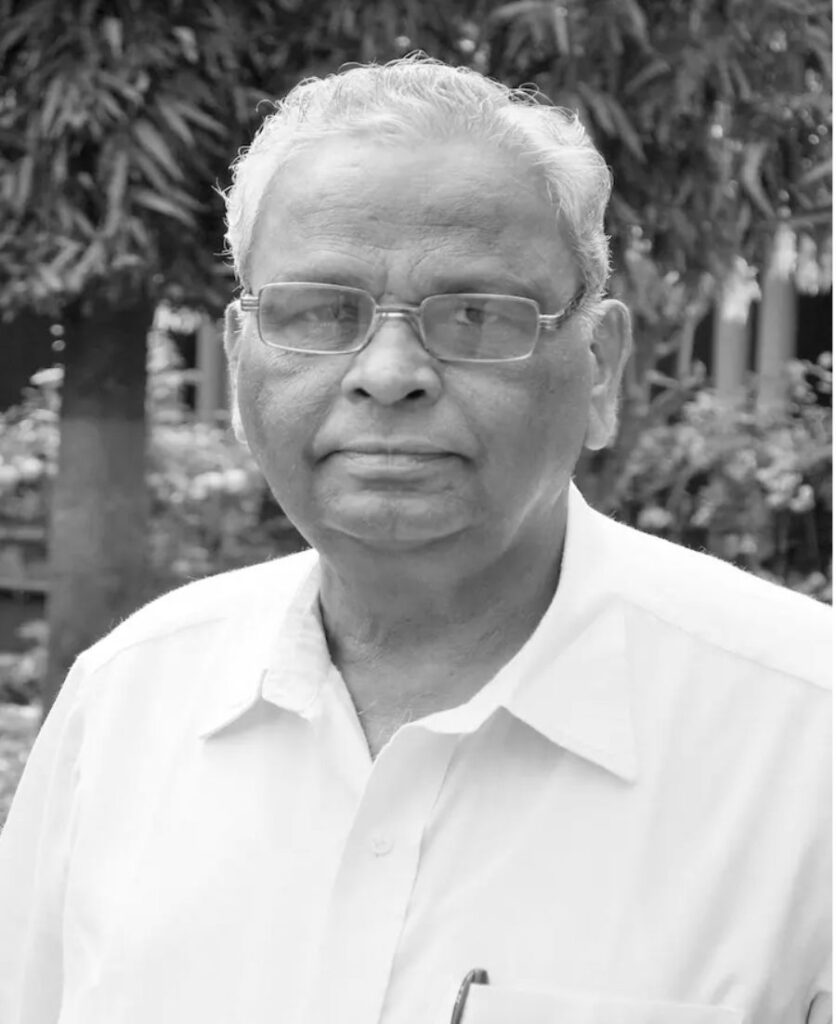
Director-Professor of Biochemistry · Director JBTMRC · Forty-Four Years at Sevagram · The Man Who Named His Diagnostic Test After the Village
His friends teased him in his later years: “You’ve come full circle — from Bio-chemi-stry to Tree.”
He laughed. He knew it was true.
The man who had spent four decades studying the molecular biology of parasites, building diagnostic kits, running immunodiagnostic workshops for medical schools across the country, and mentoring nineteen PhD students in the biochemistry of filariasis and tuberculosis — this man, in the last chapter of his Sevagram years, was planting amla trees on a fifteen-acre farm behind the boys’ hostel. He had named the project Arogyadham. The Jain group from Jalgaon had helped him establish it. He tended the saplings himself. The carbon, hydrogen, and oxygen molecules he had studied for decades now appeared in the flowering shrubs and fruit-bearing trees he was cultivating by hand.
The campus was amused and a little fascinated. It was not a contradiction, exactly — it was a completion. A hard-nosed scientist from a small village in Andhra Pradesh had arrived in a small village in Maharashtra in 1970, spent forty-four years building something significant, and then, in the fullness of it, found his way back to the soil.
***
Kallur, Oklahoma, St. Louis, Sevagram
Bhaskar Chenappa Harinath was born on September 4, 1937, in Kallur, a village in the Chittoor district of Andhra Pradesh, sixty kilometres from Tirupati. He completed his BSc at the University of Madras in 1954, his MSc in Biochemistry at Nagpur University in 1961, and then — in the movement that would define the arc of his professional life — went to the United States, completing his PhD at Oklahoma State University and postdoctoral fellowships at Washington University School of Medicine in St. Louis from 1968 to 1969.
He arrived at MGIMS on April 24, 1970, one year after the institution admitted its first students. He came with a PhD from America, postdoctoral training at one of the world’s leading medical research institutions, and the particular energy of someone who has been preparing for something important and has finally found the place to do it.
The department he was joining did not yet exist as a separate entity. Biochemistry and Physiology shared a combined department. In 1974, they split — Dr. Harinath taking charge of Biochemistry, Dr. Deshkar leading Physiology. What Dr. Harinath inherited was, in terms of equipment, faculty, and research infrastructure, almost nothing. What he brought was the training to build it from scratch and the temperament to insist that it be built well.
***
Filariasis, Research, and SEVAFILACHEK
The research direction he chose was not obvious. Filariasis — the mosquito-borne parasitic infection that causes lymphatic damage and, in advanced cases, the disfiguring swelling of limbs — was a serious public health problem in rural India but not a prestige research area. It was the kind of disease that afflicts poor communities and receives attention proportional to their political influence, which is to say: insufficient. Harinath saw it as an opportunity precisely because it was underworked.
He built his department’s research identity around it. He studied the immunology of filariasis, developed diagnostic methods, and created a diagnostic test he named SEVAFILACHEK — after Sevagram, the village where he had made his home and his laboratory. It was a deliberate act of naming: this diagnostic tool carried the village’s identity into the scientific literature.
He recruited Dr. M.V.R. Reddy and Dr. G.B.K.S. Prasad from Sri Venkateswara University in Telangana, and together they published groundbreaking work on filariasis. His PhD students — P. Kaliraj, P. Rama Prasad, Kumud Parkhe, I. Kharat, Ashok Malhotra, V. Chenthamarakshan, K. Cheirmaraj, L. Jena, and others — formed what he explicitly cultivated as a family of filarial biologists. He guided nineteen PhD students between 1980 and 2011. He published over two hundred papers in international journals, operated from a village with no urban research infrastructure, and earned a reputation among immunodiagnostics researchers worldwide that had nothing to do with the prestige of his institution’s address.
He ran popular workshops on immunodiagnostics in Biochemistry that drew medical schools across the country to Sevagram. He convinced Dr. Sushila Nayar to invest in equipment the department needed, arguing his case with the persistence of someone who understood that good research requires tools and that tools require institutional will to acquire them.
The Dr. B.C. Roy Award came in December 1993, recognising his contributions to the development of a specialty at MGIMS. He joined the company of Dr. Sushila Nayar, Dr. J.S. Mathur, Dr. P. Nayar, and Dr. Prakash Behere as MGIMS recipients of the Medical Council of India’s most prestigious honour for specialty development. He served as President of the Indian Immunology Society from 1990 to 1992 and President of the Association of Clinical Biochemists of India from 1994 to 1995. He later patented the Mycobacterial ES-31 serine protease for tuberculosis diagnostics and established the MycoProtein-DB, a database for mycobacterial proteases.
***
The TB Tests and the Difficulty of Being Wrong
Later in his career, he extended his diagnostic work from filariasis to tuberculosis — developing serological tests he believed would be effective tools for TB diagnosis. He invested significantly in this direction: time, effort, his department’s research focus.
The Indian government eventually banned serological tests for TB diagnosis in favour of sputum smear microscopy and molecular tests, which had demonstrated evidence of superiority. His tests were effectively set aside.
It was hard for him. He had spent years on this work, believed in it, built around it. The frustration and disillusionment were real, and those who knew him could see it. Science requires the willingness to be wrong, but that willingness is easier to profess than to embody when a decade of effort is what is being set aside. His filariasis work remained a genuine and lasting contribution. The TB diagnostic work was a lesson in how even gifted and productive scientists can develop biases toward their own methods. He carried both parts of the record honestly.
***
The Man in the Laboratory
He was outwardly impatient — known for occasional bursts of temper, a strict taskmaster who held his students and himself to high standards and was not gentle when those standards were not met. He spoke English with a distinct Telugu accent and never became fluent in Marathi or Hindi, which in Sevagram’s linguistic community was a permanent marker of his outsider origin. He did not compensate for this with social effort — he was a man of few words outside the laboratory, not given to gossip or small talk, often more absorbed in mosquito-borne disease than human conversation.
Yet he earned genuine respect — from colleagues, from staff, from the influential figures in Sevagram’s Gandhian world — through the quality of his work and the integrity of his conduct. In a village where simplicity was both an ethic and a daily reality, a biochemist from Andhra Pradesh who had trained in Oklahoma and St. Louis and then chose to spend forty-four years in Sevagram building a research department was understood to be doing something unusual. The choice itself commanded a certain regard.
As a mentor, he was demanding and inspiring in equal measure. His perfectionism was not mere exactingness — it came from a genuine belief that research done carelessly was not worth doing, and that students were capable of more than they typically asked of themselves. The research family he built, and the publication record that emerged from it, vindicated the belief.
***
The Last Chapter
He retired from MGIMS in 2014 and moved to Tirupati with his wife Vimla. The amla farm — Arogyadham — was behind him, but the impulse it represented followed him: an interest in Yoga, Naturopathy, and herbal medicine that deepened in his final years. He dreamed of creating a holistic health retreat and senior citizen homes in a nature-friendly environment. He donated nine acres of land near IIT Tirupati for the establishment of an orphanage — a late act of generosity from a man whose working life had been organised around building institutions that outlasted him.
His son Ashok, a 1984 MGIMS alumnus who had earned both his MBBS and MD at the institution, married his classmate Renuka Kulkarni, who completed her MD in Pathology at MGIMS. Both eventually settled in the United States. His son Anil, an engineer, also went abroad.
Dr. Harinath died on October 22, 2022, survived by Vimla and his two sons. He had arrived in Sevagram in 1970 as a young man freshly returned from America, full of ambition and research plans. He left in 2014 as someone who had built more than he had planned, in a place that had given him more than he had expected.
The amla trees at Arogyadham are still there. From Bio-chemi-stry to Tree: the journey, in the end, made its own kind of sense.
Mentored Students (MD/MS)
Immunological study in filariasis
Lipid metabolism in pregnancy
Metabolism and mechanism of action of diethylcarbamazine
Immunodiagnosis of human filariasis
In vitro cultivation studies with filarial parasite
Immunodiagnostic studies in filariasis
Immunological Studies in Bancroftian Filariasis
Studies on filarial excretory and secretory antigens
Studies in Filarial excretory and secretory antigens
Detection treatment and immuno-monitoring of filarial patient
Immunochemical approaches for diagnosis of Filariasis
Immunological and Immunoprophylactic Studies in Filarial infections
Diagnostic use of filarial antigen and antibody isolated from hydrocele fluid
Humoral immune response in pulmonary tuberculosis
Filarial antigens of Diagnostic and Prophylactic Importance
Immuno-diagnosis of extra-pulmonary tuberculosis
Studies on in vivo released filarial antigens
Isolation, Purification and Diagnostic use of Mycobacterium tuberculosis excretory secretory antigens in Tuberculosis
Studies in Mycobacterial and nerve antigens in Leprosy
Oxidative stress and effects of antioxidants supplementation in carcinoma of upper digestive tract and oral submucous fibrosis
Studies on in vitro and vivo released mycobacterium tuberculosis antigen in tuberculosis
Utility of ES-31 and ES-41 antigens for immunoscreening of pulmonary and extrapulmonary tuberculosis – hospital case study
Biochemical and immunological studies in tuberculosis
Isolation and characterization of filarial antigens with Diagnostic and prophylactic potential
Studies on circulating antigens in tuberculosis
Isolation, Characterization and; possible function of certain mycobacterial excretory secretory antigens of diagnostic interest
Studies on Mycobacterial Excretory-Secretory protein antigens of diagnostic interest in HIV-TB coinfection
Key Milestones
| 1937 | Born, 4 September, Kallur, Chittoor district, Andhra Pradesh — sixty kilometres from Tirupati |
| 1954 | Completed BSc, University of Madras |
| 1961 | Completed MSc Biochemistry, Nagpur University |
| 1968 | Completed PhD, Oklahoma State University |
| 1969 | Postdoctoral fellowship, Washington University School of Medicine, St. Louis |
| 1970 | Arrived MGIMS, 24 April — joined combined Biochemistry and Physiology department |
| 1974 | Biochemistry separated from Physiology — took charge of department |
| 1980 | Began guiding PhD students — nineteen students between 1980 and 2011 |
| 1990 | President, Indian Immunology Society — until 1992 |
| 1993 | Dr. B.C. Roy Award, December — MCI’s most prestigious honour for specialty development |
| 1994 | President, Association of Clinical Biochemists of India — until 1995 |
| 2011 | Last PhD student guided — thirty-one years of doctoral mentorship |
| 2014 | Retired from MGIMS — established Arogyadham amla farm, fifteen acres, behind boys’ hostel |
| 2014 | Moved to Tirupati with wife Vimla — donated nine acres near IIT Tirupati for orphanage |
| 2022 | Died, 22 October, Tirupati — survived by Vimla, sons Ashok and Anil |