Dr. Narendra Samal
Professor & Head of Pathology · MGIMS Tenure 1972 – 1992 Lifespan 2 April 1947, Charinangala, Odisha — 3 December 2023, Sevagram Education MBBS (Sriram Chandra Bhanj Medical College, Cuttack) [1970]MD Pathology (MGIMS, Sevagram) [1981]
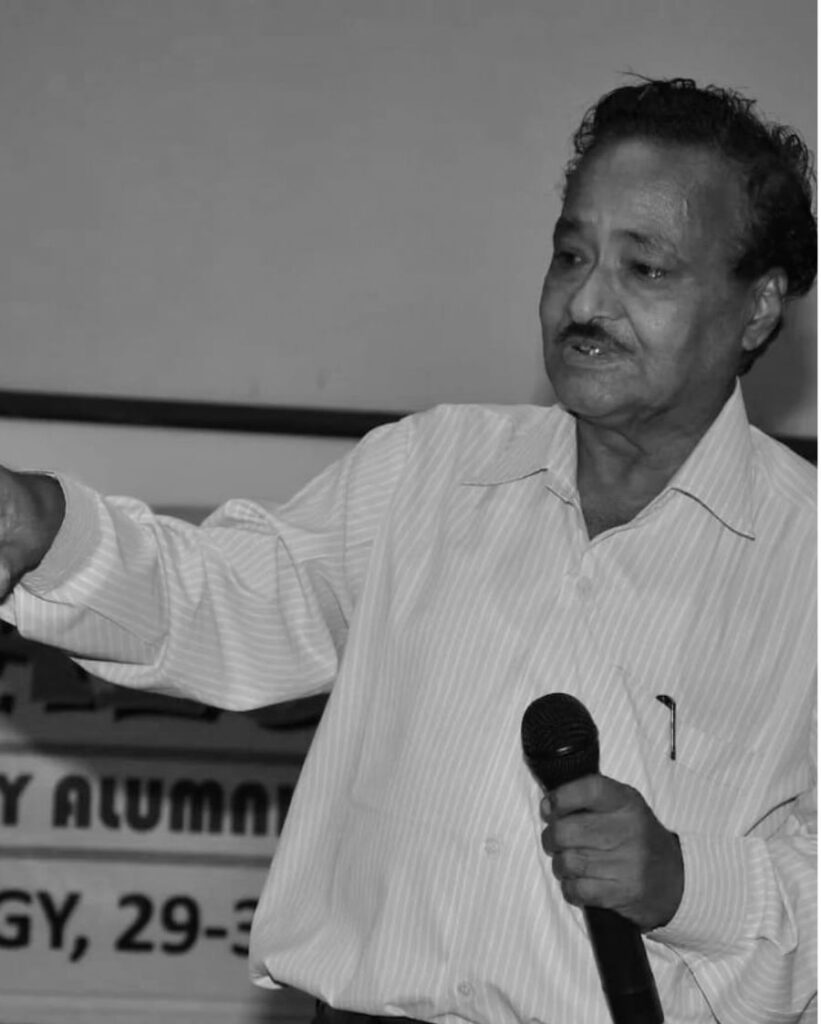
Professor & Head of Pathology · Twenty Years at Sevagram · The Rarest Kind of Life
Three months after Dr. Narendra Samal died, on February 26, 2024, Swarnlata died too — at home, as if she could not bear to leave him alone on his final journey.
They had spent fifty years proving, in the specific language of action rather than declaration, that love was a practice and not a sentiment. He had waited years to pursue his own postgraduate degree so that she could complete hers first. He had resigned as Professor and Head of Pathology — a position of genuine standing, built over two decades — so that she could accept a department headship at a new institution. He had converted from Islam to Hinduism and changed his name, officially documented in the Maharashtra Gazette in February 1985, so that there would be no ambiguity about where he stood. When she suffered a severe brain injury in a scooter accident in the early 1990s, he became her doctor, her nurse, and her steady presence until her recovery. When a stroke left him profoundly disabled in his final years, she became his caregiver, tending to him without complaint until his death. Then she followed him, three months later.
Some bonds are too strong to be broken even by time. Theirs was one of them.
Charinangala, Cuttack, and the Road West
Naziruddin Khan was born on April 2, 1947, in Charinangala, a village in Badchana tehsil of Odisha, just months before Indian independence. He was orphaned early. Poverty was a constant companion through his childhood and education — through Bhadrak College, through Utkal University, through Sriram Chandra Bhanj Medical College in Cuttack, where he completed his MBBS in 1970. Each institution he passed through was a step taken with the single-mindedness of someone who understood that education was the only available path.
What brought him to MGIMS was a Gandhian freedom-struggle veteran named Bihari Lal, who had a keen eye for potential and wrote a letter to Dr. Sushila Nayar recommending the young Dr. Khan. When he arrived at MGIMS in the summer of 1972, the only available position was house officer in Medicine. He took it without hesitation.
In August 1972, he transitioned to Pathology as a Lecturer — the department where he would spend the next two decades building both his career and the field itself. The following year he married Swarnlata Samal, an Odia woman from a Hindu family, and together they committed to a life in Sevagram — one thousand kilometres from Odisha, in a place whose language, culture, and rhythms were entirely unfamiliar. They were both without postgraduate degrees when they arrived. Neither had the resources to enrol in a three-year programme away from MGIMS. They would have to be patient, and they were patient — but he was patient for her first.
The Discipline in the Classroom
Students from the 1975 to 1992 batches called him Khan Chacha. They said this with a particular warmth that coexisted, uneasily to outsiders but naturally to those who had been taught by him, with the memory of flying chalk and flying dusters.
“He used to strike terror in the hearts of students,” recalled Monika Ahuja of the 1982 batch. Abhay Kelkar from 1987 put it differently: “Despite the occasional turbulence, we were blessed to have been taught, scolded, and rebuked by this teacher in his inimitable style.”
His intensity was not cruelty. It was the particular severity of a man who believed pathology was serious, that medical students were capable of mastering it seriously, and that anything less than full engagement was a failure of respect — toward the subject, toward the patients who needed doctors to understand it, and toward the students themselves. He was easily recognisable in the corridors: white khadi trousers, an off-white silk shirt, paan almost always in his mouth, a distinct Odia accent that gave his presence a quality unlike anyone else on campus. He supervised seventeen postgraduate students through their MD theses, including V.C. Gupta, Aruna Mutha, Kiran Swarup, Milind Jagtap, Nitin Gangane, Girish Muzumdar, and Renuka Kulkarni. Dr. Nitin Gangane went on to become Dean of MGIMS and later Vice-Chancellor of KLE Academy of Higher Education and Research, Belagavi.
Beyond teaching, he took on the editorship of the MGIMS Annual Reports in the mid-1980s, working with Dr. S. John Premendran, Mr. Shankar Bhat, Dr. Pradeep Joel, and Mr. C.D. Gokulachandran. In September 1988, Dr. Sushila Nayar appointed him Warden of the Boys’ Hostel alongside Dr. A.P. Jain — tasked with improving discipline and conditions in a hostel that had become difficult to manage. He approached it with the same rigour he brought to the classroom. Dr. Nayar wrote him a personal letter of commendation, acknowledging his conscientiousness and the trust he had justified through his service.
The Name in the Gazette
The conversion and the name change — from Naziruddin Khan to Narendra Samal — happened in February 1985 and were officially recorded in the Maharashtra Gazette. He had already been Swarnlata’s husband for twelve years. The conversion was not a precondition she had set. It was a statement he chose to make, about belonging, about commitment, about the kind of man he intended to be.
Their home in Sevagram became a tradition for students during Saraswati Puja — the Muslim-turned-Hindu professor and his Hindu wife welcoming students with sweets and warmth, across whatever religious boundaries the calendar recognised. Dr. V.K. Gupta, a pathologist from the 1976 batch who remembered both of them well, spoke of the love they shared as something that transcended the narrow categories the world tried to impose on it.
The Resignation, and What It Meant
In May 1992, he resigned as Professor and Head of Pathology at MGIMS.
The reason was straightforward: Swarnlata had been offered the position of Head of the Department at the newly established JN Medical College in Sawangi, Wardha. She had been a Lecturer at MGIMS since 1976, had risen through Reader and Associate Professor, and had reached Professor in 1990. But the path to department head at MGIMS was blocked by the existing structure. Dr. Nayar, who valued them both, had created an additional professorship specifically to ensure Swarnlata’s promotion could proceed. It was not enough.
He resigned from the position he had built over twenty years. He walked away from it so that she could walk toward something she deserved.
Dr. Nayar wrote him a personal note expressing her disappointment — not anger, but the sadness of someone who had invested in a person and wished the conversation had happened earlier. She respected his decision. She wished him well.
At Sawangi, he developed clinical laboratories and continued teaching pathology. In November 2017, he suffered a severe stroke that required intensive care and mechanical ventilation for three weeks. He survived but was left profoundly disabled — dependent, confined, the active and forceful figure of the classroom reduced to the stillness of a man who could no longer do for himself. For six years, Swarnlata cared for him at home, without complaint, with the matter-of-fact devotion that had characterised everything she had done in their life together.
He died on December 3, 2023. She died on February 26, 2024.
What He Left
Their elder son Nitin is an MGIMS alumnus from the class of 1995 who completed his MS in Orthopaedics at his father’s institution. Their younger son is a physiotherapist. The boys grew up in the house where Saraswati Puja was celebrated and paan was always present and students came for sweets, where their father wore white khadi and spoke with an Odia accent and threw chalk when he needed to and loved their mother in a manner that left no room for ambiguity.
The seventeen pathologists he trained are practising across the country. The institution he helped build across two decades in Sevagram, and the one he helped launch in Wardha, carry the imprint of a man who understood that rigour and love were not opposites — that both demanded the same quality of commitment, the same refusal to do things halfway.
He gave everything to his work and everything to his wife, and somehow both were given fully, not divided. This is the rarest kind of life.
Mentored Students (MD/MS)
Comparative histopathological study of the skin, oral mucosa and lymph node in leprosy
Clinico-pathological study of endometrium in dysfunctional uterine bleeding
Study of Hepatitis B surface antigen ( HBsAg) and alpha fetoprotein (AFP) in various liver diseases
Fibrinogen levels in sickle cell disease
Study of Hepatitis B surface antigen (HBsAg) immunostatus in cases of leprosy
Study of Hepatitis B surface antigen immunostatus in case of lymphoproliferative disorders
Study of malignant soft tissue tumors with special reference to histomorphology at Mahatma Gandhi Institute of Medical sciences: A review of 10 years
Detection of Hepatitis B surface antigen (HBsAg) and antibody (anti-HBs) from filter paper blood samples
A correlative study of filarial antigen and antibody in blood and hydrocele fluid of hydrocele cases with histomorphology of tunica vaginalis
Epidemiological study of dysplasia of uterine cervix in married women around Sevagram: retrospective analysis
Alloxan-induced diabetes mellitus in albino rats with special reference to histomorphology of pancreas
Histological study of early skin lesions in leprosy
The prevalence of human immunodeficiency virus infection among blood donors and patients with leprosy and tuberculosis in rural population around Sevagram
Cytological study of leukoplakic lesions in oral cavity
Cytomorphological study of palpable thyroid diseases by fine needle aspiration cytology
Immunodiagnosis of tuberculosis
Key Milestones
| 1947 | Born, 2 April, Charinangala, Badchana tehsil, Odisha |
| 1970 | Completed MBBS, Sriram Chandra Bhanj Medical College, Cuttack |
| 1972 | Arrived MGIMS — house officer in Medicine, then Lecturer in Pathology, August |
| 1973 | Married Swarnlata Samal |
| 1976 | Swarnlata joined MGIMS as Lecturer in Pathology |
| 1985 | Converted to Hinduism, changed name to Narendra Samal — recorded in Maharashtra Gazette, February |
| 1988 | Appointed Warden, Boys’ Hostel — alongside Dr. A.P. Jain, September |
| 1990 | Swarnlata promoted to Professor of Pathology |
| 1992 | Resigned as Professor & Head of Pathology, May — so Swarnlata could accept department headship at JN Medical College, Sawangi |
| 2017 | Suffered severe stroke, November — left profoundly disabled |
| 2023 | Died, 3 December |
| 2024 | Swarnlata died, 26 February — three months after him |