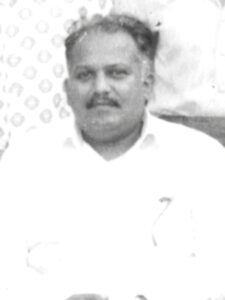
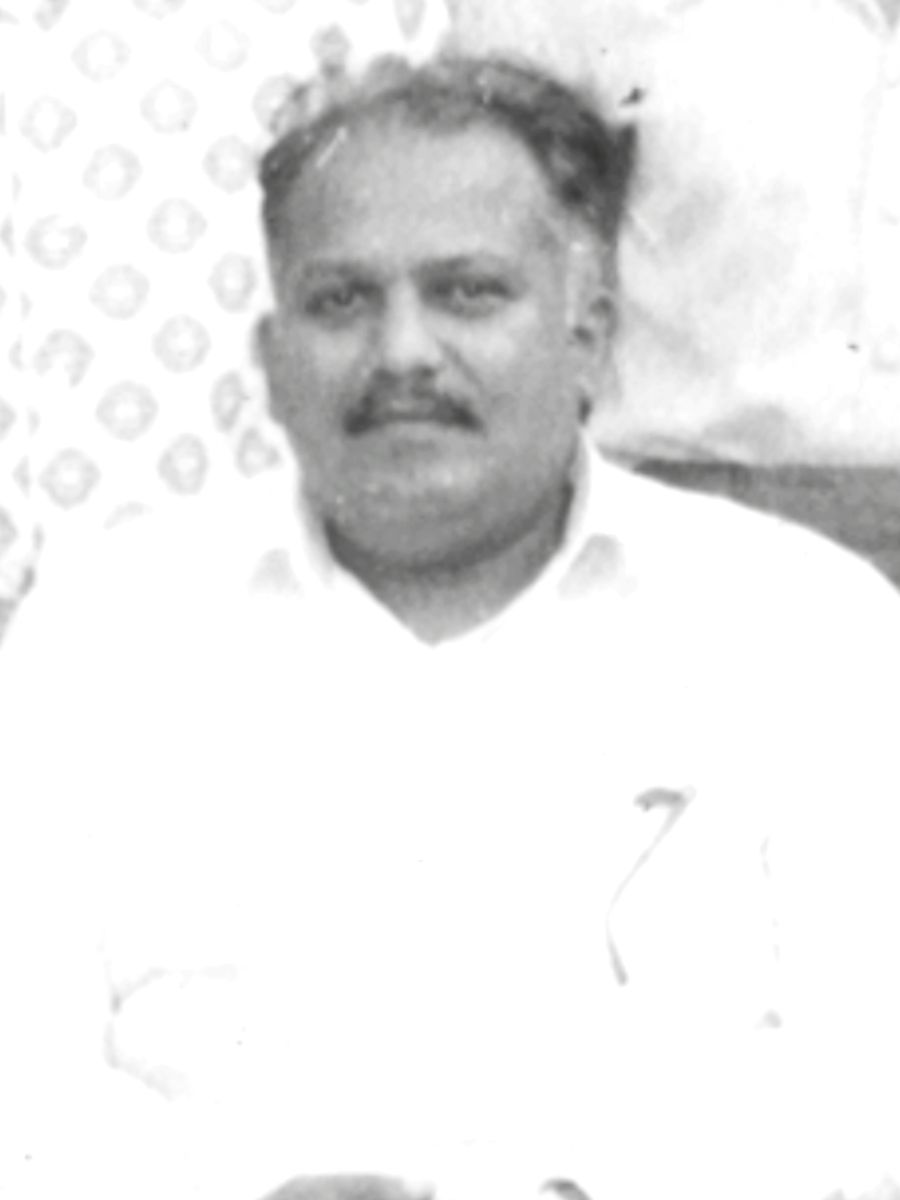
Dr. R.M. Shetti Head of Anaesthesiology at MGIMS. Portrait extracted from a historical group photograph taken at Sevagram.

Dr. Ramakant Nagesh Shetti

Professor of Anaesthesiology · Vice Principal · MGIMS

MBBS, Mahatma Gandhi Medical College Osmania University (1963);
MS Anaesthesiology, Amritsar (1968)

b. 24 March 1939, Gulbarga   ·   d. 2004

Tenure: 1975 – 1984

Professor of Anaesthesiology · Vice Principal · Nine Years at Sevagram · The Man on His Own Terms

Ramakant Nagesh Shetti — Babu to those who loved him, R.N. Shetti to the world — was born on March 24, 1939, in Gulbarga, the first of ten children. The household he grew up in worshipped learning.

His father, Dr. Nagesh Subrao Shetti, had walked barefoot through the dusty lanes of Ankola as a boy. Leaving home young, he was mentored by a distant relative who was an eye surgeon. He eventually earned certification from the Henderson Eye Institute and built a formidable practice in Gulbarga, drawing patients from considerable distances who sought the certainty of his care rather than the false promise of miracles. Cataracts, trachomas, and blindness were faced with calm hands and a steady gaze.

His mother, Sushilabai, taught mathematics and lived by strict logic. At her husband’s urging, she travelled alone to Hyderabad to complete her education while her children, including young Ramakant, remained at home under the care of older siblings. It was a fiercely bold decision for a mother in the 1940s, and it permanently planted in the household the belief that knowledge was the greatest inheritance available.

From these origins, Shetti rose through the schools of Gulbarga, topped the district in his pre-university certificate examinations, and entered Mahatma Gandhi Medical College, Osmania University, graduating with his MBBS in 1963.

Anaesthesia — the silent, high-stakes art of keeping life suspended between breath and blade — drew him in completely. He completed his Diploma in Anaesthesiology in 1965 and travelled to Amritsar in 1968 to train under the legendary Dr. Pritam Singh, earning his MS and FICS. His thesis examined chloroform’s effects on the heart rate and blood pressure of dogs. It was precise, methodical work that established the rigid intellectual habits he would carry for the rest of his career.

On February 14, 1975, he arrived in Sevagram by bus and train across the dust-blown plains of Maharashtra. His appointment: Professor of Anaesthesiology. His starting salary: ₹2,632.20. One of his two bags contained absolutely nothing but books and medical journals.


The Operating Theatre He Commanded

Anaesthesia at MGIMS in the 1970s was a high-wire act. The department worked with a Boyle’s machine delivering nitrous oxide, ether, and halothane. Blood pressure was measured manually with a mercury sphygmomanometer. End-tidal CO₂ monitoring was entirely unknown. None of the department’s few members held an MD. They worked with sheer resolve and what little they had.

Within these constraints, Dr. Shetti administered cardiac anaesthesia for open mitral valvotomy and pericardiectomy — procedures of considerable complexity performed by Dr. K.K. Trivedi in a rural medical college with minimal monitoring and limited staff. The Shetti-Trivedi partnership was one of those rare institutional collaborations whose outputs defied all reasonable expectation: a surgeon and an anaesthesiologist who trusted each other completely, pushing together against the absolute limits of what a resource-constrained setting could offer.

His presence in the theatre was unmistakable. Absolute silence prevailed the moment he entered. Casual banter ceased. Staff moved with urgent purpose. The hawk-like focus and expectation of perfection were not conveyed through speeches but through the quality of attention he brought to every procedure — a quality that immediately infected everyone around him. “Safety in anaesthesia was his top priority,” a former student recalled. This was not a corporate slogan. It was the organizing principle of how he worked, expressed in the stillness of the theatre and the rigid discipline of the team.

The standard held beyond the theatre. One Sunday morning, he telephoned the ICU to check on a critical patient and discovered the duty resident had slipped away to watch the Mahabharata on television. He dressed, drove to the hospital, and confronted the situation directly. The rule he enforced that day — no doctor leaves a ward unattended without a replacement arriving — outlasted his time at Sevagram by decades.

When a student named Alex suffered a severe head injury and lay in surgery fighting for his life, Dr. Shetti had a family holiday planned. The railway tickets were booked; the bags were packed. He abandoned it without negotiation. “Cities and palaces will not disappear,” he said. “Vacations can wait.” He stayed by the student’s side for the forty-eight critical hours that followed.


The Editor, the Vice Principal, and the Cooperative

From 1982 to 1985, he served as the editor of the Indian Journal of Anaesthesiology — reviewing manuscripts, refining language, correcting proofs, and maintaining rigorous peer review. He made monthly trips to Nagpur with his assistant editor, Dr. Sanjay Khot, and stenographer Kuljeet Singh, to procure paper, oversee the printing press, and dispatch copies to subscribers. He believed the strength of a journal rested entirely on the quality of its manuscripts, and he worked relentlessly to build it into a trusted national resource.

On November 17, 1977, he was appointed Vice Principal, adding heavy administrative responsibility to his clinical and editorial work. He wore the responsibility effortlessly, never retreating from the operating theatre.

The housing cooperative society was a different kind of work entirely, but characteristic of the exact same quality of attention. In the late 1970s, several cooperative societies in the Sevagram area had collapsed due to mismanagement and bitter internal disputes. Dr. Shetti decided this one would not.

Alongside three hospital technicians, he navigated revenue offices, Gram Panchayat halls, and the governor’s chambers, deploying fierce logic, sharp eloquence, and a well-timed chuckle that disarmed resistant officials. He negotiated with Manimala Chaudhary of the Kasturba Health Society to secure land plots for technicians, nurses, clerks, and paramedics. The society was successfully established. He acquired a plot for himself, but never built on it. When he eventually left Sevagram, he transferred it quietly to Dr. Sushil Verma of Pharmacology. His energy had been invested entirely in the creation of the society, not in personal accumulation.


The Man in Full

He was fluent in Kannada, Hindi, Marathi, Telugu, English, and Urdu. He possessed a deeply discerning ear for music — able to instantly identify specific gharanas and ragas. He visited Rhythm House in Bombay just to record cassettes of his favourite songs. He watched The Guns of Navarone eleven times, adored the films of Guru Dutt, and kept a vast personal library that ran from Shakespeare to Ayn Rand to Robin Cook. The last book by his bedside during his final hospitalisation was The Da Vinci Code.

He carefully curated the Sevagram cine club’s fortnightly screenings in the anatomy lecture hall, selecting films that would be enriching rather than merely diverting — providing vital cultural life to a community that had no television, no internet, and no multiplex. The mirchi bhajjis and bondas at Wardha East station were a regular, unapologetic pleasure. He frequently walked from Sevagram to Wardha station with excellent intentions of losing weight, and always returned with the exact same cheerful appetite intact.

At 13 MLK Colony, his wife Rajani — hailing from Ankola, the same coastal town where his father had grown up barefoot — painted, wrote poetry in Kannada, and learned Indian classical music at the Gandhi Ashram. He was, by all accounts, her most ardent admirer. Their four children were raised with a deep appreciation for culture and travel. None pursued medicine. All carry exactly what he gave them.


The Diagnosis

In June 2004, Dr. R.N. Shetti was diagnosed with acute myeloid leukaemia. His haematologist at Christian Medical College, Vellore, Dr. Chandy, made a highly unusual note in the clinical record: a determined professional, aware of the disease, had chosen not to undergo chemotherapy. He understood its side effects. He did not wish to burden his loved ones during the final phase of his life and had decided to confront the illness on his own terms.

He had inscribed a verse in his personal diary, Robert Frost’s famous conclusion to “Stopping by Woods on a Snowy Evening”:

The woods are lovely, dark and deep, But I have promises to keep, And miles to go before I sleep, And miles to go before I sleep.

He had kept the promises. He had gone the miles. When leukaemia finally arrived in June 2004, he chose not to undergo chemotherapy, declined to burden his family, and met the end on the exact same terms he had met absolutely everything else in his life — directly, on his own authority, and without flinching.

He died three months after the diagnosis. He was sixty-five. His children read the Sai Satcharitra to him from his hospital bed and played his favourite music — Bhimsen Joshi, perhaps, or Mehdi Hassan, or Lata Mangeshkar. He had always known exactly which music he wanted.


Dr. Ramakant Nagesh Shetti

Professor of Anaesthesiology · Vice Principal · Nine Years at Sevagram · The Man on His Own Terms

Ramakant Nagesh Shetti — Babu to those who loved him, R.N. Shetti to the world — was born on March 24, 1939, in Gulbarga, the first of ten children. The household he grew up in worshipped learning.

His father, Dr. Nagesh Subrao Shetti, had walked barefoot through the dusty lanes of Ankola as a boy. Leaving home young, he was mentored by a distant relative who was an eye surgeon. He eventually earned certification from the Henderson Eye Institute and built a formidable practice in Gulbarga, drawing patients from considerable distances who sought the certainty of his care rather than the false promise of miracles. Cataracts, trachomas, and blindness were faced with calm hands and a steady gaze.

His mother, Sushilabai, taught mathematics and lived by strict logic. At her husband’s urging, she travelled alone to Hyderabad to complete her education while her children, including young Ramakant, remained at home under the care of older siblings. It was a fiercely bold decision for a mother in the 1940s, and it permanently planted in the household the belief that knowledge was the greatest inheritance available.

From these origins, Shetti rose through the schools of Gulbarga, topped the district in his pre-university certificate examinations, and entered Mahatma Gandhi Medical College, Osmania University, graduating with his MBBS in 1963.

Anaesthesia — the silent, high-stakes art of keeping life suspended between breath and blade — drew him in completely. He completed his Diploma in Anaesthesiology in 1965 and travelled to Amritsar in 1968 to train under the legendary Dr. Pritam Singh, earning his MS and FICS. His thesis examined chloroform’s effects on the heart rate and blood pressure of dogs. It was precise, methodical work that established the rigid intellectual habits he would carry for the rest of his career.

On February 14, 1975, he arrived in Sevagram by bus and train across the dust-blown plains of Maharashtra. His appointment: Professor of Anaesthesiology. His starting salary: ₹2,632.20. One of his two bags contained absolutely nothing but books and medical journals.


The Operating Theatre He Commanded

Anaesthesia at MGIMS in the 1970s was a high-wire act. The department worked with a Boyle’s machine delivering nitrous oxide, ether, and halothane. Blood pressure was measured manually with a mercury sphygmomanometer. End-tidal CO₂ monitoring was entirely unknown. None of the department’s few members held an MD. They worked with sheer resolve and what little they had.

Within these constraints, Dr. Shetti administered cardiac anaesthesia for open mitral valvotomy and pericardiectomy — procedures of considerable complexity performed by Dr. K.K. Trivedi in a rural medical college with minimal monitoring and limited staff. The Shetti-Trivedi partnership was one of those rare institutional collaborations whose outputs defied all reasonable expectation: a surgeon and an anaesthesiologist who trusted each other completely, pushing together against the absolute limits of what a resource-constrained setting could offer.

His presence in the theatre was unmistakable. Absolute silence prevailed the moment he entered. Casual banter ceased. Staff moved with urgent purpose. The hawk-like focus and expectation of perfection were not conveyed through speeches but through the quality of attention he brought to every procedure — a quality that immediately infected everyone around him. “Safety in anaesthesia was his top priority,” a former student recalled. This was not a corporate slogan. It was the organizing principle of how he worked, expressed in the stillness of the theatre and the rigid discipline of the team.

The standard held beyond the theatre. One Sunday morning, he telephoned the ICU to check on a critical patient and discovered the duty resident had slipped away to watch the Mahabharata on television. He dressed, drove to the hospital, and confronted the situation directly. The rule he enforced that day — no doctor leaves a ward unattended without a replacement arriving — outlasted his time at Sevagram by decades.

When a student named Alex suffered a severe head injury and lay in surgery fighting for his life, Dr. Shetti had a family holiday planned. The railway tickets were booked; the bags were packed. He abandoned it without negotiation. “Cities and palaces will not disappear,” he said. “Vacations can wait.” He stayed by the student’s side for the forty-eight critical hours that followed.


The Editor, the Vice Principal, and the Cooperative

From 1982 to 1985, he served as the editor of the Indian Journal of Anaesthesiology — reviewing manuscripts, refining language, correcting proofs, and maintaining rigorous peer review. He made monthly trips to Nagpur with his assistant editor, Dr. Sanjay Khot, and stenographer Kuljeet Singh, to procure paper, oversee the printing press, and dispatch copies to subscribers. He believed the strength of a journal rested entirely on the quality of its manuscripts, and he worked relentlessly to build it into a trusted national resource.

On November 17, 1977, he was appointed Vice Principal, adding heavy administrative responsibility to his clinical and editorial work. He wore the responsibility effortlessly, never retreating from the operating theatre.

The housing cooperative society was a different kind of work entirely, but characteristic of the exact same quality of attention. In the late 1970s, several cooperative societies in the Sevagram area had collapsed due to mismanagement and bitter internal disputes. Dr. Shetti decided this one would not.

Alongside three hospital technicians, he navigated revenue offices, Gram Panchayat halls, and the governor’s chambers, deploying fierce logic, sharp eloquence, and a well-timed chuckle that disarmed resistant officials. He negotiated with Manimala Chaudhary of the Kasturba Health Society to secure land plots for technicians, nurses, clerks, and paramedics. The society was successfully established. He acquired a plot for himself, but never built on it. When he eventually left Sevagram, he transferred it quietly to Dr. Sushil Verma of Pharmacology. His energy had been invested entirely in the creation of the society, not in personal accumulation.


The Man in Full

He was fluent in Kannada, Hindi, Marathi, Telugu, English, and Urdu. He possessed a deeply discerning ear for music — able to instantly identify specific gharanas and ragas. He visited Rhythm House in Bombay just to record cassettes of his favourite songs. He watched The Guns of Navarone eleven times, adored the films of Guru Dutt, and kept a vast personal library that ran from Shakespeare to Ayn Rand to Robin Cook. The last book by his bedside during his final hospitalisation was The Da Vinci Code.

He carefully curated the Sevagram cine club’s fortnightly screenings in the anatomy lecture hall, selecting films that would be enriching rather than merely diverting — providing vital cultural life to a community that had no television, no internet, and no multiplex. The mirchi bhajjis and bondas at Wardha East station were a regular, unapologetic pleasure. He frequently walked from Sevagram to Wardha station with excellent intentions of losing weight, and always returned with the exact same cheerful appetite intact.

At 13 MLK Colony, his wife Rajani — hailing from Ankola, the same coastal town where his father had grown up barefoot — painted, wrote poetry in Kannada, and learned Indian classical music at the Gandhi Ashram. He was, by all accounts, her most ardent admirer. Their four children were raised with a deep appreciation for culture and travel. None pursued medicine. All carry exactly what he gave them.


The Diagnosis

In June 2004, Dr. R.N. Shetti was diagnosed with acute myeloid leukaemia. His haematologist at Christian Medical College, Vellore, Dr. Chandy, made a highly unusual note in the clinical record: a determined professional, aware of the disease, had chosen not to undergo chemotherapy. He understood its side effects. He did not wish to burden his loved ones during the final phase of his life and had decided to confront the illness on his own terms.

He had inscribed a verse in his personal diary, Robert Frost’s famous conclusion to “Stopping by Woods on a Snowy Evening”:

The woods are lovely, dark and deep, But I have promises to keep, And miles to go before I sleep, And miles to go before I sleep.

He had kept the promises. He had gone the miles. When leukaemia finally arrived in June 2004, he chose not to undergo chemotherapy, declined to burden his family, and met the end on the exact same terms he had met absolutely everything else in his life — directly, on his own authority, and without flinching.

He died three months after the diagnosis. He was sixty-five. His children read the Sai Satcharitra to him from his hospital bed and played his favourite music — Bhimsen Joshi, perhaps, or Mehdi Hassan, or Lata Mangeshkar. He had always known exactly which music he wanted.