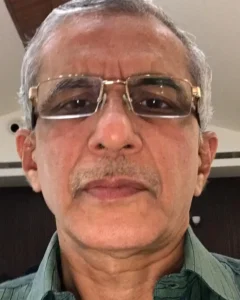

The First Resignation
In 1978, a twenty-four-year-old Vivek Poflee had topped Medicine in his final MBBS examinations. He had successfully secured a highly coveted seat in the MD program at IGMC Nagpur, placing himself within reasonable distance of the secure, prestigious career his family expected and he had worked relentlessly toward.
Then, he took a hard look at the man running his department. He saw a Head of Department who spent his energy cultivating political connections, who remained entirely indifferent to patients, and who valued self-promotion above teaching—making genuine learning the absolute last priority in a place where it should have been the first.
Poflee watched this for as long as his conscience allowed. And then, he walked out.
“Madness,” said some. “Reckless,” said others. But he resigned anyway. This pattern—of deliberately leaving a situation that was working adequately on paper because the conditions for integrity had been compromised in practice—would recur in his career. It defined him far more precisely than any medical credential ever could.
Call Bells and Cockroaches
He was born on August 1, 1954, in Nagpur. His father, Dr. Wamanrao Poflee, was a medical officer in the State Medical Services. His mother, Sumati, had been a brilliant student who chose instead to raise children deeply curious about how the world functioned. The household naturally produced scientists, engineers, economists, and doctors.
Young Vivek absorbed an early and permanent obsession with the mechanics of the physical world. He spent hours in his bedroom and at Somalwar High School building call bells, buzzers, and wireless transmitters, much to the amusement—and occasional alarm—of his family. His instinct was always for tinkering, for taking a system completely apart to understand it, and then reassembling it better than it had been before.
Medicine entered his life as the natural next step from a household where healing was present and his own aptitude for science was undeniably clear. He entered IGMC Nagpur in 1971, topped his MBBS in 1975, and secured his MD seat in 1978. Then came the resignation.
What followed was a masterclass in self-sufficiency. Rather than navigating the politics of the Indian academic system, he went to Baghdad in January 1979. He spent two years in Iraq—moving through Quadhmia Republic Hospital, Balad Republic Hospital, and Mahmood Hospital—practicing medicine in a foreign landscape, far from the institutional support that makes clinical work comfortable. When he returned to India, he bought a friend’s dispensary, set up a private practice, and quietly rebuilt a life that worked.
Three years after walking away, with merit finally restored to the department, he reapplied to the MD program. This time, he trained under Dr. P.Y. Deshmukh—a man of genuine intellectual seriousness, precisely the thing his previous supervisor had not been. He completed his MD in 1983. In September 1984, he joined MGIMS in Sevagram.
The Four Pillars and the Hand Mill
He arrived at a Department of Medicine already in formidable formation. The unit in the mid-1980s stood, as he later described it, on four massive pillars: Dr. O.P. Gupta, Dr. A.P. Jain, Dr. Ulhas Jajoo, and Dr. S.P. Kalantri. Each was a complete physician in the manner the institution demanded—holding clinical, teaching, and research commitments simultaneously without apparent strain. Poflee found his place within this structure not by replicating what the others were doing, but by bringing exactly what they lacked.
He gravitated toward clinical neurophysiology—EEGs, EMG, and nerve conduction studies. It was a field resting at the precise intersection of neurology and physics, requiring the kind of patient, systematic attention to electromechanical data that suited his engineering temperament perfectly. After training at NIMHANS in Bangalore and CIIMS in Nagpur, he returned to MGIMS and established the neurophysiology clinic—a facility that had not existed before his arrival.
His most widely noticed contribution, however, was the Hand Mill Test. It began with a straightforward clinical roadblock: some patients requiring coronary evaluation could not walk on a treadmill due to severe knee arthritis or muscular conditions. The standard stress test was therefore impossible.
Poflee, channeling the boy who built wireless transmitters, took a stationary exercise bicycle, modified one of its pedals, and bolted the entire metal frame to a concrete platform so patients could crank the machine with their hands instead of their legs. He tested it with a cardiologist in Nagpur, then replicated it at MGIMS. A Medicine resident, Dr. Sanjeev Batra, wrote his thesis on the comparative results. Soon, engineering students from nearby institutions began seeking out the MGIMS doctor who physically built his own diagnostic equipment. He welcomed them all.
Guitar, Violin, Flute
He had played the guitar for years, though the brutal demands of medicine had gradually displaced the music. At MGIMS, Gajanan Ambulkar—an artist by temperament and training—persuaded him to pick it up again.
A small, beautiful ensemble formed: Poflee on guitar, Dr. S. John Premendran on violin, and Dr. R.K. Gupta from Pharmacology on flute. When Mrs. Kamala Desikan invited them to perform at the college’s Silver Jubilee, they played a patriotic musical program to an audience of faculty and students. It was the kind of magical occasion that small institutions, when they are functioning well, generate entirely without effort—people with separate, hidden skills discovering that they could produce something beautiful together.
The Second Departure and the Silence
He left MGIMS in April 1992. He was not unhappy; he was simply honest. The four pillars of the Medicine department were firmly rooted where they had always been, and there was absolutely no upward movement available for a fifth person of his seniority. He named this reality clearly, rather than constructing a more flattering, diplomatic account of his departure.
In 1992, he joined Jawaharlal Nehru Medical College in Sawangi as Professor and Head of Medicine. The college was only two years old and desperately needed someone to build it from nothing. He did exactly that, eventually extending his reach into the roles of Medical Superintendent and Dean.
And then, he resigned again.
Administration was not the work he had come into medicine to do. The endless files, the bureaucratic meetings, the institutional politics—they were pulling him away from the patients and the teaching. In 1994, he returned to Nagpur, resumed private practice, and continued clinical neurophysiology at SureTech Hospital, deliberately ensuring his services remained available to patients who could not pay.
In 2005, a profound tragedy struck. An autoimmune vasculitis rapidly took his hearing in both ears. But the tinkerer simply adapted. He did not retire. He continued his work as a neurophysiologist in total silence.
Reva, Then Comet
He and his wife, Sandhya, were among the very first doctors in Nagpur to drive an electric car—first the Reva, then the Comet. The choice was deeply consistent with a sensibility that had always been drawn to how complex systems worked, and what those systems cost the world they operated within.
He delivered health talks on All India Radio. He conducted workshops on the cybernetic principles of business management. In 2021, he published a book of devotional songs he had composed and set to music himself. His interests were too vast to be reduced to mere hobbies; they were the natural expression of a mind that simply refused to observe the usual, artificial partition between the scientific and the spiritual.
What the Departures Were About
His son Hrishikesh, born in Sevagram in 1986, studied computer science, moved to the United States, joined the US Army as a cybersecurity specialist, and married Dr. Teja Mehendale, a family physician from Pune. The invisible connections between what MGIMS produced and the wider world run, in his case, across a generation and an ocean.
Vivek Poflee walked away from his first MD when a supervisor made integrity impossible. He walked away from a Deanship when administration made medicine impossible. Both decisions required him to actively discard something highly valuable—time, position, the path of least resistance—in order to preserve something he valued far more. Neither departure was made in anger. Both were made with wide-open eyes.
The Hand Mill he built is still used. The neurophysiology clinic he established at MGIMS continued to serve patients long after he left. At seventy, he remains a working neurophysiologist in Nagpur, completely at peace with the knowledge that he has fulfilled his calling.
The tinkerer who built wireless transmitters in his childhood bedroom never actually became a different person. He simply found a field large enough to contain him.