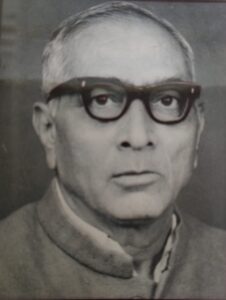
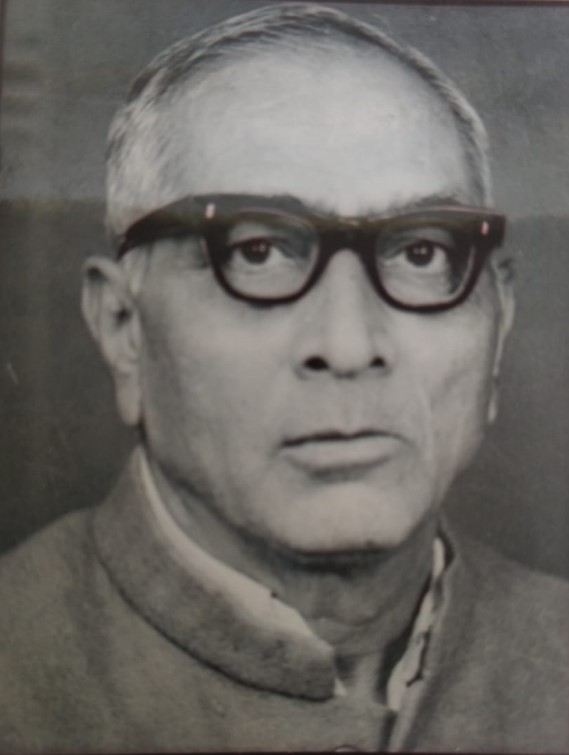
Nalinikant Mayashankar Mehta

Trustee & Finance Manager, Kasturba Health Society

b. 17 January 1917, Karachi   ·   d. 17 June 2000, Sevagram

Tenure: 1964-1988

He began work at four in the morning. Three quiet hours, just him and the numbers — before the office opened and the chaos began. Without him, MGIMS would have remained a dream.

Founding Trustee & Finance Manager, Kasturba Health Society · Disciple of J.C. Kumarappa · The Third Pillar of MGIMS

He began work at four in the morning.

“Son,” he would chuckle, “four a.m. — that was my happy hour. Three quiet hours, just me and the numbers. No phone calls, no meetings, no interruptions. I could balance the books, track every paisa, and get things in order. Once the office opened, it was chaos. I had to be ready.”

In the dim hours before Sevagram woke, Nalinibhai Mehta sat with his ledgers and made the numbers yield their truth. He had been doing this, in one form or another, since he was a teenager apprenticing under a photographer in Surendranagar because there was no money for college. Numbers had always spoken to him — not as abstractions but as instruments of discipline, of accountability, of institutional survival. Without sound finances, he understood, a dream remained a dream. With them, MGIMS took shape.

He was the third pillar of the founding trio, less celebrated than Dr. Sushila Nayar or Manimala Chaudhary, rarely photographed, seldom quoted. But when Dr. Nayar visited him after his stroke in 1991 and found him confined to his home, unable to move his right arm and leg, she wept. “Nalinbhai,” she said, “I had no idea how meticulously you kept the accounts. Where will I find someone like you?”

She never did.


Karachi, Orphanhood, and a Mentor Named Kumarappa

Nalinibhai was born on January 17, 1917, in Karachi. His mother died when he was three. His father — a merchant trading fine crockery between Karachi and Bombay — lost his entire inventory in 1922 when the ship carrying it sank. The family went bankrupt. His father died when Nalinibhai was seven. He was sent to Halvad, a small town in Gujarat’s Morbi district, to be raised by a stepmother and an uncle.

He schooled in Surendranagar, worked as an apprentice to a photographer named J.J. Mehta to pay his way, and at nineteen joined the freedom struggle. He spent four months in a British prison — a steep price for a teenager, one he never regretted. Somewhere in those years of scarcity and self-reliance, he developed what would become his defining quality: an almost physical aversion to waste.

In 1936, a Sarvodaya worker named Babalbhai Mehta urged him to visit Sevagram and meet Gandhi. He went. Gandhi sent him to the Khadi Gramodyog Vidyalaya to work under J.C. Kumarappa — economist, freedom fighter, and one of Gandhi’s closest intellectual collaborators. The apprenticeship transformed him.

Kumarappa’s vision was of self-sufficient villages built on local resources and diversified skills. His financial philosophy was equally exacting: precision in record-keeping, rigour in balancing accounts, the discipline of making every rupee yield its maximum worth. Nalinibhai did not merely absorb these lessons — he lived them. He shaved his head to save on haircuts. He wore simple clothes to conserve fabric. He treated every paisa as a moral responsibility.

The bond between mentor and disciple deepened into something like family. When Nalinibhai married Madhu Lata, Kumarappa marked the occasion with rare warmth — gifting her a gold armlet, and presenting Nalinibhai with two prized possessions: an Omega watch and a Zeiss Ikon camera. They were, as Nalinibhai understood them, not gifts but tokens of trust.


The Accounts Office in Sevagram

When Nalinibhai arrived at MGIMS in 1969 as founding trustee and member in-charge of finance, the accounts office was two cramped rooms under a sloping kavelu roof. Stone floors cool against the Vidarbha heat. A flickering tubelight. Wooden shelves sagging under the weight of thick ledgers. A noisy table fan pushing warm air over yellowing files. The smell of ink and old paper.

Three men shared a single battered wooden desk: Dadarao Shingare, who had left school after sixth grade but handled the hospital’s cash flow with meticulous care; Kanakdas, a boy from Kerala who had arrived in Wardha in the mid-sixties nearly illiterate and orphaned, found by Manimala Chaudhary lingering near the ashram kitchen, given a job ringing the hourly chime, who then taught himself Hindi and English and the General Financial Rules by kerosene lamplight until the bell boy became the chief accountant; and Bhimrao Pradhan, who had studied to tenth grade in Yavatmal and worked his way from laboratory attendant to accountant through sheer observation and persistence.

None had studied commerce. None had trained under an accountant. Together, they managed an annual budget of one lakh rupees.

“Am I to blame,” Dr. Sushila Nayar once said, defending these men, “if I entrust sensitive jobs to men who may not be very bright but on whom I can rely?”

Nalinibhai understood exactly what she meant, because he had built his own career on the same principle — that reliability, precision, and integrity were worth more than any qualification. He supervised the three men, trained them further, and stood behind them when anyone questioned their credentials. The accounts office under his watch was impenetrable. Auditors found nothing to fault. Not once.


Making Every Paisa Count

The founding years of MGIMS were financially precarious in ways that those who joined the institution later can scarcely imagine. The Gandhi Smarak Nidhi provided a one-time grant of one million rupees when MGIMS opened in 1969, with a clear condition attached: no further funds. The institution had to become self-sustaining from that moment.

Nalinibhai accepted this as a challenge, not a constraint. Government grants, hospital revenues, donations, interest from the KHS endowment — he tracked every source, stretched every allocation, and maintained balance sheets of such clarity that they served as models of institutional transparency. He convinced Dr. Nayar that the three of them — she, Manimala Chaudhary, and himself — would accept only a nominal honorarium of ₹500 per month. This increased in small increments over the years, reaching ₹2,000 by the time his stroke ended his working life. For a man who had access to an institution’s entire finances, the restraint was extraordinary and deliberate.

For five years he shuttled between Delhi and Sevagram — Delhi for the Gandhi Centenary Year programmes and the Gandhi Smarak Nidhi’s fundraising work, Sevagram for the accounts. When in Sevagram, he slept on the floor and rode a bicycle to inspect the society’s agricultural land. He kept the same hours — four in the morning, ledger open, pencil moving — regardless of which city he was in.

In 1970 he settled permanently in Sevagram. He was fifty-three years old. He would spend the next twenty-one years managing the finances of a growing medical institution, never wavering in precision or principle.

His desk, those who worked alongside him recall, was not merely a workstation. It was a stronghold. A single misplaced digit in a ledger would prompt a sharp glance. An unclear expense would summon a booming interrogation. He was frank, outspoken, and sometimes blunt — a man who called a spade a spade without social lubrication. Nobody minded, because the frankness came from conviction, not malice. He had no personal stake in any financial decision. He had only the institution.

He built relationships with donors through the same quality. With Sarla Parekh — who became a holding trustee of the Kasturba Health Society — and with contributors large and small, he understood that fundraising was not about solicitation but about trust. A small gift from a local shopkeeper mattered as much as a corporate donation. He treated every donor with identical respect. People gave not just money but faith, because Nalinibhai made the institution’s integrity visible in his own person.

In 1982, he and P.L. Tapdiya — who had come to MGIMS as a young chartered accountancy apprentice in 1965 and stayed for six decades — arranged a lunch between Dr. Sushila Nayar and Dhirubhai Mehta. That meeting brought Dhirubhai into the KHS fold. After Annasaheb Sahastrabuddhe’s death, Dhirubhai became Vice President, then Dr. Nayar’s most trusted ally, and after her death led the institution for twenty-four years. One lunch, arranged by Nalinibhai, shaped the next quarter century of MGIMS governance.


Madhu Lata

Through the working years, Madhu Lata was beside him — battling rheumatic heart disease for nearly thirty years, her heart weakened by a blocked valve, yet maintaining the household and raising their three children: sons Rajiv Lochan and Bharat Bhushan, and a daughter, Vrinda. On May 19, 1987, in Ahmedabad, she died. The family she had built and held together remained her lasting legacy. Nalinibhai, who had balanced institutional accounts with iron discipline for decades, was less equipped for this particular loss. It was his daughter-in-law Lata who held things together then, and who would do so again when the stroke came.


The Stroke, and the End

In 1991, while in Gujarat, Nalinibhai suffered a stroke. It took his voice — that booming, interrogating, never-uncertain voice — and left him unable to move his right arm and leg. He was seventy-four years old. He came home to Ramdas Colony in Sevagram and did not leave again.

Lata cared for him through the final decade with unwavering devotion. He spent his days confined to home, the ledgers gone, the four o’clock mornings gone, the chaos of office hours that he had always been three hours ahead of — all of it gone.

Dr. Sushila Nayar visited him. She wept. She had not known, she said, how meticulous he had been. It was a strange thing to say about a man she had worked alongside for twenty-seven years — but perhaps the full dimension of his precision only became visible in its absence, when the accounts had to be managed without him.

He died on June 17, 2000, at home in Ramdas Colony, surrounded by Lata, Bharat, and his family. Six months later, Dr. Sushila Nayar followed him.

They had both witnessed MGIMS entire — from the two cramped rooms under the kavelu roof to the thousand-bed teaching hospital it became. Between them, they had held the institution’s vision and its finances, its direction and its discipline, in careful, complementary hands for more than three decades. One without the other would have been insufficient. Together, they built something that outlasted them both.

Nalinikant Mayashankar Mehta

Founding Trustee & Finance Manager, Kasturba Health Society · Disciple of J.C. Kumarappa · The Third Pillar of MGIMS

He began work at four in the morning.

“Son,” he would chuckle, “four a.m. — that was my happy hour. Three quiet hours, just me and the numbers. No phone calls, no meetings, no interruptions. I could balance the books, track every paisa, and get things in order. Once the office opened, it was chaos. I had to be ready.”

In the dim hours before Sevagram woke, Nalinibhai Mehta sat with his ledgers and made the numbers yield their truth. He had been doing this, in one form or another, since he was a teenager apprenticing under a photographer in Surendranagar because there was no money for college. Numbers had always spoken to him — not as abstractions but as instruments of discipline, of accountability, of institutional survival. Without sound finances, he understood, a dream remained a dream. With them, MGIMS took shape.

He was the third pillar of the founding trio, less celebrated than Dr. Sushila Nayar or Manimala Chaudhary, rarely photographed, seldom quoted. But when Dr. Nayar visited him after his stroke in 1991 and found him confined to his home, unable to move his right arm and leg, she wept. “Nalinbhai,” she said, “I had no idea how meticulously you kept the accounts. Where will I find someone like you?”

She never did.


Karachi, Orphanhood, and a Mentor Named Kumarappa

Nalinibhai was born on January 17, 1917, in Karachi. His mother died when he was three. His father — a merchant trading fine crockery between Karachi and Bombay — lost his entire inventory in 1922 when the ship carrying it sank. The family went bankrupt. His father died when Nalinibhai was seven. He was sent to Halvad, a small town in Gujarat’s Morbi district, to be raised by a stepmother and an uncle.

He schooled in Surendranagar, worked as an apprentice to a photographer named J.J. Mehta to pay his way, and at nineteen joined the freedom struggle. He spent four months in a British prison — a steep price for a teenager, one he never regretted. Somewhere in those years of scarcity and self-reliance, he developed what would become his defining quality: an almost physical aversion to waste.

In 1936, a Sarvodaya worker named Babalbhai Mehta urged him to visit Sevagram and meet Gandhi. He went. Gandhi sent him to the Khadi Gramodyog Vidyalaya to work under J.C. Kumarappa — economist, freedom fighter, and one of Gandhi’s closest intellectual collaborators. The apprenticeship transformed him.

Kumarappa’s vision was of self-sufficient villages built on local resources and diversified skills. His financial philosophy was equally exacting: precision in record-keeping, rigour in balancing accounts, the discipline of making every rupee yield its maximum worth. Nalinibhai did not merely absorb these lessons — he lived them. He shaved his head to save on haircuts. He wore simple clothes to conserve fabric. He treated every paisa as a moral responsibility.

The bond between mentor and disciple deepened into something like family. When Nalinibhai married Madhu Lata, Kumarappa marked the occasion with rare warmth — gifting her a gold armlet, and presenting Nalinibhai with two prized possessions: an Omega watch and a Zeiss Ikon camera. They were, as Nalinibhai understood them, not gifts but tokens of trust.


The Accounts Office in Sevagram

When Nalinibhai arrived at MGIMS in 1969 as founding trustee and member in-charge of finance, the accounts office was two cramped rooms under a sloping kavelu roof. Stone floors cool against the Vidarbha heat. A flickering tubelight. Wooden shelves sagging under the weight of thick ledgers. A noisy table fan pushing warm air over yellowing files. The smell of ink and old paper.

Three men shared a single battered wooden desk: Dadarao Shingare, who had left school after sixth grade but handled the hospital’s cash flow with meticulous care; Kanakdas, a boy from Kerala who had arrived in Wardha in the mid-sixties nearly illiterate and orphaned, found by Manimala Chaudhary lingering near the ashram kitchen, given a job ringing the hourly chime, who then taught himself Hindi and English and the General Financial Rules by kerosene lamplight until the bell boy became the chief accountant; and Bhimrao Pradhan, who had studied to tenth grade in Yavatmal and worked his way from laboratory attendant to accountant through sheer observation and persistence.

None had studied commerce. None had trained under an accountant. Together, they managed an annual budget of one lakh rupees.

“Am I to blame,” Dr. Sushila Nayar once said, defending these men, “if I entrust sensitive jobs to men who may not be very bright but on whom I can rely?”

Nalinibhai understood exactly what she meant, because he had built his own career on the same principle — that reliability, precision, and integrity were worth more than any qualification. He supervised the three men, trained them further, and stood behind them when anyone questioned their credentials. The accounts office under his watch was impenetrable. Auditors found nothing to fault. Not once.


Making Every Paisa Count

The founding years of MGIMS were financially precarious in ways that those who joined the institution later can scarcely imagine. The Gandhi Smarak Nidhi provided a one-time grant of one million rupees when MGIMS opened in 1969, with a clear condition attached: no further funds. The institution had to become self-sustaining from that moment.

Nalinibhai accepted this as a challenge, not a constraint. Government grants, hospital revenues, donations, interest from the KHS endowment — he tracked every source, stretched every allocation, and maintained balance sheets of such clarity that they served as models of institutional transparency. He convinced Dr. Nayar that the three of them — she, Manimala Chaudhary, and himself — would accept only a nominal honorarium of ₹500 per month. This increased in small increments over the years, reaching ₹2,000 by the time his stroke ended his working life. For a man who had access to an institution’s entire finances, the restraint was extraordinary and deliberate.

For five years he shuttled between Delhi and Sevagram — Delhi for the Gandhi Centenary Year programmes and the Gandhi Smarak Nidhi’s fundraising work, Sevagram for the accounts. When in Sevagram, he slept on the floor and rode a bicycle to inspect the society’s agricultural land. He kept the same hours — four in the morning, ledger open, pencil moving — regardless of which city he was in.

In 1970 he settled permanently in Sevagram. He was fifty-three years old. He would spend the next twenty-one years managing the finances of a growing medical institution, never wavering in precision or principle.

His desk, those who worked alongside him recall, was not merely a workstation. It was a stronghold. A single misplaced digit in a ledger would prompt a sharp glance. An unclear expense would summon a booming interrogation. He was frank, outspoken, and sometimes blunt — a man who called a spade a spade without social lubrication. Nobody minded, because the frankness came from conviction, not malice. He had no personal stake in any financial decision. He had only the institution.

He built relationships with donors through the same quality. With Sarla Parekh — who became a holding trustee of the Kasturba Health Society — and with contributors large and small, he understood that fundraising was not about solicitation but about trust. A small gift from a local shopkeeper mattered as much as a corporate donation. He treated every donor with identical respect. People gave not just money but faith, because Nalinibhai made the institution’s integrity visible in his own person.

In 1982, he and P.L. Tapdiya — who had come to MGIMS as a young chartered accountancy apprentice in 1965 and stayed for six decades — arranged a lunch between Dr. Sushila Nayar and Dhirubhai Mehta. That meeting brought Dhirubhai into the KHS fold. After Annasaheb Sahastrabuddhe’s death, Dhirubhai became Vice President, then Dr. Nayar’s most trusted ally, and after her death led the institution for twenty-four years. One lunch, arranged by Nalinibhai, shaped the next quarter century of MGIMS governance.


Madhu Lata

Through the working years, Madhu Lata was beside him — battling rheumatic heart disease for nearly thirty years, her heart weakened by a blocked valve, yet maintaining the household and raising their three children: sons Rajiv Lochan and Bharat Bhushan, and a daughter, Vrinda. On May 19, 1987, in Ahmedabad, she died. The family she had built and held together remained her lasting legacy. Nalinibhai, who had balanced institutional accounts with iron discipline for decades, was less equipped for this particular loss. It was his daughter-in-law Lata who held things together then, and who would do so again when the stroke came.


The Stroke, and the End

In 1991, while in Gujarat, Nalinibhai suffered a stroke. It took his voice — that booming, interrogating, never-uncertain voice — and left him unable to move his right arm and leg. He was seventy-four years old. He came home to Ramdas Colony in Sevagram and did not leave again.

Lata cared for him through the final decade with unwavering devotion. He spent his days confined to home, the ledgers gone, the four o’clock mornings gone, the chaos of office hours that he had always been three hours ahead of — all of it gone.

Dr. Sushila Nayar visited him. She wept. She had not known, she said, how meticulous he had been. It was a strange thing to say about a man she had worked alongside for twenty-seven years — but perhaps the full dimension of his precision only became visible in its absence, when the accounts had to be managed without him.

He died on June 17, 2000, at home in Ramdas Colony, surrounded by Lata, Bharat, and his family. Six months later, Dr. Sushila Nayar followed him.

They had both witnessed MGIMS entire — from the two cramped rooms under the kavelu roof to the thousand-bed teaching hospital it became. Between them, they had held the institution’s vision and its finances, its direction and its discipline, in careful, complementary hands for more than three decades. One without the other would have been insufficient. Together, they built something that outlasted them both.