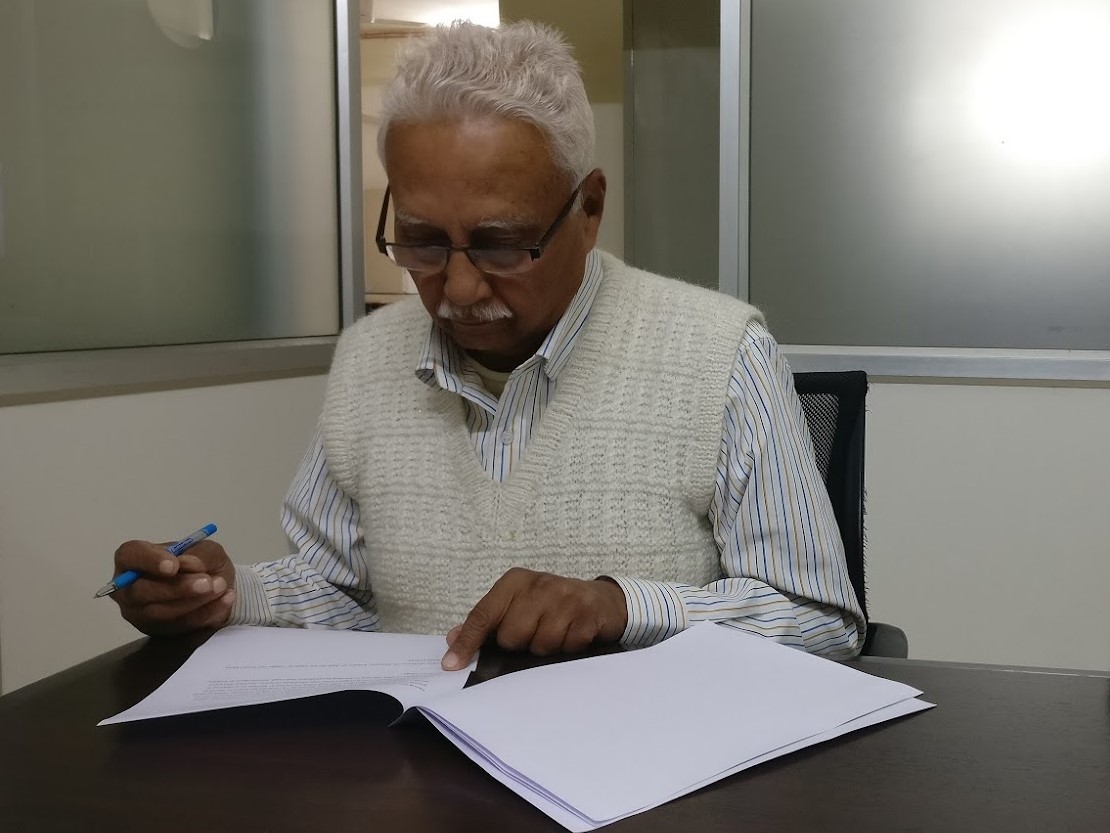
Professor & Head of Anatomy · Seven-Year Hostel Warden · The Man Who Cooked Aloo Sabzi for the Boys at Ten at Night
One evening around half past nine, the phone rang in Dr. S.K. Ghosh’s quarters. The boys’ hostel mess had run out of aloo sabzi. Without deliberation, he pulled on his kurta and dhoti and walked over. He cooked a fresh batch for twenty or thirty students himself, right there in the hostel kitchen. They stood watching, wide-eyed — this commanding professor, the man whose dissection hall presence made first-years straighten their spines involuntarily, standing over a pot of potatoes at ten in the evening because the boys needed to eat.
He told the story later with a smile. It was not, for him, a remarkable thing. It was simply what the situation required.
This quality — the complete absence of a gap between his public authority and his private generosity — was what those who knew Dr. Samit Kumar Ghosh most consistently described. He was fiery and exacting in the classroom, outspoken to the point of bluntness in meetings, capable of a temper that students found memorable. He was also the man who cooked for the hostel, adopted the stray dogs, watched the birds on Sunday mornings, and treated orderlies and artists and fellow professors as members of the same family. Both things were equally true. Neither cancelled the other.
Jalpaiguri, Kolkata, and the Long Road to a Professorship
Samit Kumar Ghosh was born on April 20, 1942, in Jalpaiguri, West Bengal, moving to Kolkata as a boy when his father’s medical career required it. He grew up in a small fishing village — an upbringing that gave him a naturalist’s attentiveness to the world around him and a self-reliance that came from having to find his own way. His relationship with his father was strained, a chasm he described as difficult to span. He decided early that he would be a self-made man.
His academic record was not distinguished. Third division in HSC, second division in Inter Science. In 1960, he joined Calcutta National Medical College — India’s oldest, founded in 1848 — and struggled there too, failing his Medicine practicals on the first attempt. He graduated, completed two years of house jobs in General Surgery, Orthopaedics, and Cardiac Surgery in Kolkata, and harboured ambitions of going to Britain for further training. The plan did not materialise. He pivoted.
In 1968, he enrolled in the MS Anatomy programme at Maulana Azad Medical College in New Delhi — a decision that would define the rest of his working life. He completed the degree in 1971, began as a Demonstrator, and moved to the University College of Medical Sciences in December 1976 as Lecturer. By 1986, he was a Reader. He had spent nearly two decades building a solid academic reputation, and the professorship he had earned by any measure of merit remained out of reach — institutional politics at UCMS held more sway than qualification. Year after year, the promotion slipped past him.
By 1990, Delhi had begun to feel suffocating.
Then a colleague — a Professor of Gynaecology who sensed his restlessness — sent him a postcard. The message was brief: You might think of shifting to Sevagram. It’s a place you might like. The following day, as if in orchestrated confirmation, he saw an advertisement on the UCMS Dean’s notice board. MGIMS was looking for a Professor of Anatomy.
He met Dr. Sushila Nayar at her Connaught Place office in Delhi. She listened, assessed, and urged him to apply. He interviewed in Sevagram against one other candidate. His name alone appeared on the appointment list.
Arriving in Sevagram
He stepped off the train at Sevagram station into a quiet so complete it startled him. No rush, no exhaust, no urban noise. The air smelled of earth. Nights were dark, broken only by owls. Mornings brought birdsong. As he walked the ashram’s dusty lanes and took in the hospital’s whitewashed walls, he felt — unexpectedly, immediately — at home.
It was not the life he had been living. It was the life that suited him.
The Anatomy department he inherited in September 1990 was small: Dr. Anbalagan, who had been serving as acting head, Mrs. R.R. Fulzele, and Mrs. K. Padmawathy, who joined shortly after. The department had a modest research culture, some teaching infrastructure, and the accumulated foundation laid by Dr. Hari Rao and others who had preceded him. Dr. Ghosh set about transforming it with the focused energy of someone who had spent nineteen years waiting for a department to lead.
He brought teaching, research, and academic ambition to the forefront simultaneously. He worked with Gajanan Ambulkar — the artist who had collaborated with Dr. Indurkar on the dissection hall murals — to develop histological resources and museum specimens. He worked with Khan, the orderly who handled cadavers, with the same directness and respect he gave his academic colleagues. He guided Dr. Anbalagan through the completion of his PhD a year after arriving. Within three years, postgraduate seats in the department — previously unfilled — were occupied, largely by Bengali students whom he had personally contacted and encouraged to apply. Dissection tables that had sat idle were now in use. Research on animal models was underway.
In the Classroom and the Department
His teaching was precise, demanding, and memorable. He preferred chalk and blackboard to PowerPoint — not from technophobia but from conviction that the act of drawing structures in real time, visible to students as they emerged, was pedagogically superior to the finished image on a slide. His Bengali-accented English became, for generations of MGIMS students, the voice in which they first understood the brachial plexus or the anatomy of the posterior triangle.
He was strict. Punctuality was non-negotiable. Standards in the dissection hall were absolute. Students stood up straighter when they heard his footsteps in the corridor. And yet — as those who moved past initial apprehension consistently discovered — beneath the demanding exterior was a teacher who genuinely wanted them to succeed and a person capable of unexpected warmth.
From 2000 to 2007, he served as Warden of the Boys’ Hostel — a seven-year tenure, the longest of any warden in the institution’s history. Unaware that a furnished warden’s quarters existed within the hostel, he continued living in his own home and came to the hostel each evening for two hours: reviewing documents, checking mess accounts, meeting parents, addressing student complaints, and maintaining the kind of steady, engaged oversight that a residential institution requires from those nominally responsible for it. The aloo sabzi episode was characteristic.
His major organisational achievements included the 1994 national conference of the Anatomical Society of India — hosted in Sevagram with minimal resources, successful enough that the delegates remembered the rural hospitality long after they had forgotten the academic proceedings — and the 2002 All India Cytogenetic Conference, which helped establish the genetics laboratory that would become a lasting feature of the institution. He guided Dr. Indra Ingole through her MD and PhD degrees, established postgraduate programmes, and built a departmental culture that outlasted his own tenure.
He was also responsible, in a quieter way, for the institution of Durga Puja celebrations in Sevagram — helping organise the annual festival for the Bengali community that had grown around the medical college, clad always in his signature white kurta and dhoti, as much a cultural anchor as an academic one.
What He Loved
On Sunday mornings, he sat in his backyard and watched birds. He had a trained ear for them — knew species by their calls as readily as by their appearance, could hear the presence of birds that remained invisible in the canopy. He grew plants and kept fish. When two street dogs appeared near his quarters, he and his wife Laxmi took them in — Kali and Lali — feeding them, giving them freedom, eventually bringing them on a train journey from Sevagram to Kolkata. They stayed with the family until 2015.
His wife Laxmi, from Barasat in the Ganges delta, had taught Bangla at Union Academy Senior Secondary School in New Delhi for twenty-eight years before retiring in 1998. She spent her retirement years in Sevagram, where she became a beloved figure — warm, generous, devoted to the dogs and to the community around her. She battled diabetes, high blood pressure, and heart disease with the same grace she brought to everything. When the family left Sevagram in 2007, she carried Sevagram with her. She died in Kolkata on January 13, 2009.
In 1999, drawn by a fascination with Tagore’s writings and their connection to Kangra in Himachal Pradesh, he traveled there and found in its pine forests and tea plantations a landscape that gave him a peace he described as permanent. He returned to it in memory.
After Sevagram
He retired from MGIMS on December 22, 2007 — the same year Dr. Anbalagan left, the two departures marking the end of an era in the department they had built together. He moved to Kathmandu, joining Nepal Medical College as Professor and Head of Anatomy, where he taught for another twelve years. His career in anatomical science spanned five decades, from 1969 to 2019 — beginning in a Delhi demonstration room and ending in Nepal, with seventeen years in a Gandhian village at its centre.
His son Saurav — MBBS from Maulana Azad Medical College, MS and MCh in Oncosurgery from Tata Memorial Hospital — briefly lectured at MGIMS before becoming Professor and Head of Surgery at Kolkata Medical College. The son of an anatomy professor who had to leave Delhi to find a professorship became, in his own right, a professor in Kolkata. The arc had straightened.
Dr. Ghosh was, as those who worked alongside him said, impossible to overlook and impossible to summarise easily. The old oak tree metaphor — towering and commanding above, rooted deep in kindness below — captures something true. What it does not capture is the Sunday morning stillness in the backyard, the ear cocked for a bird call, the man who had spent a week making sure a national conference ran properly in a village without infrastructure, now entirely quiet, watching the trees.