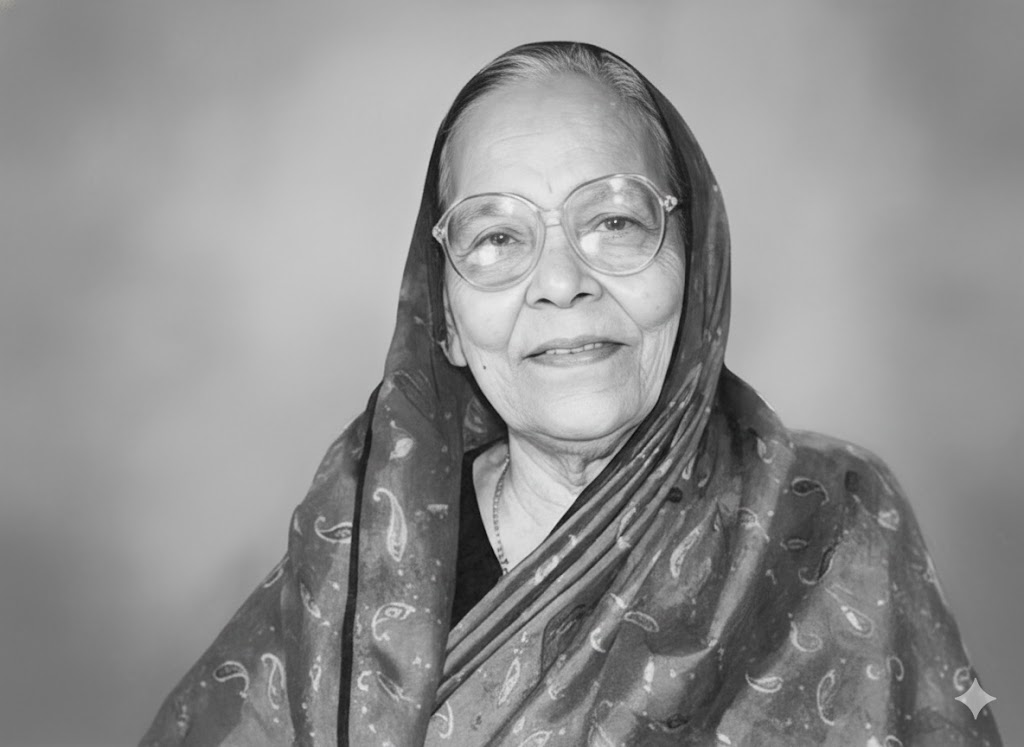
If my father was the iron foundation of our family, my mother—whom we addressed as “Bai” in the Marwari tradition—was the light that filled the rooms. Born Parvati Mundra on January 5, 1925, in Barshi, she arrived in Wardha in 1940 as a fifteen-year-old bride, thrust into a world that was as unfamiliar as it was daunting. She was the first of five children, raised in a devoutly orthodox home where her father, a seller of tea and biscuits, was more focused on Ishwar Bhakti (devotion to God) than on the formal education of a daughter.
Her marriage to my father was a study in contrasts. He was nine years her senior, an orphan with no roof of his own and a stubborn, radical streak. She was a delicate girl from Western Maharashtra who had never traveled more than a few miles from her parents. Most shocking to her traditional family was my father’s ultimatum: “The bride will not wear a ghoonghat.” For a girl raised in an era where the veil was a woman’s shield, this was a radical exposure. Yet, on February 18, 1940, she stepped into her new life with her face uncovered—a silent revolutionary before she even knew the meaning of the word.
***
The Ghosts of Marwari Mohalla
The transition was brutal. The young girl who had been the apple of her father’s eye in Barshi was suddenly responsible for a household in the “Marwari Mohalla” of Wardha. Her first home was a rented space that the locals whispered was haunted by ghosts. My father, who viewed such superstitions with scientific contempt, ignored the rumors, but for Bai, the fear was real.
In those early months, she was like a “scared deer running in the forest,” as she later described herself. She would cry inconsolably, begging her parents to take her back to Barshi. When her uncle came to drop her off, he had to leave stealthily while she slept, knowing she wouldn’t let him go if she were awake. She woke up to a world where she had no mother-in-law to guide her, only the memory of her parents 500 miles away. Yet, it was in this “haunted” house that she found her footing. She lived there for fifteen years, and it was within those walls that five of her six children were born.
***
The Mastery of the Hearth
Bai belonged to an era that defined a woman by her ability to manage a home without the luxuries of electricity, gas, or running water. For years, she ran a full house with nothing but a smoke-emitting chullah (mud stove). I remember the story of my father buying her a modern gas stove in 1955, thinking it would ease her burden. Bai was so suspicious of the new technology—or perhaps so loyal to the familiar discomfort of the woodsmoke—that she made him return it. Eventually, she compromised on a “Magan Chullah,” a smokeless alternative that cost ten rupees.
Watching her in the kitchen was like watching a master artisan. She had arrived in Wardha not knowing how to knead dough, but she soon surpassed her teachers. Her “jugglery” of serving steaming hot phulkas to my father, who sat cross-legged for his meals, was a sight to behold. She specialized in aloo-bhaat (potato rice) and meethe chawal (sweet rice) for guests, and for me, her kela-ka-kalvan (mashed bananas with milk and sugar) remains the taste of childhood. She didn’t just cook; she nurtured. She would churn buttermilk manually—a task we children called jhagda-bilona because of the rhythmic noise—to separate the butter that would eventually become the ghee that flavored our lives.
***
The Physician’s Birth on Independence Day
I was the youngest of her six, born on August 15, 1957, in our second home at the Bajaj Electricals campus. My birth brought a specific joy to my parents; not only was I a boy, but I arrived at 6:27 AM on India’s tenth Independence Day. My father, always one for brevity, changed my birth name from Devendra to Shriprakash, and then quickly shortened it to “SP.”
I often wonder how easily Bai, who had only a primary school education, adapted to calling her youngest son by an English abbreviation. To her, I was just SP. I remember telling her when I was five years old that my “real” parents were Lord Shiva and Parvati on Mount Kailash, and that while she shared the same name, she was just a temporary guardian. She would laugh, a light, musical sound, and continue her chores. On my birthdays, she didn’t provide balloons or cakes. Instead, she would wake me early, rub my skin with haldi (turmeric) and milk, give me a new pair of locally-stitched half-pants, and offer a homemade pedha as a blessing. She never remembered her own birthday, but she celebrated ours with a quiet, fierce devotion.
***
A Balance of Tradition and ‘Sholay’
Bai was a slight woman, barely four feet ten inches tall, but she had a vibrant, inquisitive mind. Despite her limited schooling, she read the Hindi newspapers from cover to cover every day. She had a deep love for Hindi cinema, a passion that often saw her sitting in the “ladies’ compartment” of the local Vasant Talkies. She saw the 1975 blockbuster Sholay at least three times, and she was so enamored by the screen that she gave her granddaughters nicknames like “Padmini” and “Helen” after the famous actresses.
She had an uncanny ability to balance the old world with the new. In 1997, when she suffered her first heart attack, she was brought to the ICU at Sevagram. As a physician there, I watched her receive streptokinase, a modern clot-buster. She accepted the technology of the hospital with the same grace she used to accept a new sari from my father. She was agile and active; even in her eighties, if a guest arrived unannounced, she would disappear and re-emerge in seconds, having changed her sari and bangles to properly welcome them.
***
The Final Ledger and the Serene Exit
In the final years of her life, Bai’s memory began to flicker, but her spirit remained bright. She would clap and sing bhajans (hymns) whenever she heard them on the television. She had a particular fondness for the song “Sajan Re Jhoot Mat Bolo” from the movie Teesri Kasam, and she famously sang it on stage at a family wedding in 2005, much to the amazement of the younger generation.
In 2000, at the age of seventy-five, she decided to make her will. I sat with her, explaining the legal intricacies word by word. I was stunned by her clarity; she understood exactly how her assets should be equitably distributed. She wanted no loose ends, no “unbalanced accounts.”
She left this world exactly as she had lived in it—with a quiet, uncomplaining grace. She passed away in the early hours of the morning, as peacefully and as quickly as my father had. She had spent over six decades as the weaver of our family’s story, balancing tradition with modernity, and faith with reason. She belonged to an era of women who worked incessantly without ever asking for their contributions to be acknowledged. To her, motherhood wasn’t a job; it was an evolution. She taught me that resilience doesn’t have to be loud; it can be as quiet as the steam rising from a phulka or the turn of a newspaper page in the afternoon sun.