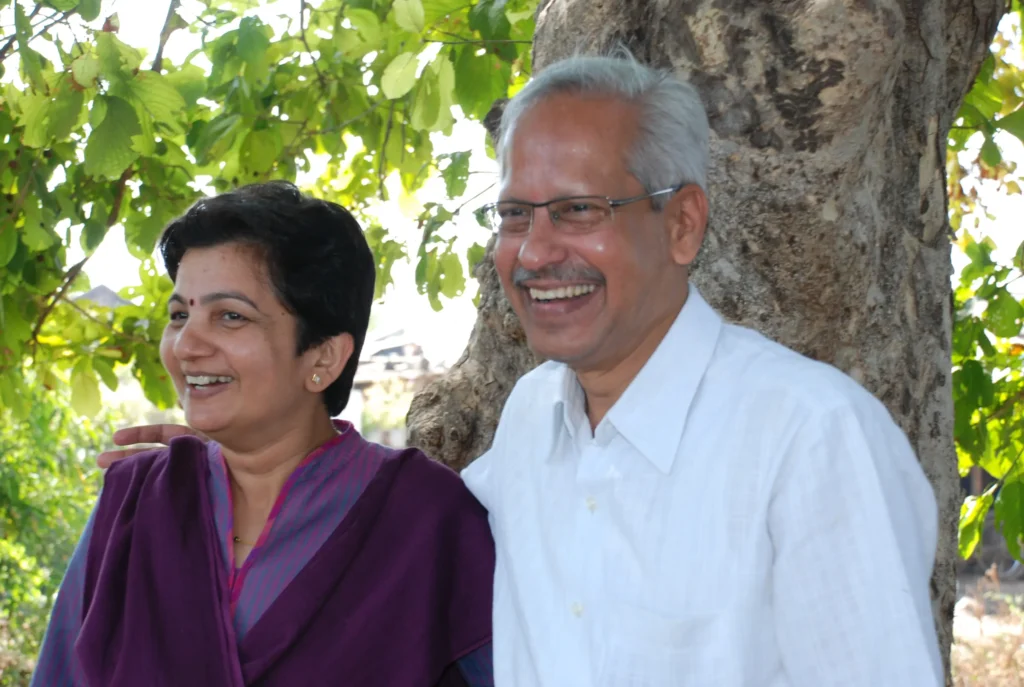
We began, like many couples in 1984, with an arranged marriage. No romance preceded it, no courtship worth mentioning. Just photographs exchanged, horoscopes not matched, and a wedding date fixed. What followed was not a fairy tale but something more durable: a functional partnership that has lasted four decades.
Bhavana studied biology at Holkar College, Indore, then completed a diploma in medical laboratory technology in Mumbai. She never worked in a lab. The work bored her. While pregnant with our first child in 1986, she finished a B.Ed. degree—not because she intended to teach, but because the college was nearby and she disliked idleness.
A year later, with two small children at home, she began traveling from Sevagram to Nagpur—eighty kilometers each way—to learn computers. This was 1992. Personal computers were rare. The internet did not exist in India. Most people thought computers were large machines that occupied air-conditioned rooms in banks. Bhavana simply noticed that these machines would matter and decided she should understand them.
That decision, made without announcement or drama, shaped not only her career but the hospital’s future.
***
The Hospital Information System
For twenty-eight years, Bhavana worked with the Hospital Information System at Kasturba Hospital, MGIMS Sevagram. She did not hold a grand title. She was not a department head. She simply made the system work.
When the hospital decided to computerize patient records in the early 1990s, most staff resisted. Doctors preferred handwritten notes. Nurses distrusted keyboards. The administrative staff feared redundancy. Bhavana trained them anyway—one reluctant clerk at a time, one skeptical physician after another.
She troubleshot endlessly. When the server crashed at 2 a.m., she drove to the hospital. When data disappeared, she recovered it. When workflows jammed, she redesigned them. She translated medical chaos—unreadable prescriptions, misfiled records, lost lab reports—into orderly digital systems.
Her colleagues debated policy in meetings. She built solutions that actually worked. The full story appears in Chapter 6 of this memoir, but the essence is simple: while others talked about modernization, she modernized.
She retired in July 2023. By then, Kasturba Hospital’s information system was among the most functional in rural India. She had created it almost single-handedly, with neither fanfare nor self-promotion.
***
The Scooter, The Car, and Four Women Drivers
In 1984, I owned a Bajaj 150 scooter, registration number MH 32-922. After marriage, Bhavana learned to ride it—unusual in Wardha, where few women rode two-wheelers. We kept that scooter for twenty years, repainting it green midway through its life.
In 1999, we bought a second-hand lemon-colored Maruti 800 (MP 09-0036) from Sendhwa, Madhya Pradesh. The car had been driven for only one year and fit our budget. None of us knew how to drive.
Bhavana, then thirty-seven, took lessons. She learned methodically, practiced daily, and within months was navigating Wardha’s chaotic traffic with the calm of a taxi driver. Today she drives with near-surgical precision, though I occasionally remind her that speed limits exist.
In our MLK Colony neighborhood, there are exactly four women who drive while their husbands sit in the passenger seat: Mrs. Mehendale, Mrs. Shukla, Mrs. Vyas, and Bhavana. This fact is neither progressive nor traditional. It is simply how things are.
She now drives a Honda Jazz, which she parks with the efficiency of someone solving a geometry problem. Most evenings, she drives to Wardha, navigates the market traffic, negotiates with vegetable vendors, and returns with the week’s supplies. She does this without complaint, as if ferrying groceries were an Olympic event she intends to win.
***
The Household as Industrial Operation
If I had to describe Bhavana’s role at home, I would call her the operating system. The house runs because she makes it run.
Laundry appears folded. Bills are paid before reminders arrive. Repairs happen before they become crises. Visitors are fed. Groceries never quite run out. The children grew up secure without realizing how much backstage work produced that comfort.
She managed an astonishing range of tasks: washing clothes, ironing, mending socks, sewing buttons, mothproofing woolens, sweeping floors, cleaning sinks and toilets, tending the garden, shopping for vegetables and rice, cooking three meals daily, entertaining relatives, managing finances, overseeing repairs, supervising the maid and gardener, paying bills—all while attending to the children’s schooling, clothing, discipline, and morale.
She did this without a washing machine for the first decade. Without a car for fifteen years. Without domestic help for long stretches when we could not afford it. She simply worked harder.
Her management of people is firm but fair. Vimal, our maid, has stayed for over thirty years. Devanand, the gardener, for twenty-five. She scolds them for lateness, interrogates unscheduled leave, and raises her voice when work is sloppy. Yet she is generous with bonuses, advances for medical bills, and small gifts during festivals.
They understand the arrangement. The tongue may be sharp, but the heart is soft—what I call the coconut temperament. Hard shell, sweet interior. That is why they stay.
***
Perfectionism Without Sentimentality
Bhavana is a perfectionist, though she would deny it. Each morning, she selects my clothes: shirt, trousers, socks, polished shoes. She reminds me monthly to get a haircut. The bedsheets and pillowcases must be arranged in a specific order. Cushions have designated corners.
This is not obsessive-compulsive disorder. It is simply her belief that chaos can be prevented with sufficient attention. She is probably right.
She shops with the same precision. In the era of online commerce, she navigates Amazon like a procurement officer, comparing prices, checking reviews, tracking deliveries. Watching her find the best deal on bedsheets is like watching someone solve a differential equation.
She has also redesigned our home multiple times—new furniture, fresh paint, rearranged rooms. Her aesthetic is neither traditional nor modern but functional. If something does not work, she replaces it. Sentimentality does not factor into decisions about sofas.
***
The Cook
Bhavana’s cooking is not elaborate. She does not experiment with fusion cuisine or follow celebrity chefs. She simply makes food that tastes unmistakably like home.
Her repertoire includes vegetable curries, fragrant rice, Marwari and Gujarati dishes like puran poli, and desserts: kheer, shrikhand, gulab jamuns. Former medical residents who trained under me still remember her gulab jamuns. They were soft, sweet, and arrived on time—which, in a busy hospital household, was itself a minor miracle.
Meals in our home follow a timetable. Breakfast at 7:30 a.m., lunch at 1 p.m., dinner at 8 p.m. Deviations are rare. Guests are fed regardless of arrival time. No one leaves hungry.
This is not hospitality in the theatrical sense. It is simply her belief that feeding people properly is a basic obligation. She executes it with the efficiency of a military quartermaster.
***
The Gardener
Bhavana tends plants with the same systematic care she applies to everything else. She works closely with Devanand, the part-time gardener, ensuring proper pruning, watering, and feeding. Old trees are replaced with newer, more colorful varieties. Flower beds are reorganized seasonally.
The results are visible. Our garden blooms year-round, not because we live in a favorable climate but because she treats horticulture like another management problem requiring persistent attention.
She subscribes to Down to Earth, an environmental magazine, and reads extensively about climate change, deforestation, and pollution. This is not fashionable eco-consciousness. She genuinely worries about what we are leaving for our grandchildren.
***
Crises Without Drama
In 2012, I underwent an angioplasty. Bhavana handled it with remarkable calm. No visible panic, no tearful bedside vigils. She simply accepted the situation and did what needed doing: coordinating with doctors, managing visitors, ensuring I followed post-operative instructions.
When her ninety-year-old father suffered a massive stroke and lay unconscious, she was the first to suggest we let him die with dignity at home. Some family members hesitated, hoping for miraculous recovery. She remained firm. “This is what he would want,” she said. She was right.
Her clarity in crises is often braver than my medical training. I know the science. She knows when to stop fighting.
***
The Editor
Despite my position as a professor of medicine, Bhavana has never been impressed by titles or hierarchy. She punctures inflated egos, especially mine.
She is my most ruthless editor. Whenever I write something long-winded—which is often—she says, “Keep it short, SP.” I argue. She insists. I eventually cut. She is usually right.
This applies to life decisions as well. When I had spent too long as hospital administrator, she said, “Retire while you’re still wanted. Don’t wait to be bowled out.” I resisted at first, citing unfinished projects. She repeated the advice until I listened. Again, she was right.
***
The Dogs
From 1994 to 2004, we had a Pomeranian named Zombie. From 2013 to 2019, we had a Labrador, also named Zombie. Bhavana treated both as if they were additional children: regular feeding schedules, grooming, vaccinations, daily exercise.
She walked them herself, rain or shine. When they fell ill, she sat up through the night. When they died, she grieved quietly and then moved on. Sentimentality ended where practicality began.
***
The Grandmother
After our son Ashwini married Shaily, they lived with us in a joint family arrangement. Bhavana managed the household as both mother and mother-in-law, navigating the delicate balance between authority and diplomacy.
When grandchildren arrived—Diti, Nivi, and Krit—she found unexpected joy. She spent hours reading to them, playing Uno, telling stories. She instilled in them a love for learning, respect for science, and concern for the environment. Watching her shape their values was like watching her debug code: patient, systematic, effective.
During a recent visit to Chandigarh, she observed the creche at PGI where our daughter Amrita works as a radiologist. Seeing how it allowed working parents to focus on their jobs without anxiety about childcare, Bhavana decided to start a similar facility at Kasturba Hospital.
She retired in July 2023 specifically to run this creche. At sixty-one, most people slow down. Bhavana started a new career.
***
The Routine
For over twenty years, Bhavana has practiced yoga for one hour every morning. Recently, she added a five-kilometer evening walk, completed in under fifty minutes. She tracks her walks on Strava with the same precision she applies to grocery lists.
She reads the Times of India daily, follows science and environmental news, and shares articles she finds important. Her recent interest is classic English films—Gladiator, The Last Samurai—though her favorite remains the Hindi film Wake Up Sid (2009), which she has watched countless times.
This disciplined routine—yoga, walking, reading, watching one film nightly—is not asceticism. It is simply her way of organizing time so nothing is wasted.
***
Storms and Reconciliations
We have argued often. About disciplining the children. About which car to buy. About trivial irritations magnified by stress. Sometimes we stopped speaking for days. Sulking is not beneath either of us.
Bhavana’s temper is quick. Mine is slower but more stubborn. The combination occasionally produces thunderstorms.
But like actual storms, these episodes pass. Reconciliation is never announced. It simply happens—through shared tasks, resumed conversations, small gestures of care. The lingering tension dissolves like the smell of rain on dry earth.
I suspect marriages survive not because two people are compatible but because they learn to compensate for each other’s excesses. She trims my sentences; I supply footnotes to her conclusions. Somewhere between the two, balance emerges.
***
The Partnership
Looking back over forty years, I realize Bhavana is not only my wife but also my closest friend and fiercest critic. We have weathered illnesses, career pressures, the challenges of raising children, and the slow adjustments of aging.
During the COVID-19 pandemic, when the hospital felt like a war zone and I worked eighteen-hour days, she kept the household steady. She did not offer grand speeches of encouragement. She simply assumed I would do what needed to be done. That quiet faith steadied me more than any pep talk could have.
She still repeats the same instruction she has given for decades: “Finish your work and come home.”
I usually listen.